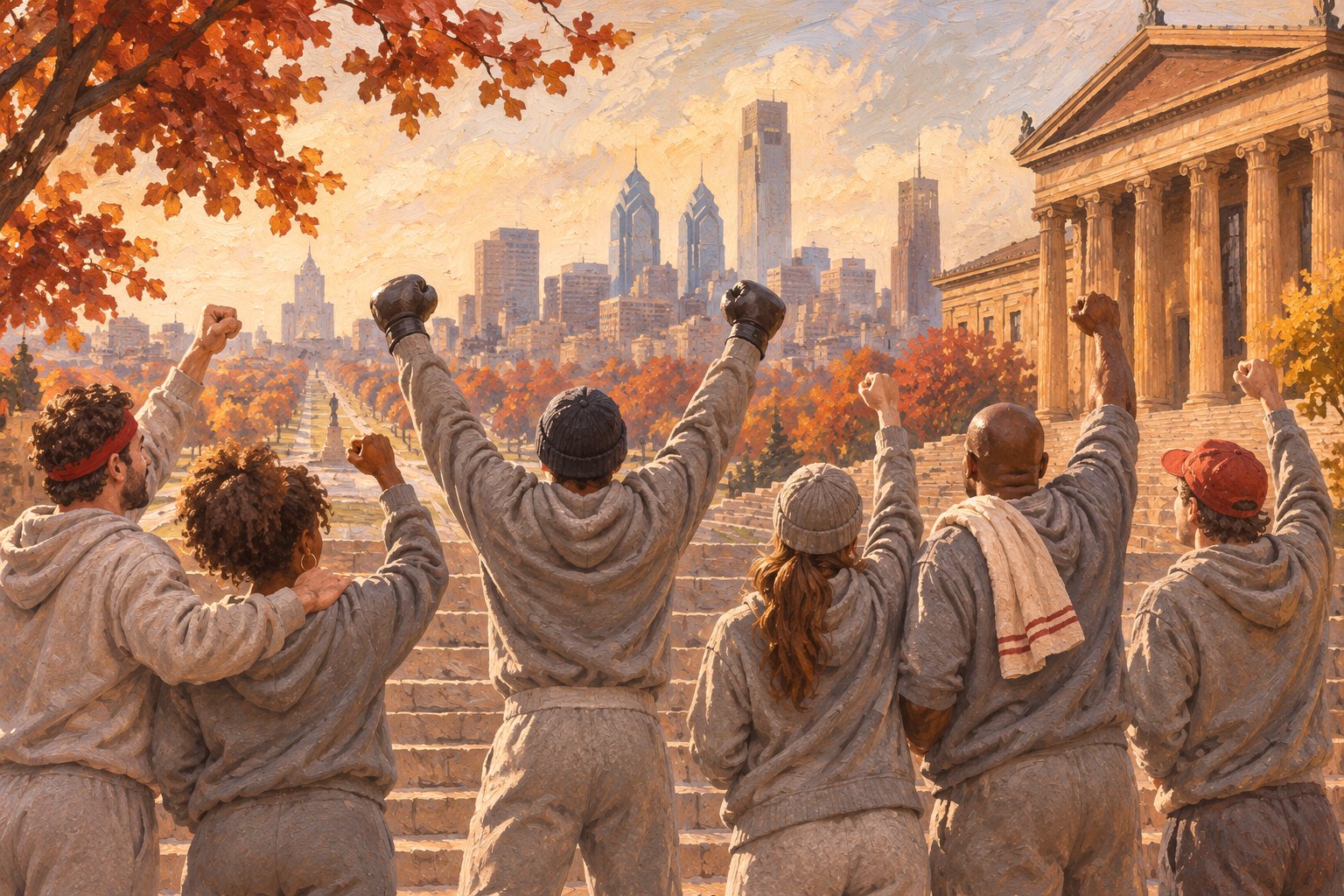
Rocky fans have broken a world record with a gathering in Philadelphia, according to ABC News, as the original film reaches its 50-year milestone. The occasion celebrates a character whose appeal extends well beyond people who follow boxing. Rocky Balboa gives audiences a recognizable expression for something harder to measure: the hope that their effort might finally matter to someone.
The record provides a timely reason to revisit Rocky, the 1976 film written by and starring Sylvester Stallone and directed by John G. Avildsen. Its enduring strength, in my view, lies in how patiently it establishes the person beneath the familiar pose. Before the raised arms comes a man who talks too much because silence might confirm that nobody wants him around.
Spoiler warning: This review discusses the original film’s relationships, championship fight, and ending. The discussion of the gathering is limited to the reported world-record achievement; the interpretation that follows concerns the movie.
Rocky’s first opponent is the feeling that he does not count
Rocky begins as a marginal Philadelphia fighter who also collects debts for a loan shark. His circumstances are unglamorous, and his behavior is contradictory. He earns money through intimidation but resists the cruelty his employer expects. He wants to seem tough while constantly seeking a little conversation.
Stallone makes those contradictions the performance’s center. Rocky’s rambling speech can sound comic, but the jokes also work as small requests for permission to stay. The character’s vulnerability emerges through his attempts to conceal it. His physical size cannot protect him from embarrassment.
That is why losing his gym locker matters. It is a practical inconvenience with an emotional verdict attached: someone else has a future, so someone else deserves the space. Rocky lives among people who have already decided what he is worth.
The film’s patient opening remains one of its best choices. Viewers expecting uninterrupted training and fighting may find its neighborhood encounters surprisingly leisurely. For me, that time is essential. We need to understand the ordinary humiliations before a championship opportunity can mean anything beyond a larger paycheck.
Adrian gives the story a second kind of courage
Adrian, played by Talia Shire, experiences a different version of being dismissed. Her brother Paulie treats her shyness as evidence of inadequacy. Rocky notices her, although his eagerness does not automatically make him sensitive to everything she needs.
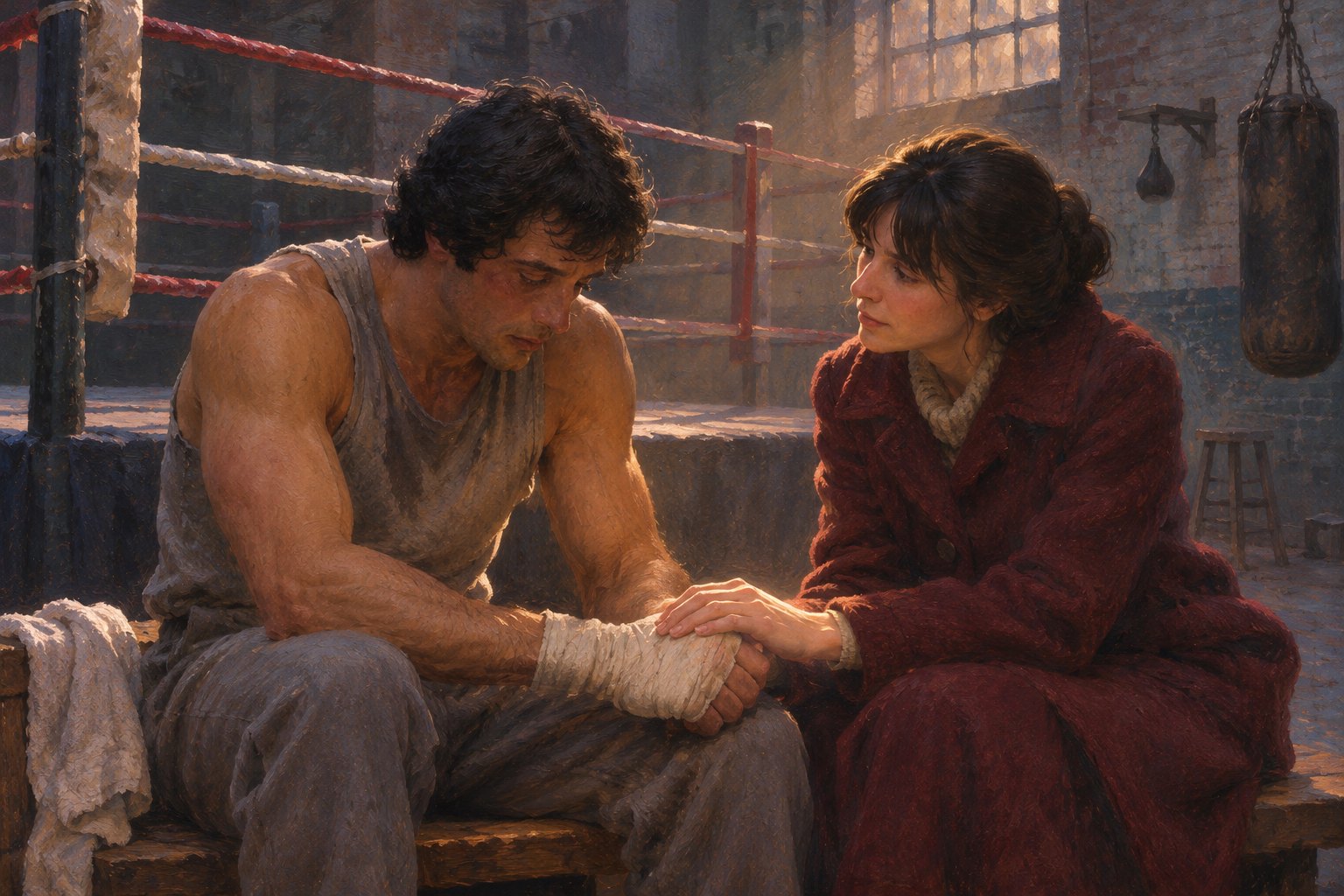
Their relationship is most persuasive when both seem uncertain about how to occupy another person’s attention. Rocky fills the air; Adrian measures her responses. Shire gives her pauses weight, making quietness feel like an active negotiation with an intimidating world.
“Together, we fill gaps,” Rocky explains. The line is moving because its language is so modest. He has no polished account of compatibility. He recognizes that being with Adrian changes how loneliness feels.
Some of the courtship deserves scrutiny. In his apartment, Rocky presses forward while Adrian is visibly uncomfortable and expresses a wish to leave. The scene’s romantic intention does not erase its troubling pressure. A retrospective can value the relationship while acknowledging that the film sometimes asks viewers to accept persistence too readily.
Adrian becomes more compelling as she asserts herself, especially against Paulie. Her growth gives the romance its necessary balance: she needs room to speak, and Rocky needs to learn that affection involves listening. Questions about devotion and another person’s independence also shape our analysis of the complicated romance in Mad Love.
Mickey needs a second chance, too
Mickey, played by Burgess Meredith, initially regards Rocky as squandered potential. When the title opportunity arrives, his offer to manage him carries an uncomfortable question: why does the help become available only after someone important has noticed?
Rocky’s anger makes sense. Advice offered after years of dismissal can feel like another person claiming ownership of your sudden good fortune. Yet Meredith also lets Mickey’s desperation show through his aggression. This older man wants his accumulated knowledge to retain some use.
Their reconciliation gives the training an emotional foundation. Rocky needs expertise, and Mickey needs someone willing to receive it. Neither can recover the years already lost, but they can choose what to do with the remaining opportunity.
That dependence complicates the movie’s reputation as a celebration of individual willpower. Rocky performs the labor, but his preparation requires other people. The same distinction between personal bravery and shared ability informs our character analysis of cooperation in Jaws.
Apollo Creed understands the spectacle before he understands Rocky
Apollo Creed, played by Carl Weathers, selects an unknown challenger after his scheduled opponent becomes unavailable. Rocky’s nickname and local identity offer a marketable story. From Apollo’s perspective, the event needs an appealing narrative as well as a fight.
Weathers makes Apollo’s confidence magnetic. He understands publicity, enjoys performance, and assumes he can control the competitive outcome. His mistake is treating Rocky’s role in the promotion as a reliable measure of Rocky’s capacity in the ring.
This makes Apollo a more interesting opponent than a simple bully. He offers Rocky a real opportunity while misunderstanding what Rocky intends to do with it. One man sees a successful show; the other sees a chance to revise his own sense of himself.
The Philadelphia gathering adds an intriguing echo to that distinction. A public celebration can be counted and recognized. The private reasons people feel attached to a fictional fighter remain individual. The record documents participation without explaining every participant’s emotional investment.
The ending makes endurance more important than the decision
Before the fight, Rocky admits that he does not expect to beat Apollo. His ambition becomes “go the distance.” It is a remarkably vulnerable declaration for a sports movie: he acknowledges the gap in ability and chooses a goal that still demands everything he has.
The training sequences build exhilaration through repeated effort, culminating in the famous ascent of the museum steps. Their appeal comes from making improvement visible. A body that struggled can now complete the movement with confidence.
The fight then restores the cost that an uplifting montage can briefly obscure. Rocky absorbs punishing damage. The spectacle is exciting, but endurance looks exhausting and frightening. Determination does not make him invulnerable.
Apollo wins by split decision after fifteen rounds. Rocky’s attention turns toward Adrian, and his cry of “Adrian!” pulls the emotional center away from the official result. The ending works because the film has prepared two outcomes: the judges decide the contest, while Rocky discovers whether he can face himself differently afterward.
A small visual detail reveals the larger meaning
On a rewatch, pay attention to Rocky’s visit to the empty arena before the bout. He notices that the promotional image has his trunks wrong. The response dismisses the discrepancy as unimportant. This is an explicit story detail rather than a hidden Easter egg, but it quietly captures his position: the machinery selling his image has little interest in getting him right.
Adrian’s importance becomes clearer beside that moment. Public recognition can turn Rocky into a useful symbol. Intimacy allows him to remain a particular, imperfect person.
That tension is what makes the Philadelphia celebration such a fitting invitation to return to the original. Fifty years later, Rocky can unite a crowd because his story leaves room for victories smaller than a championship. My reading of the ending is that self-respect becomes sustainable when someone else can recognize the person doing the struggling. The raised arms supply the unforgettable image; the embrace supplies its meaning.
Original content by this site's editorial team. Published: November 14, 2026 at 03:10:55 PST (Los Angeles time)