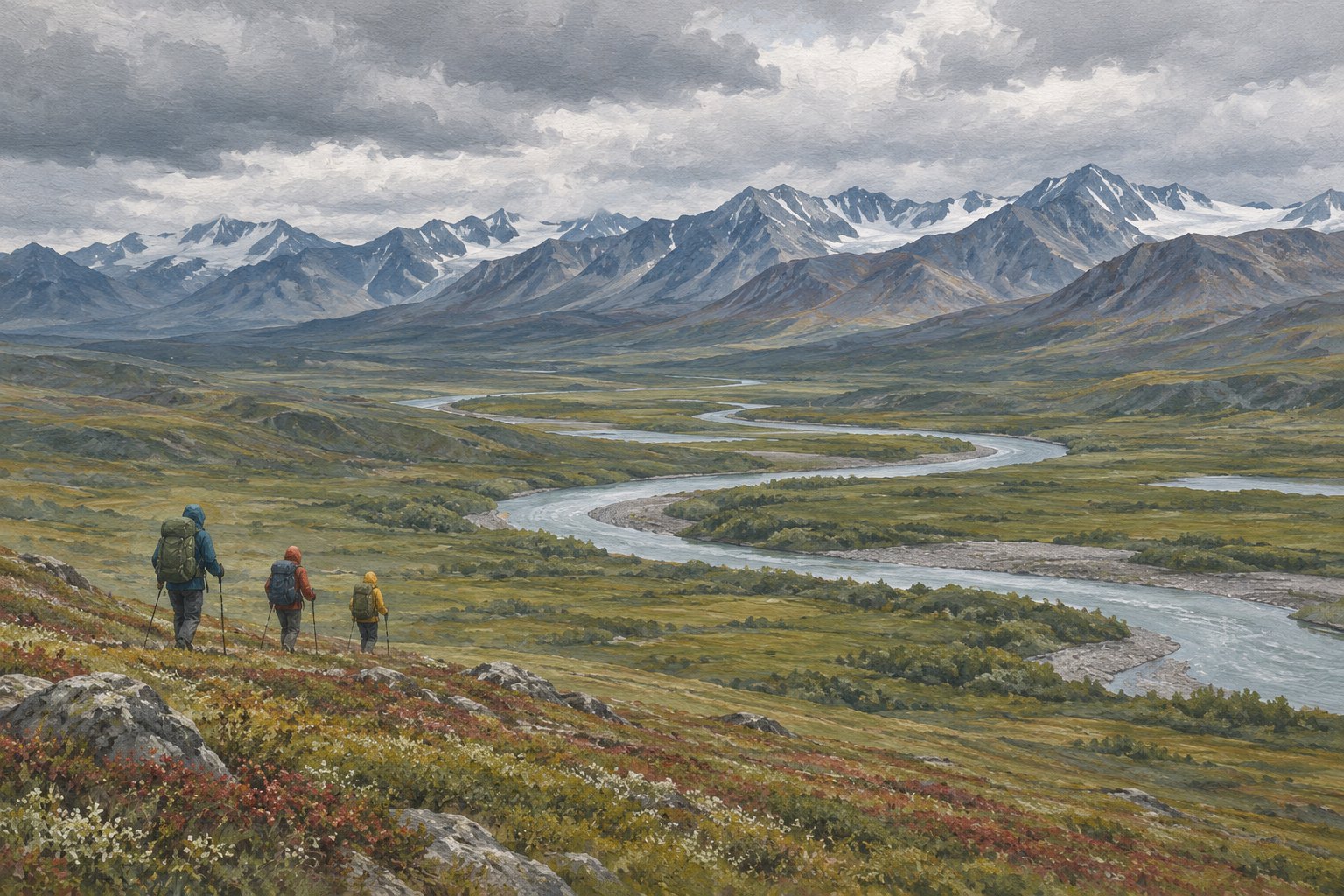
Roadless begins with a goal that audiences can immediately understand: travel on foot along the proposed Ambler Mining Road corridor in Alaska and show people the landscape that development could change. Director and expedition leader Robert Lester makes physical effort the entry point into an environmental argument. The intriguing complication is what happens when completing the journey stops being a realistic measure of success.
Spoiler notice: This article discusses expedition developments described in published coverage. It offers an interpretation of those reported events and verified film descriptions, rather than a firsthand assessment of the complete documentary. The accompanying images are conceptual illustrations.
The journey gives an abstract proposal human scale
Screening descriptions from the Oregon Museum of Science and Industry and participating theaters identify the expedition’s intended route as 211 miles. Three adventurers enter a landscape of tundra, rivers, and forests, facing hunger, exhaustion, mosquitoes, and difficult footing. Those details establish the documentary’s central storytelling device: a distance that can look simple on a map becomes a succession of demanding bodily experiences.
That approach has an obvious strength. Viewers do not need specialist knowledge to understand tired legs or the difficulty of carrying equipment across uneven ground. The travelers provide a recognizable point of contact with an unfamiliar place. Their vulnerability makes the terrain legible in ways that a diagram alone cannot.
There is also a limitation. An exhausting expedition cannot, by itself, establish the full consequences of an industrial project. Physical experience and environmental evidence answer different questions. The most productive way to approach Roadless is to consider how those forms of understanding might complement each other, while keeping their differences in view.
Robert Lester’s stake is personal
In an interview with Montana broadcaster KTVQ, Lester connects his filmmaking to the value of places that many viewers will never visit. That gives his role a useful tension: he is both someone undertaking an adventure and someone responsible for translating it into a public argument.
Those responsibilities do not always pull in the same direction. The adventurer has a destination, a schedule, and a test of endurance. The filmmaker needs revealing material. The conservation advocate needs the audience to care about something that exists beyond his own experience. A successful day for one role might be a frustrating day for another.
My reading of that setup is that Lester becomes most interesting when personal accomplishment and public purpose cease to be interchangeable. Reaching a finish line would provide a clear ending. Helping viewers understand a place requires a less tidy kind of attention.
That distinction also connects with the question of artistic identity explored in our character analysis of Wonder Boys: what remains of a worthwhile project when its creator has to relinquish the version that originally defined it?
A changed plan complicates the adventure narrative
Max Bennion’s review in SLUG Magazine reports that Bill Craig leaves the expedition after six days. Lester and Ben Kaden subsequently abandon the intention to walk the entire corridor and redirect their effort toward documenting the Brooks Range.
That reported development changes the terms of the story. An expedition organized around completing a route promises a measurable outcome. Once that objective falls away, the film must give viewers another reason to follow its progression. Continuing to gather footage may be practical and valuable, but the new purpose still needs dramatic clarity.
It would be unfair to treat Craig’s departure as evidence of a moral failing or to invent a conflict between the travelers. Leaving a demanding journey is an action; the private motives behind it require evidence. What can be discussed is its structural effect: the original group and original plan no longer provide a stable framework.
Endurance is not the same as understanding
One brief line from the film, quoted in Bennion’s review, captures the travelers’ depletion: “Yeah, we’re…kinda at the end here.” Its ordinary phrasing resists the polished confidence associated with expedition storytelling.
As a reported moment, it invites a distinction between recognizing a limit and resolving a story. Exhaustion explains why someone needs to stop. It does not necessarily explain what the experience means. A documentary has to build that second understanding through context, relationships, and the arrangement of its material.
I find the underlying possibility compelling: accepting a limit could become a form of honesty. But the emotional value of that admission should not exempt the film from questions about its construction. Sincerity gives viewers a reason to listen; it does not guarantee that every transition or conclusion will persuade them.
The landscape needs perspectives beyond its visitors
Bennion also describes interviews with experts and Indigenous participants. Their inclusion raises an essential question for evaluating the documentary: how much room does it make for people whose relationship with the region extends beyond the expedition?
A visitor can experience a place intensely while knowing it briefly. Longstanding relationships with land involve different forms of knowledge, responsibility, and dependence. A film gains depth when those perspectives shape its meaning, rather than merely confirm the visitors’ emotional response.
This is also why beautiful landscape imagery needs careful interpretation. An expansive view can communicate scale and invite attention. It cannot independently explain who uses the land, what changes would matter most, or how competing claims should be assessed. The human context determines whether scenery becomes understanding.
The same distinction between an inviting premise and an earned perspective informs our discussion of the expectations surrounding The Brighter Side. A film’s subject may attract us; its point of view determines what we take away.
What the unfinished journey can mean
The deeper interpretive possibility in Roadless is that the land’s significance survives the travelers’ changing plans. An expedition can fall short of its intended destination without making its surroundings less worthy of attention. That separates the value of the place from the achievement of the people documenting it.
For viewers drawn to environmental documentaries, this makes the project worth considering with two questions in mind: does the changed objective produce a clearer understanding of the region, and do the people connected to that region receive meaningful space within the story?
My provisional judgment is that this tension offers more substance than a straightforward endurance premise. Whether the finished film fully realizes it requires direct viewing. The idea itself is strong: learning when to revise an ambition can be revealing, especially when the responsibility to look carefully continues after the original goal has become unreachable.
Original content by this site's editorial team. Published: November 18, 2026 at 22:34:20 PST (Los Angeles time)