Zach Cregger’s Resident Evil finds a compelling horror problem inside an ordinary virtue: the impulse to help. The enthusiastic assessment from The Hollywood Reporter presents the reboot as a welcome renewal for the franchise. Beyond that verdict, the reported story suggests a sharper reason to pay attention. Its protagonist keeps encountering situations in which a humane response exposes him to danger.
That makes this more than a question of whether the monsters are frightening. Through Bryan, the medical courier played by Austin Abrams, the film offers a disturbing possibility: surviving a catastrophe might require distrusting the very instincts that make someone worth saving.
Spoilers: The following analysis discusses encounters described in published reviews, along with dialogue quoted by critic Frank Scheck. It offers an interpretation of those reported scenes, rather than a firsthand screening verdict, and leaves the ending undisclosed.
A delivery job with an ethical trap inside it
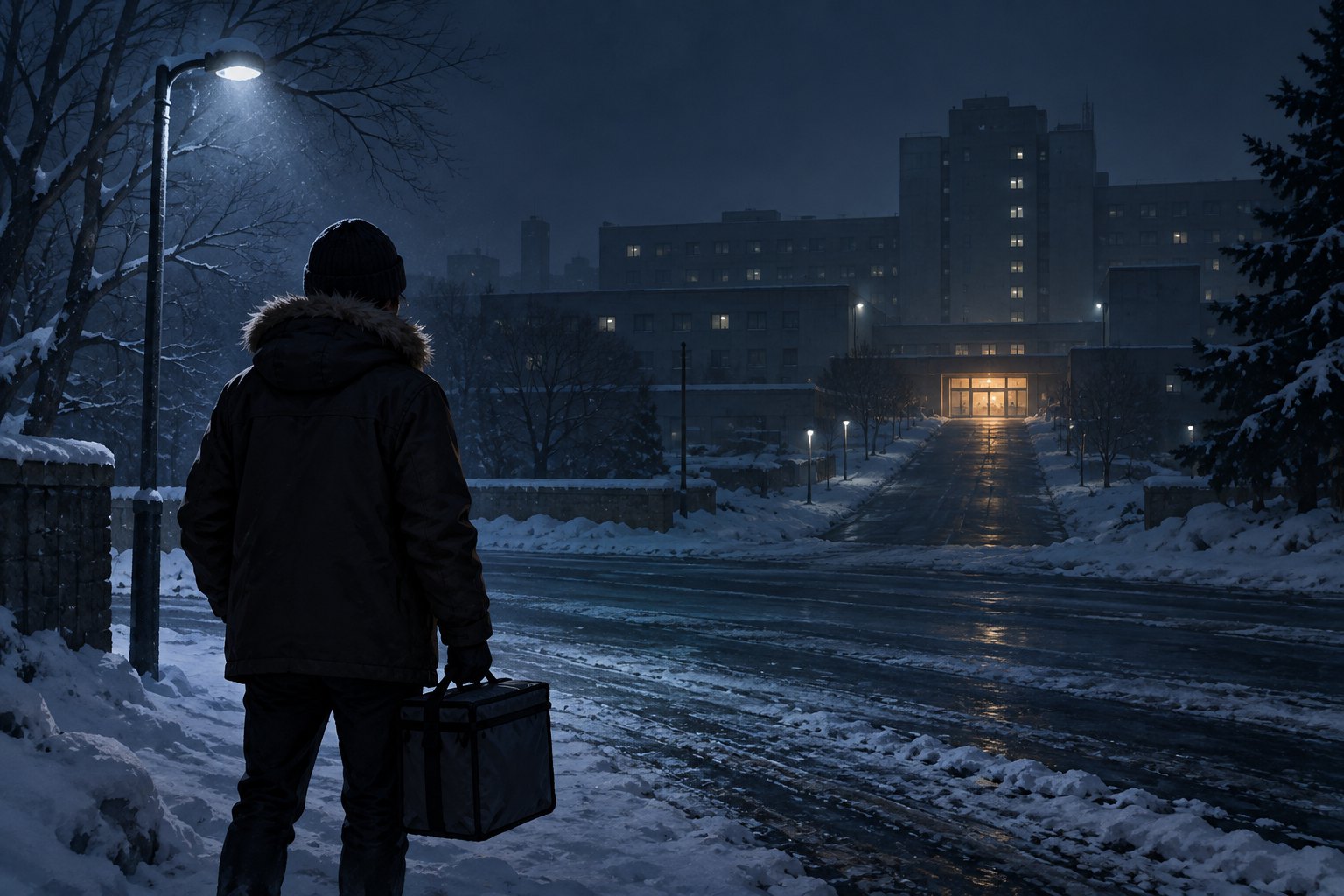
Scheck’s account establishes Bryan as a courier who accepts an urgent nighttime delivery to a hospital in Raccoon City. On the road, his car strikes a woman. He puts the injured stranger inside his vehicle, attempting to help despite the unsettling condition of her body.
Consider that decision from Bryan’s position. He has been involved in an accident, and someone needs assistance. Leaving her behind would demand an explanation. Helping her requires none. The audience may recognize the warning signs of a horror movie, but he is responding to an emergency without that protective distance.
This is where the premise becomes morally interesting. Viewers can mistake their knowledge of the genre for superior judgment. We know that an apparently helpless person might become a threat. Bryan cannot reasonably begin every encounter by assuming the worst. His vulnerability arises partly from behaving according to rules that make everyday life possible.
Our earlier examination of Bryan’s ordinary responsibilities and escalating panic considers why a working courier makes an accessible protagonist. The deeper question here concerns what happens when responsibility itself becomes dangerous.
When distress stops being a reliable signal
Scheck also describes Bryan approaching a crying girl in a motor home and getting bitten. Taken together, these encounters establish a cruel pattern: another person’s apparent suffering invites an intervention that can injure the helper.
The important element is the invitation. A creature charging down a hallway creates a relatively straightforward problem. Someone who appears to need assistance creates uncertainty before the physical threat even begins. Bryan must decide what kind of situation he is in, and a mistaken answer has consequences.
My reading is that this structure makes compassion a source of suspense. The viewer wants him to remain responsive to other people while also wanting him to keep his distance. Those desires cannot always be reconciled. The tension belongs to our expectations of heroism as much as to his chances of escape.
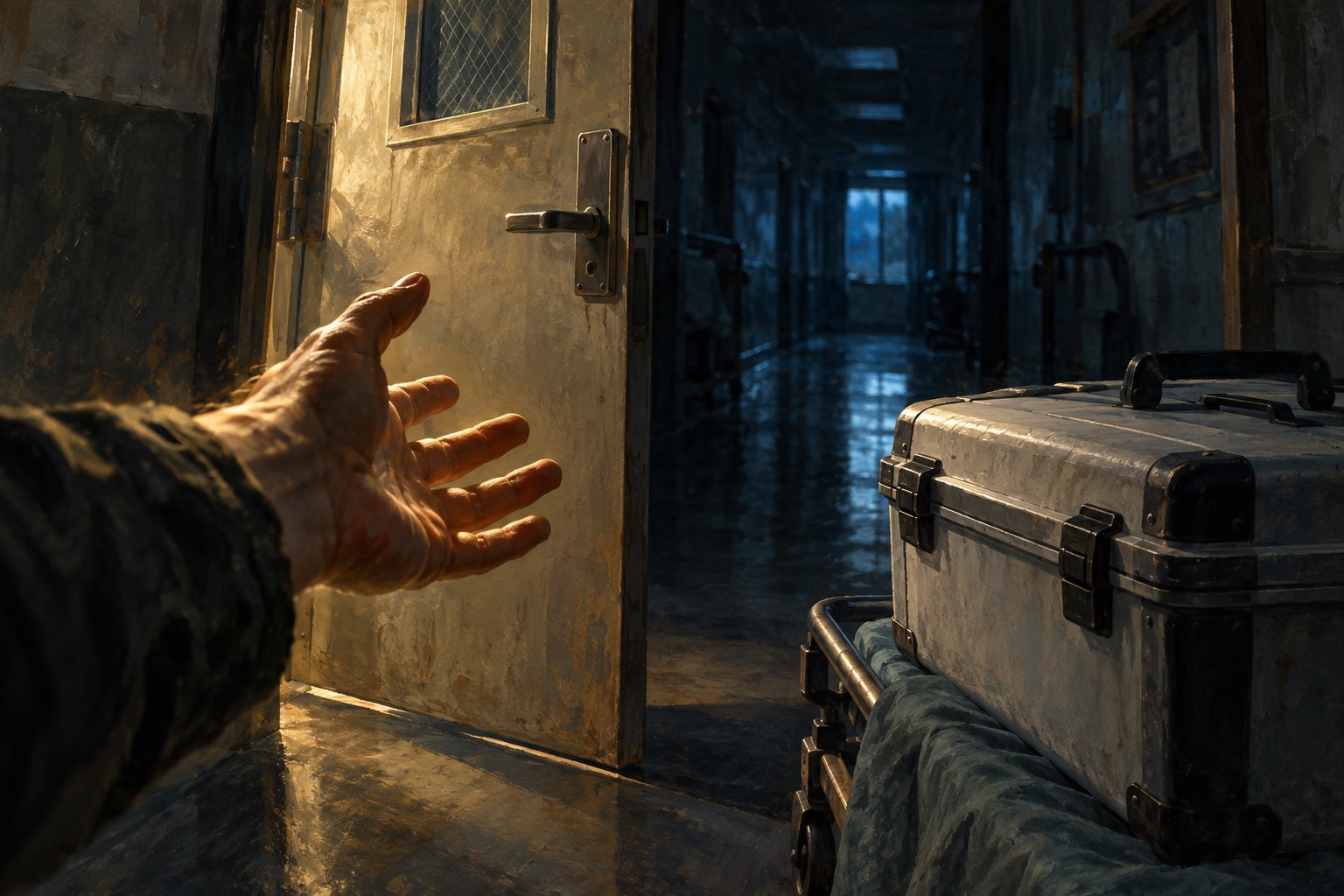
There is a risk in repeatedly using this device. If every vulnerable figure becomes a trap, the pattern can flatten into a predictable instruction to trust nobody. The richer interpretation preserves the discomfort: a bad outcome does not automatically prove that offering help was foolish. Horror becomes more troubling when there is no clean lesson to carry into the next encounter.
Why Bryan’s complaints matter
Two lines quoted in Scheck’s review capture Bryan’s exasperation: “What is this shit now?” and “What the fuck was that about?” Their appeal lies in how little authority they claim. He is trying to make sense of events that refuse to become manageable.
The first question anticipates yet another problem. The second attempts to process something already endured. Together, they suggest a man caught between dread and disbelief, with almost no room for reflection. Neither resembles the polished declaration of a hero who has mastered his surroundings.
That distinction matters to the comedy. An invulnerable protagonist can make a joke because danger has become easy. A frightened protagonist can complain because danger has become intolerable. The latter response allows humor to coexist with vulnerability, provided the consequences retain their force.
There is also something recognizable about having language fall short. We often imagine courage as eloquence under pressure. A muttered complaint can express a smaller, more credible form of endurance: the person is overwhelmed, annoyed, and still present. Bryan’s speech gives the audience a way to understand that state without requiring a confession or explanatory monologue.
Learning to survive without becoming a different person
In an interview with ABC, Abrams described Bryan as resembling someone encountering the games for the first time and figuring out their mechanics. That characterization offers a useful distinction between acquiring skills and acquiring certainty.
A person can improve at handling an immediate problem without understanding the larger crisis. For a survival story, that gap is productive. Practical competence supplies movement, while incomplete knowledge preserves fear. The protagonist may become more capable without becoming comfortable.
For Bryan, the ethical version of that learning curve is especially intriguing. Better judgment would involve recognizing danger without automatically treating every stranger as disposable. Total suspicion offers a simpler rule, but it would also narrow his character. The challenge is to become harder to exploit while remaining capable of concern.
This is an interpretive standard, not a claim about an unseen final transformation. It is also a more revealing way to evaluate the film than merely asking how dramatically it improves on its predecessors. As our discussion of the expectations surrounding a Resident Evil revival argues, lowered expectations cannot do the work of criticism.
The deeper horror is losing the reason to help
The most substantial reading of Bryan’s predicament concerns the difference between protecting a body and preserving a person. Staying alive is an urgent objective. Remaining someone who can recognize another human being’s distress is a less measurable achievement.
For me, that is where this particular story earns attention. The courier’s helpfulness gives danger an emotional cost beyond injury. Each disastrous encounter raises the possibility that he will stop seeing strangers as people with needs and begin seeing them exclusively as potential threats.
That possibility does not turn the film into a moral lecture. It gives its physical ordeal a question worth carrying past the immediate shock: how much of yourself can survival demand before escape starts to resemble another kind of loss?
A game reference with an emotional function
ABC’s reporting confirms that Cregger included a typewriter reference and reshot its scene to get the prop right. The interview also identifies over-the-shoulder framing and resource collection as connections to the games.
The typewriter is particularly suggestive because of its association with saving progress. For a player, that means the effort already spent can be preserved. In an adaptation centered on someone struggling to get through the next encounter, the reference can evoke a longing for a pause, security, and a chance to recover.
That is an interpretation of the reference’s resonance, not a claim that Bryan literally gains a game mechanic. Its value lies in the emotional association: after sustained uncertainty, even the idea of a safe stopping point becomes powerful. Recognition serves the story best when it helps us understand what the person inside it desperately needs.
Original content by this site's editorial team. Published: September 16, 2026 at 13:09:30 PDT (Los Angeles time)