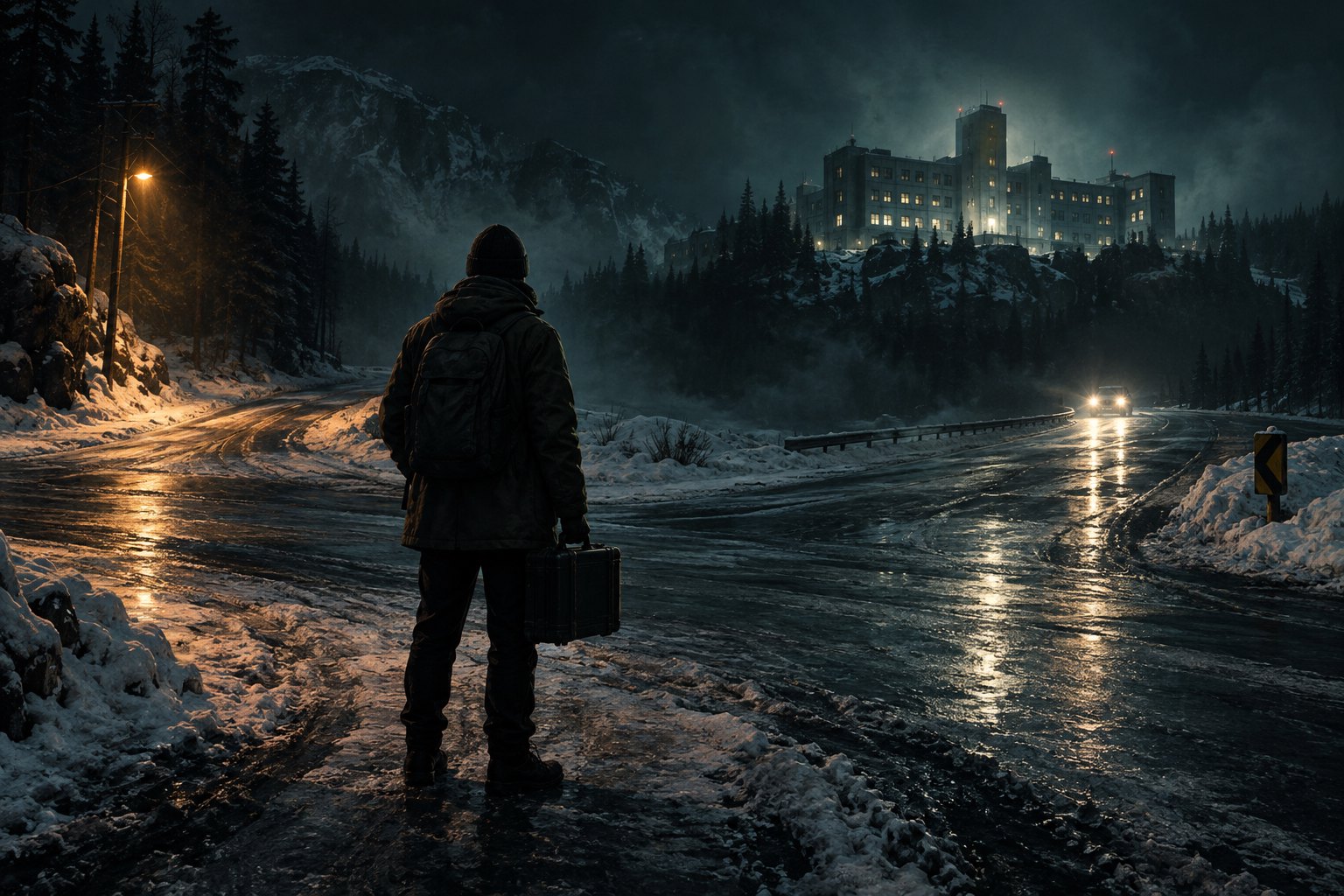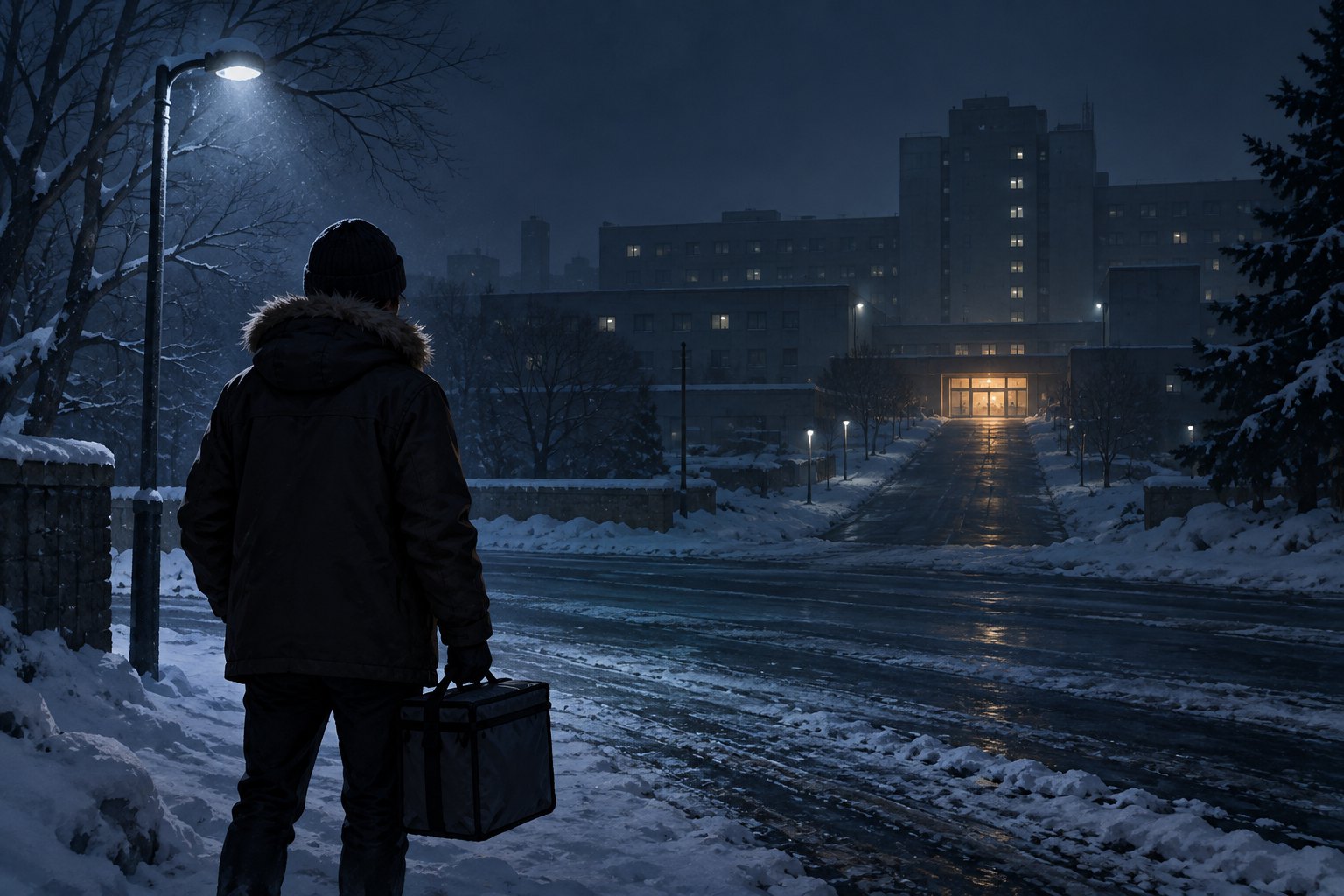
Resident Evil has an appealing proposition for anyone who enjoys the atmosphere of horror games but struggles to stay alive in them: understanding fear should not require mastering a controller. Zach Cregger’s film centers on Bryan, a medical courier played by Austin Abrams, whose lack of preparation offers an immediate point of entry. The interesting question is how his mistakes can make watching feel participatory, even when the audience cannot choose his next move.
Matt Goldberg’s enthusiastic review for Decoding Everything identifies that accessibility as a major strength. His verdict belongs to him; the analysis here examines the film’s officially described premise and scenes documented in published reviews. It is a character-focused reading of that material, rather than a claim to an independent screening.
Spoiler notice: The following discusses the opening setup, weapon-related difficulties, and reported visual references. It does not disclose the ending.
Bryan enters with a job, not a strategy
Sony’s synopsis establishes a deliberately straightforward situation: Bryan is a medical courier caught in a night of escalating danger. Cregger directs, with screenplay credit shared by Cregger and Shay Hatten. That occupational detail gives the story a useful starting point. A courier normally works toward a specific destination; survival horror makes reaching any destination uncertain.
William Bibbiani’s review for TheWrap describes Bryan accepting another delivery at the end of his shift and driving toward Raccoon City without snow chains. The setup gives him a practical disadvantage before the extraordinary threats arrive. His initial problem is recognizable: he has agreed to a task for which he is insufficiently equipped.
Read through Bryan’s perspective, this is a story about a plan losing its usefulness. A delivery assignment promises a sequence: collect, travel, hand over, leave. Once that sequence breaks down, the skills that made the task manageable stop providing reassurance. The route may still have an endpoint, but Bryan no longer knows what reaching it will require.
That distinction matters for an inexperienced viewer. You can understand the loss of a workable plan without knowing the franchise’s history. The character supplies the immediate objective, and the obstacles supply the questions. Who created this disaster can become interesting later; getting through the next few minutes already matters.
A weapon does not automatically create an action hero
The Associated Press reports a particularly revealing exchange as Bryan struggles with a gun: “I only use guns in video games.” His explanation continues: “It’s confusing in real life!” The joke exposes the gap between recognizing a tool and knowing how to operate it. An object associated with control becomes another demand on his attention.
That gap is a useful way to understand the movie’s appeal to people who struggle with games. Recognizing what a situation requires is different from executing the response. You might see the exit, understand the threat, and still fail to make your hands cooperate quickly enough.
Onscreen, the equivalent tension depends on giving a character room to struggle. If a solution arrives with no effort, spectators can admire it but have little to work through. A visible difficulty invites mental participation: assess the obstacle, anticipate an error, revise the likely outcome.
My reading is that Bryan’s unfamiliarity provides a bridge between observation and involvement. Viewers do not need his exact experience to recognize the sensation of being hurried through something they barely understand. The uncomfortable pause before competence arrives can carry more suspense than competence itself.
Watching can preserve the puzzle without the penalty
Games can make failure costly in a very practical sense: a mistake may require repeating something already attempted. Film removes that particular burden. The viewer cannot lose progress through a missed input, even while identifying with a character who is losing ground.
This changes the pleasure of survival horror. Someone who abandons a game because repetition becomes frustrating may still enjoy its underlying questions. Where would you go? What deserves your attention? Which apparent advantage is actually useful? A movie can keep those questions active while carrying everyone through the same unfolding experience.
The challenge is to make obstacles understandable without making their solutions obvious. Confusion about a character’s next move can be exciting. Confusion about what is happening at all usually creates distance. Clear objectives give uncertainty somewhere to gather.
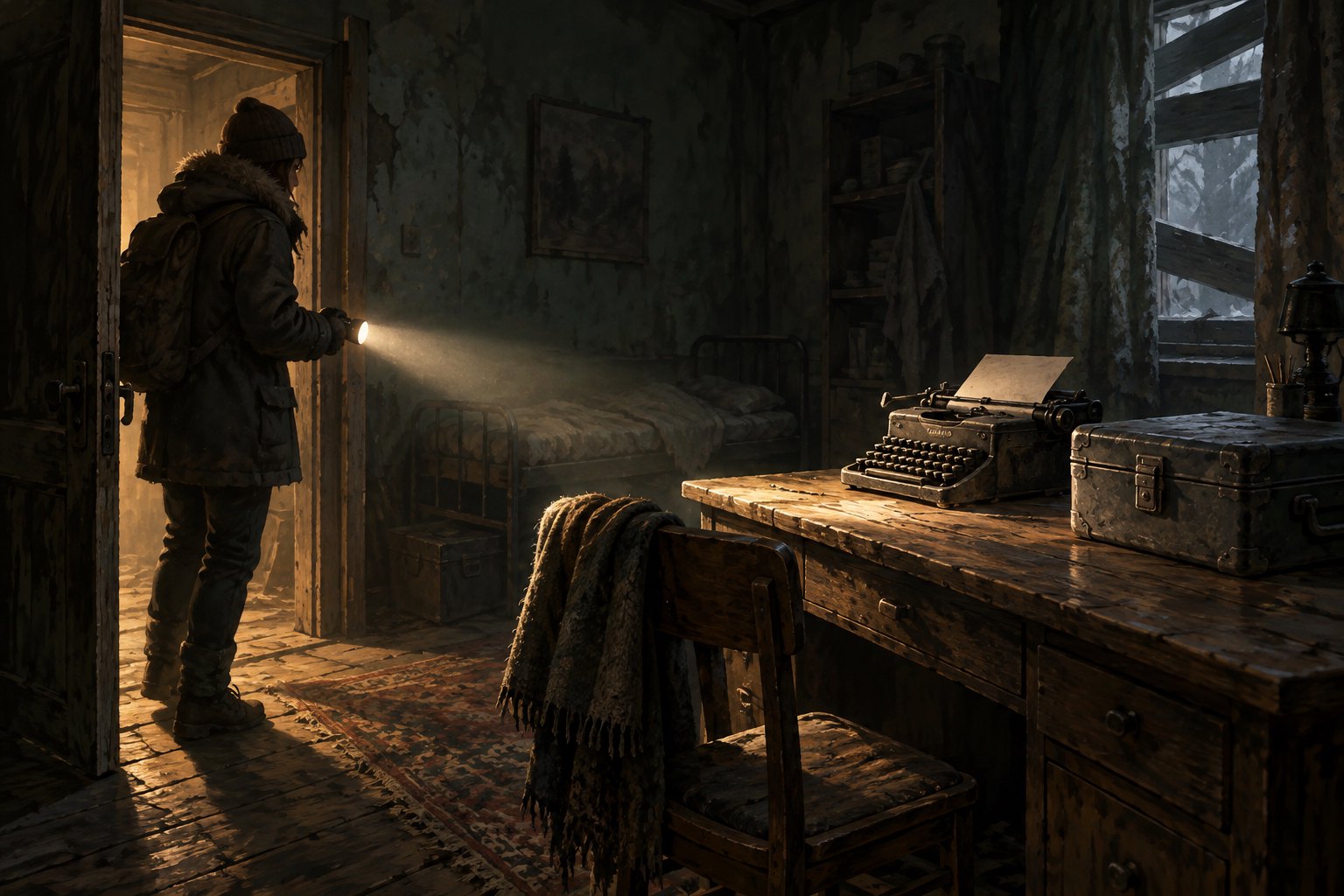
That is also why a confined viewpoint can be valuable. The audience has a reason to inspect whatever the protagonist notices. A doorway becomes a decision; an unfamiliar object becomes a possibility. These are principles of visual suspense, and they explain how a game adaptation can welcome viewers who have never played its source material.
Inexperience needs variation to remain interesting
There is a limit to the appeal of watching someone get things wrong. If every mistake produces the same response, vulnerability can become a routine. A character must register changing circumstances, even if those changes never turn him into an expert.
Joey Magidson’s review for Awards Radar describes Bryan talking to himself, mishandling weapons, and celebrating a partial victory before considering what follows. Those reported behaviors suggest several distinct relationships to danger: uncertainty, momentary confidence, and incomplete foresight. They give the character more expressive possibilities than a continuous state of panic.
For a viewer, premature relief can be particularly involving. It briefly aligns our desire with the character’s: let this be enough. When that confidence proves fragile, suspense grows from an emotional investment already made. The reaction matters because we participated in the hope.
Our discussion of Bryan’s ordinary panic amid the monster mayhem explores the emotional foundation of that connection. Here, the additional issue is competence: whether his experience changes how he understands the next problem.
Finishing the ordeal is only one kind of ending
Goldberg’s review pairs its strong recommendation with a reservation about the conclusion, arguing that Bryan’s journey does not receive a satisfying resolution. That criticism should be kept separate from any unverified description of what happens. Still, it raises a worthwhile distinction between exhausting a series of obstacles and completing a dramatic movement.
A survival story can resolve its immediate danger while leaving its central relationship unfinished: the relationship between the protagonist and his own limitations. Has he learned to judge risk? Has he become more resourceful? Has surviving changed what he wants? These questions do not demand a speech or an elaborate epilogue. Sometimes a small decision can answer them.
The distinction also sharpens the broader debate addressed in our examination of how to judge a successful Resident Evil movie. An adaptation can capture an enjoyable experience and still invite criticism of its dramatic payoff. Those judgments are compatible.
The deeper appeal: uncertainty without exclusion
The strongest interpretation of this approach is that imperfect understanding becomes an invitation. Bryan offers viewers a way into a frightening world through the effort of navigating it. Expertise is no longer the entrance fee.
That does not mean knowledge has no value. An experienced player may recognize structures or objects that another viewer simply accepts as part of the setting. The best version of that relationship lets familiarity enrich a scene while leaving its immediate tension available to everyone.
Reported Easter eggs that leave room for newcomers
TheWrap identifies a typewriter in a lonely room and a silver case containing guns among the film’s references to the games. These are reported details, not evidence that every familiar object carries a hidden plot explanation.
The useful editorial test is simple: does the object have a readable presence before someone explains the reference? A newcomer should be able to remain inside Bryan’s predicament while a longtime fan enjoys an additional association. That balance preserves the central attraction of this Resident Evil: the possibility of sharing survival horror’s anxious curiosity without first proving you are good at surviving it.
Original content by this site's editorial team. Published: September 16, 2026 at 14:22:37 PDT (Los Angeles time)