Sebastián Lelio has died at 52, according to The New York Times. For viewers remembering his portraits of women, A Fantastic Woman offers a particularly revealing place to return. Its central concern is painfully straightforward: a woman loses the man she loves, then encounters people who believe they can decide whether her grief deserves recognition.
Lelio’s achievement lies in making that conflict personal. Marina has a job, an artistic ambition, a relationship, and a future she expects to share. When that future disappears, the film stays with the person left behind. Remembering its director means attending to the woman his film asks us to see.
Spoiler warning: This appreciation discusses the story, key confrontations, fantasy sequences, and closing performance in A Fantastic Woman.
Marina’s loss begins with an ordinary shared life
The 2017 film, directed by Lelio and written with Gonzalo Maza, stars Daniela Vega as Marina and Francisco Reyes as Orlando. Sony Pictures Classics’ synopsis establishes the essential situation: Marina works as a waitress and aspires to sing; she and Orlando are planning their future when he suddenly becomes ill and dies.
That opening relationship matters enormously. Without it, the later confrontations might turn Marina into an illustration of discrimination. Beginning with affection gives her something specific to lose. We understand that the person being questioned at the hospital has just experienced a catastrophe, even when the people questioning her seem unable to recognize it.
From Marina’s perspective, the story involves two different emergencies. One is irreversible: Orlando is gone. The other is imposed by the living: she must defend her place in a relationship that existed before anyone demanded an explanation. The second emergency keeps interrupting the first.
For me, that interruption is the film’s sharpest dramatic idea. Grief ordinarily requires time in which little appears to happen. Marina instead faces demands, suspicion, and decisions. Her emotional life is continually made to wait.
A name should not require an argument
“My name is Marina.” The line, documented in the BFI’s program notes, is among the film’s most forceful because it contains so little ornament. It states a fact. Its repetition exposes the effort other people expend refusing to accept that fact.
Vega gives the character a presence that resists the expectation of constant explanation. Marina’s reserve can be read as a practical response to hostile encounters: every additional disclosure might become another opportunity for someone to question her. The performance invites attention without promising unlimited access.
That distinction matters in a film about a transgender woman subjected to scrutiny. Sympathy can become intrusive when an audience expects a character to reveal everything before receiving compassion. Marina’s name does not need a supporting argument, and neither does her right to mourn.
Our discussion of Ian Charleson’s struggle to be seen as a whole person in Elsinore considers a related question about identity and performance. Here, the pressure comes from people who treat their assumptions about Marina as more authoritative than anything she says.
Who gets to decide what a relationship meant?
Orlando’s family turns bereavement into a contest over belonging. His former wife bars Marina from the funeral; his son threatens her place in the home she shared with Orlando. These are concrete restrictions with emotional consequences. A doorway, a room, or a ceremony becomes a boundary between those permitted to remember publicly and someone expected to disappear.
The family’s own grief does not make its conduct harmless. Yet acknowledging that grief helps clarify the conflict: several people can suffer the same death while possessing very different power over its aftermath. Marina’s vulnerability comes partly from that imbalance.
Lelio makes us consider how easily the language of family can become a claim of ownership. Who controls the farewell? Who decides which relationship belongs in the account of a person’s life? For Marina, these questions are immediate obstacles rather than philosophical exercises.
This is also where the film risks becoming schematic. A succession of hostile encounters can narrow the space available for other aspects of Marina’s personality. My reservation is that the surrounding cruelty sometimes tells us what to think before a scene has room to develop. Vega’s composure keeps those passages anchored in a person rather than an argument.
When the wind gives resistance a physical shape
The film’s departures from realism provide a different kind of access to Marina. In its striking wind sequence, moving forward becomes an extraordinary physical struggle. The image translates pressure into posture: a body must work simply to continue along a street.
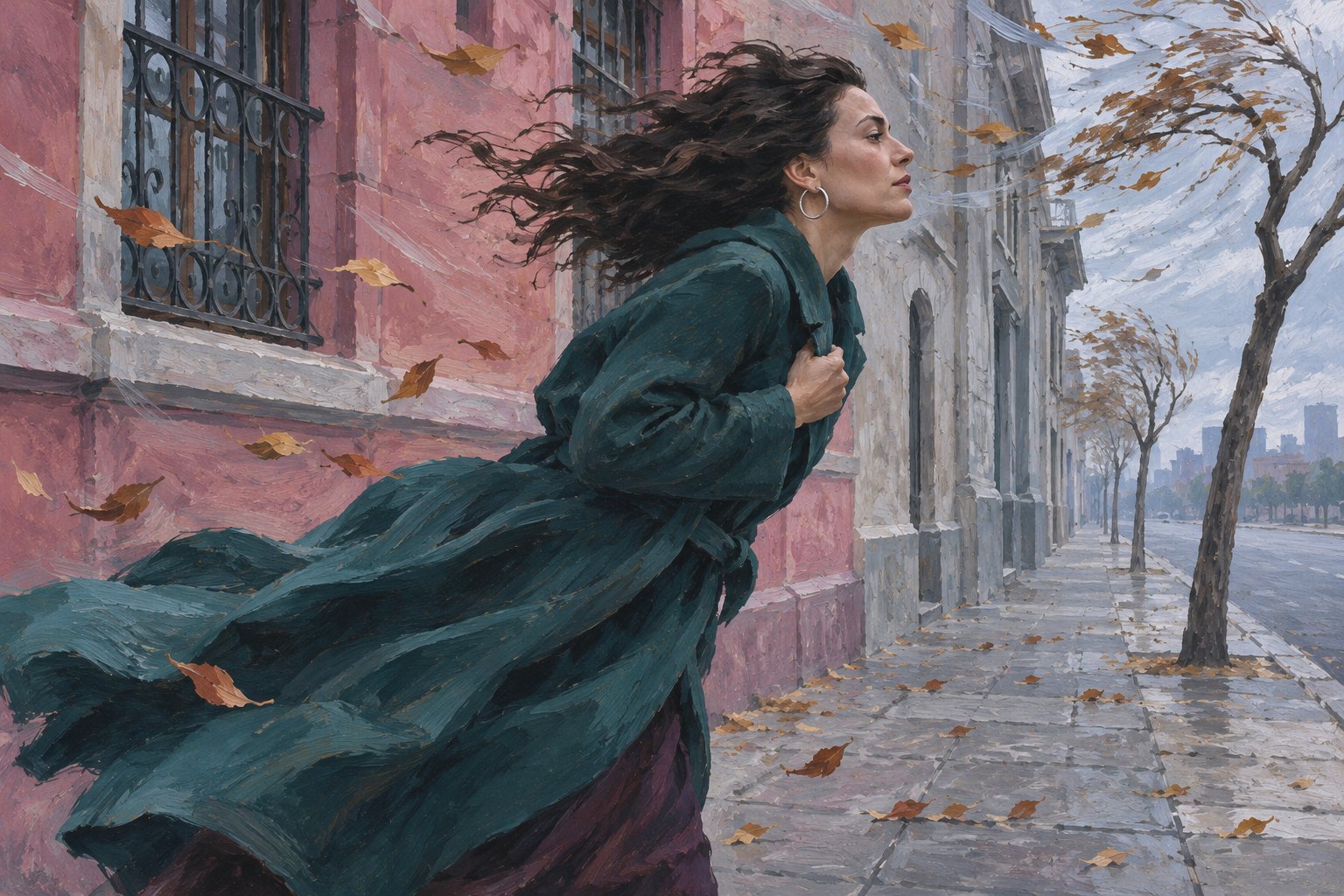
The metaphor is direct, but its directness has a purpose. After scenes structured by other people’s questions and judgments, an impossible gust lets Marina’s experience determine the terms of the image. The world briefly behaves according to what resistance feels like.
I find that shift more revealing than another explanatory conversation would have been. It gives emotional weight to an action as basic as walking. Continuing is labor; determination has a physical cost.
It also offers a useful way to think about visual storytelling more broadly. Our examination of what a performance film’s camera can reveal asks how images communicate what words cannot. Lelio’s sequence answers that question through movement and resistance.
“I’ll survive” leaves room for grief
“I’ll survive,” Marina tells her sister, another brief line recorded in the BFI’s notes. It sounds modest beside the demands made of her. Survival does not promise that the experience will become fair, that the family will change, or that loss will produce a reassuring lesson.
The closing singing performance gives that statement a fuller emotional register. Marina’s voice occupies space without being organized around an interrogation. She can express something without first answering an accusation.
My reading is that the ending protects her future from becoming merely a response to other people’s hostility. Singing connects her to an ambition that exceeds the immediate crisis. Orlando’s death remains part of her life, but it cannot be the only thing her life contains.
The deeper meaning—and a cinematic reference worth noticing
Lelio identified Buster Keaton as an inspiration for the wind sequence in an interview with IONCINEMA. That is a documented creative reference rather than a hidden plot clue. Recognizing it adds another dimension: physical cinema can make an internal struggle legible through the relationship between a performer and an unruly environment.
The deeper force of A Fantastic Woman, however, comes from its distinction between being visible and being recognized. Marina is repeatedly observed, examined, and discussed. None of that guarantees that anyone will listen to her.
As a way of remembering Lelio, the film remains valuable because it makes attention an ethical choice. Marina need not make her grief exemplary or her personality fully accessible. She needs room to say goodbye, to continue working, to sing, and to exist beyond the judgments directed at her. The film’s lasting achievement is to make that room feel necessary.
Original content by this site's editorial team. Published: November 24, 2026 at 04:43:45 PST (Los Angeles time)