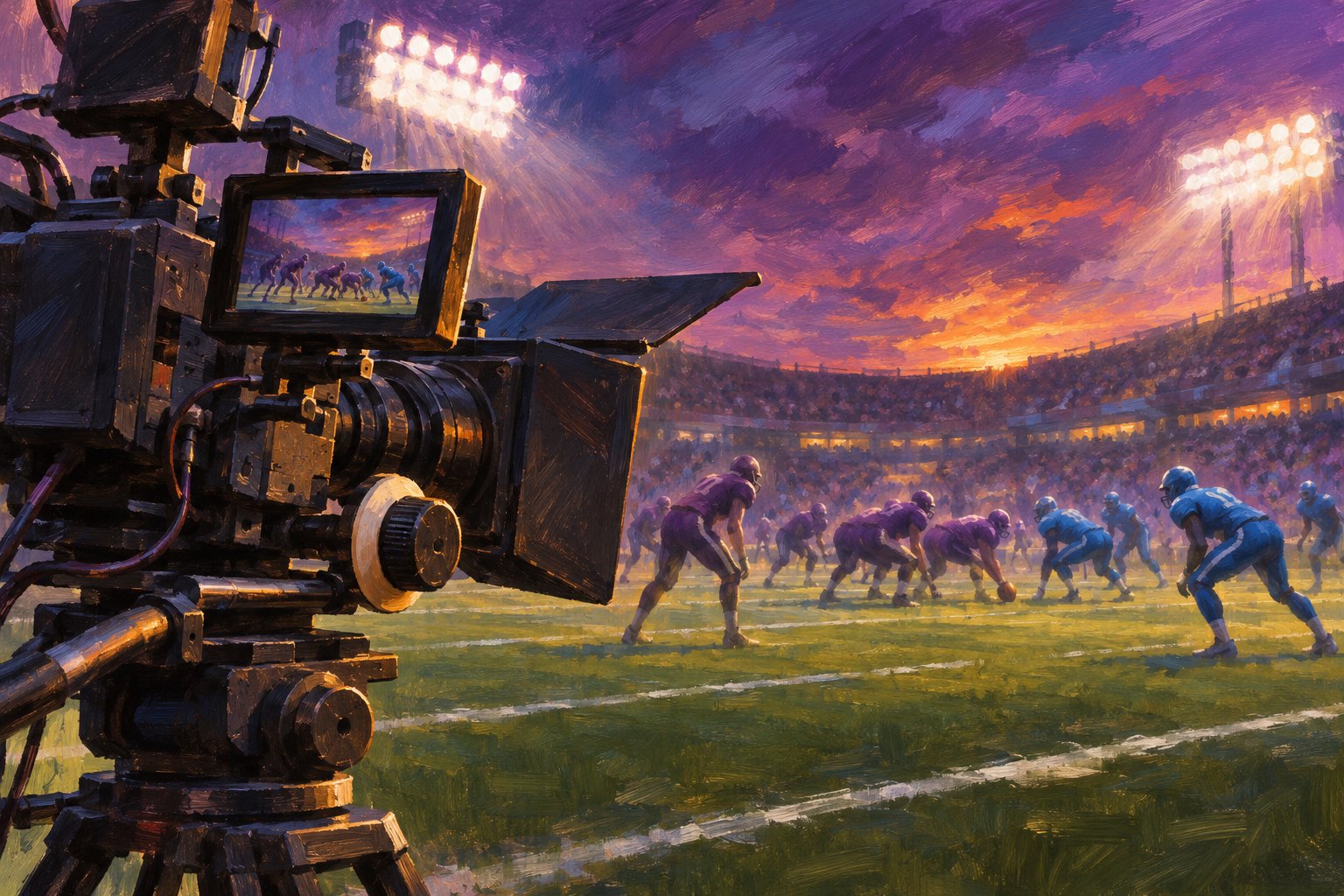
Ravens at Panthers: Mini-Movie, Volume 21 makes an intriguing promise before the footage begins: a football matchup can become a movie. The title presents the encounter as something to experience through storytelling, with the camera and the edit potentially doing more than preserving athletic action. For a film audience, that distinction is the reason to pay attention.
The Carolina Panthers’ publication identifies the subject and the mini-movie framing. Those details establish the premise, but they do not establish which players dominate the screen, what anyone says, or how individual sequences unfold. This is spoiler-free critical commentary on that premise, not a review based on a complete viewing. Specific performances, dialogue, and filmmaking choices cannot responsibly receive a verdict here.
What calling it a mini-movie changes
A highlight answers a straightforward question: what happened that deserves another look? A movie asks an additional question: why does this moment matter to someone? The difference can be small in running time and enormous in effect. An impressive play becomes a dramatic event when viewers understand the expectation, pressure, or uncertainty surrounding it.
That is the useful challenge embedded in the Ravens–Panthers title. The matchup supplies a subject; the filmmaking must supply relationships between moments. A succession of spectacular images may produce excitement, but excitement alone does not explain how one event changes the meaning of the next.
My critical preference is for sports storytelling that makes those connections legible. A viewer should be able to follow a shift in pressure without already knowing every formation or personnel decision. The strongest accessible filmmaking respects the sport’s complexity while giving an unfamiliar audience a clear emotional question to follow.
The Panthers as a collective protagonist
Because this is a Panthers publication, the first useful question concerns perspective. Which experiences does a team-centered account invite the audience to inhabit? That question matters more than assuming that every athlete shown automatically becomes a fully developed character.
A football team offers unusual possibilities for characterization because responsibility is distributed. One person may finish an action that depends on several others doing less conspicuous work. A film can acknowledge that relationship through attention: who receives a close-up, whose preparation becomes visible, and whose response gives an outcome emotional weight.
For this matchup, a character-focused reading would therefore look for how the Panthers are presented as a group. Does the storytelling make cooperation understandable? Does it allow different reactions to coexist? Those are questions for viewing, not claims about footage that has not been verified.
There is also an ethical limit to interpreting expressions. A lowered head can suggest disappointment, concentration, fatigue, or something outside the frame. Editing can encourage a particular reading, but the image alone rarely proves a private thought. Good criticism should describe that invitation without pretending to possess the athlete’s inner monologue.

The Ravens need to remain credible opponents
A Panthers-centered story can favor Carolina without reducing Baltimore to scenery. In dramatic terms, an opponent gives actions their difficulty. If the opposing side becomes merely an anonymous presence, the audience loses some understanding of what the central team must respond to.
This does not require equal screen time or an artificial claim of neutrality. It requires enough context for resistance to feel specific. The distinction is between seeing an achievement and understanding the challenge that makes it an achievement.
That principle also protects the film from easy moral shorthand. Sporting opposition does not make someone a villain. A compelling account of Ravens at Panthers would have room for competitive intensity without converting the teams into symbols of virtue and wrongdoing. Rivalry already supplies tension; invented psychology adds little.
Editing must preserve cause and consequence
The central formal question for a mini-movie is compression. A full contest contains repetition, waiting, adjustments, and actions that seem unimportant until later. A short presentation must leave much of that material out. Its meaning depends partly on what survives.
When watching Volume 21, one useful test is to ask whether each major transition remains understandable. Can you tell what changed? Does the next image answer the previous one, or does it simply offer another burst of energy? Neither slow motion nor fast cutting guarantees clarity.
Reaction shots deserve particular attention. Placing a face after an action creates an apparent emotional relationship between them. That relationship may be illuminating, but viewers should distinguish the sequence assembled on screen from assumptions about when the reaction occurred. This is a general feature of editing, not an allegation about this production.
The same issue appears in our discussion of how a concert film can translate live performance: selecting images does more than record an event. It determines where an audience looks and how long a moment has to register.
Listen for people beneath the spectacle
Sound offers another way to evaluate the mini-movie’s promise. Music can establish momentum, while environmental sound can make physical space feel immediate. Neither is inherently more truthful or expressive. What matters is whether the soundtrack helps distinguish moments or gives everything the same emotional emphasis.
If player or coach speech appears, its value should come from context. A brief remark can reveal practical communication, humor, uncertainty, or trust. Treating every sentence as an inspirational declaration risks flattening those differences.
No dialogue is quoted here because no spoken lines from Volume 21 have been verified. A memorable quotation belongs in criticism when its wording and circumstances are secure. Familiar locker-room language is not a substitute for what a person actually said.
What to look for beyond impressive images
A productive viewing approach is to follow three things: whose experience organizes the story, how clearly the edit connects actions, and whether the ending changes your understanding of earlier moments. These questions make room for enjoyment while distinguishing filmmaking from the appeal of the underlying event.
That distinction resembles the difference between admiring a performance and judging a complete film. Strong material matters, but its presence does not automatically establish that the surrounding work has found a satisfying shape.
The deeper promise: turning competition into memory
The most interesting implication of Ravens at Panthers: Mini-Movie, Volume 21 is its invitation to remember a sporting encounter as a story. A result can be recorded briefly. An experience includes anticipation, effort, dependence on other people, and uncertainty that the final outcome cannot fully convey.
My standard for the format is whether it preserves some of that uncertainty even after events have been resolved. Athletes act without access to the finished narrative. Filmmaking becomes more revealing when it respects that gap between living a moment and looking back on it. That is the promise worth testing in Volume 21: whether the matchup becomes understandable as an experience shared by people, as well as an occasion for spectacle.
Original content by this site's editorial team. Published: November 24, 2026 at 06:29:05 PST (Los Angeles time)