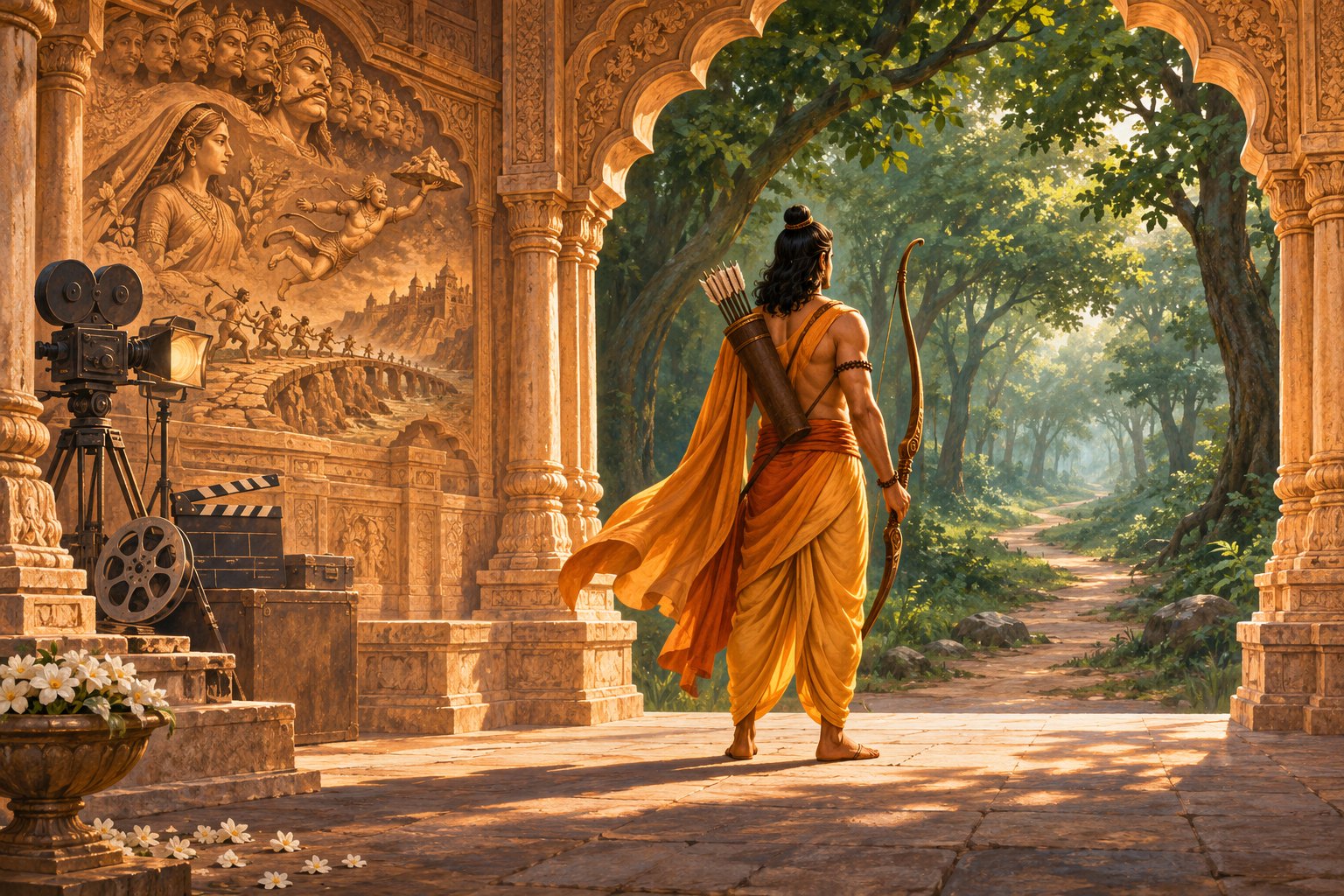
Ranbir Kapoor’s Ramayana arrives at the center of a demanding conversation: how should a lavish screen adaptation serve a Hindu epic that already carries deep meaning for its audience? BBC reporting describes the production as India’s costliest film and notes a divided critical response. Those two points establish the stakes, but neither settles its artistic value. Expense tells us about ambition; disagreement tells us that a single verdict cannot adequately describe the reception.
The most useful question concerns the people within that ambition. Can an epic make its characters emotionally present while preserving the significance that draws audiences to them? For Kapoor’s film, that is a more revealing critical starting point than treating production scale as an achievement that explains itself.
This is spoiler-free editorial analysis of the adaptation and its reported reception, rather than a screening-based review. It does not assign a rating or attribute unverified scenes, dialogue, or specific objections to critics.
What the divided reception actually tells us
A report that critics disagree does not establish what they disagree about. It cannot, by itself, prove that the performances are restrained, the effects overwhelming, or the storytelling uneven. Nor does it demonstrate a split between religious audiences and secular reviewers. Those are separate claims that require evidence.
What the disagreement does invite is a closer examination of standards. An epic adaptation can be assessed for dramatic clarity, visual imagination, emotional impact, cultural understanding, and the relationship it establishes with its subject. These standards overlap without being interchangeable. A viewer can admire an image’s grandeur while finding its emotional meaning elusive.
My critical position is that spectacle earns its strongest effects when it changes our understanding of a character. A palace can communicate the weight of authority. Distance can make separation tangible. A crowded frame can reveal isolation. The relevant question is what the scale allows us to perceive, beyond the scale itself.
Kapoor’s challenge: giving reverence a dramatic shape
With Kapoor at the center of the discussion, there is a temptation to make the actor’s presence the whole argument. Yet the more substantial issue is how an adaptation constructs attention around its central figure. Does it invite us to observe thought and response, or primarily to recognize importance?
For a revered character, stillness can be expressive. A measured gesture or a patient reaction can convey strength without overt display. But stillness needs a dramatic context. Viewers must be able to distinguish composure from emotional distance through the relationships, pressures, and consequences surrounding it.
That distinction matters because an ideal does not automatically become a compelling screen presence simply by being announced as an ideal. Cinema gives conviction a visible form through behavior. The audience learns what a character values by watching how that character attends to others, handles competing demands, and responds when circumstances change.
This is a standard for evaluating the adaptation, not a claim that Kapoor succeeds or fails at it. A responsible judgment about his performance would need to identify particular choices and explain their effects. Star image, casting approval, and familiarity with the story cannot do that work on their own.
The characters around the hero must matter
A character-centered approach to Ramayana also needs to look beyond the leading man. The surrounding figures should have a meaningful relationship to the film’s perspective. When someone speaks, objects, waits, or makes a decision, does the storytelling give that response weight?
One useful distinction is between appearing in a narrative and helping shape its emotional experience. A character may receive substantial screen time while remaining difficult to understand. Conversely, a brief exchange can establish an independent outlook if the camera, dialogue, and performance allow it to register.
For this adaptation, the critical task is to examine whose experience organizes a sequence. Whose reaction concludes it? Whose understanding changes? Whose feelings remain present after the plot advances? These questions offer a concrete way to discuss characterization without demanding that every figure receive equal time or a modernized personality.
They also protect against a familiar weakness in epic criticism: discussing characters only as symbols. Symbolic significance and individual presence can reinforce each other. A relationship becomes more powerful when the audience understands both what it represents and why it matters to the people living through it.
What an enormous budget can—and cannot—achieve
The description of Ramayana as India’s costliest film inevitably directs attention toward magnitude. Yet a spending superlative is an industrial claim, not a measure of emotional accomplishment. Without a clearly established accounting basis, it is also unwise to turn that description into a precise financial comparison.
Artistically, scale creates opportunities. Detailed environments can establish a world’s social order. Costume and architecture can clarify relationships before anyone speaks. A broad visual canvas can give a consequential decision a sense of public importance.

But these possibilities depend on selection. If every moment receives the same visual emphasis, distinctions can become harder to feel. Intimacy requires room: enough time for a response, enough quiet for a change in tone, enough visual focus for a relationship to become legible.
This does not mean an epic should be modest in appearance. It means that grandeur benefits from rhythm. The smallest gesture can deepen the largest image when the film has taught us why that gesture matters.
Faithfulness involves perspective as well as events
Adapting a beloved Hindu epic carries responsibilities that cannot be reduced to checking whether recognizable material appears. A cinematic version also makes interpretive choices through emphasis, duration, framing, and performance. What receives attention helps determine what the audience understands as important.
Our discussion of how adaptations earn changes through character motivation considers a related storytelling principle. Here, however, the sacred significance of the subject deserves its own attention. A familiar framework for adapting fiction cannot exhaust the questions raised by devotional meaning.
Respectful criticism should remain specific about the cinematic choices it evaluates. Criticizing an edit is not a judgment on a faith. Equally, identifying religious significance does not automatically explain whether a scene communicates effectively. Clear distinctions allow both artistic scrutiny and cultural seriousness.
How to read reviews of Ramayana usefully
For readers deciding what to make of the disagreement, the strongest reviews will connect their conclusions to observable evidence. Praise for emotional depth should explain how a relationship develops. Criticism of pacing should identify what becomes repetitive or underdeveloped. Admiration for visual design should describe what the images contribute.
Our essay on judging images by what they help us see and feel offers a useful companion principle: technique becomes meaningful through its effect on attention. The same applies to a monumental epic, regardless of how its images were made.
The deeper question: can an ideal feel lived?
The most compelling interpretive possibility in Kapoor’s Ramayana is the relationship between exemplary conduct and felt experience. A screen adaptation can give an ideal emotional force by making the audience understand the demands involved in sustaining it. That requires attention to relationships and consequences, alongside the image of greatness.
My view is that this should anchor the discussion of the film. Its reported expense makes it an industrial event, and its divided reception makes it a subject of debate. Its lasting artistic significance will depend on whether audiences can connect its immense world to the inner lives that give that world meaning.
Original content by this site's editorial team. Published: November 5, 2026 at 02:15:56 PST (Los Angeles time)