Promised Sky places a difficult question inside an ordinary home: how much safety can people offer one another when their own futures remain uncertain? Erige Sehiri’s 2025 drama follows Marie, an Ivorian pastor and former journalist living in Tunisia, whose household brings together women with different needs and a young child who has survived a shipwreck. Its central relationship is a makeshift family, but sharing an address does not mean sharing a destination.
Carroll College’s selection of the film for its French film program offers an entry point into a story whose geography matters. Also known as Promis le ciel, this French-Tunisian-Qatari production takes place in Tunisia and uses French and Arabic. Approaching it simply as a French film risks overlooking the African lives and relationships at its center.
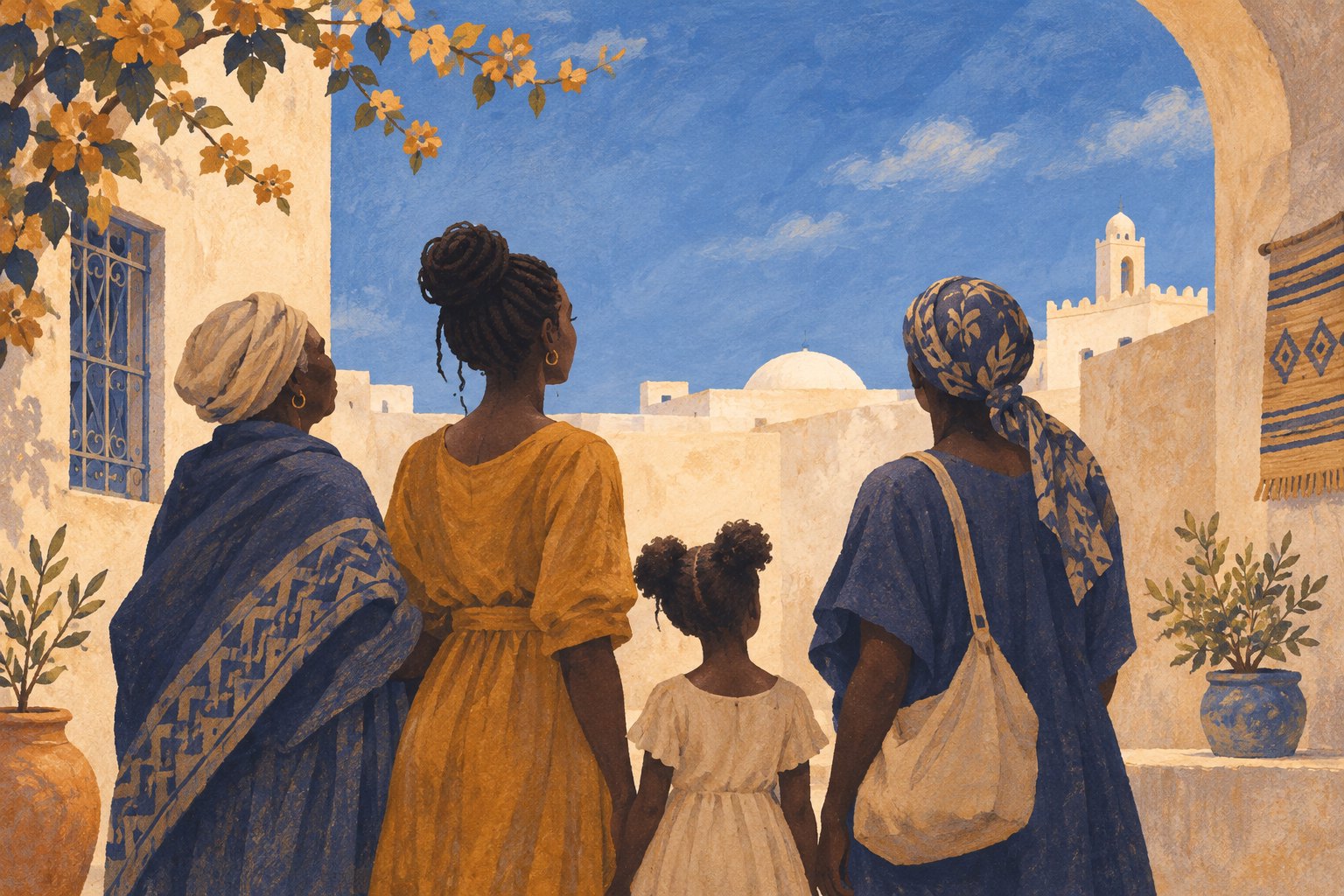
Spoiler note: This character analysis discusses the established story and selected scenes described in the film’s production interview. It does not reveal the ending or offer a scene-by-scene account. The accompanying illustrations are symbolic artwork.
Marie: When shelter becomes a responsibility
Marie, played by Aïssa Maïga, occupies two positions that do not fit together comfortably. She offers spiritual leadership, and she provides practical care. One involves speaking about hope; the other demands decisions about what can actually be sustained. Naney and Jolie already depend on the space she provides when Kenza’s presence makes those responsibilities more complicated.
My reading is that Marie’s most interesting quality lies in this overlap between generosity and authority. A person who opens her home also establishes its terms. Gratitude, dependence, affection, and disagreement can consequently occupy the same room. The household becomes dramatically meaningful because its members have reasons to need Marie without necessarily accepting her judgment about their futures.
It would be too easy to treat her religious vocation as proof that she always knows what is right. A more revealing approach asks whether her desire to protect someone leaves room for that person’s independence. Care can be sincere while remaining imperfect. That tension gives Marie more substance than the familiar figure of an endlessly selfless rescuer.
Naney: A mother with her own unfinished future
Naney, played by Debora Lobe Naney, seeks a better life for herself and her daughter. Her need for residency in Tunisia gives that ambition a concrete obstacle. Security is not an abstract aspiration when the ability to stay somewhere affects the life a parent can build.
Naney’s perspective complicates any comforting interpretation of Marie’s household. Shelter addresses an immediate need, but it cannot automatically deliver the future she wants. From her position, accepting help and wanting something beyond it are entirely compatible. Ambition does not become ingratitude simply because someone else has been generous.
This is where the film’s family structure becomes particularly useful for analysis. Naney is both a person who needs support and a mother who wants to provide it. Those roles prevent her from being understood only through vulnerability. Her choices deserve to be considered in relation to what she hopes to give her daughter, rather than measured solely against how convenient they are for the household.
Jolie: The pressure of being someone’s hope
Jolie, played by Laetitia Ky, is a student carrying her family’s expectations. Her student visa distinguishes her situation from Naney’s pursuit of residency. The difference matters: these women do not enter their shared home with identical resources or prospects.
For Jolie, education represents an individual project with a collective audience. Success can belong to the whole family, while the daily pressure of achieving it belongs to the student. That imbalance offers a useful way to understand her place in the ensemble. She needs room to imagine herself as a person whose life is still taking shape.
Reading the women separately also helps resist a flattening habit in migration stories: treating every character as another example of the same predicament. Jolie’s ambitions, Naney’s motherhood, and Marie’s leadership generate different priorities. Their solidarity has meaning precisely because those differences remain.
Readers interested in how cinema preserves individual lives within a larger social picture may also appreciate our analysis of the passengers and shared spaces in Railway Sleepers. The useful connection is a critical question: how does a film make a group visible without making its members interchangeable?

Kenza: A child whose needs exceed the adults’ hopes
Kenza is an orphaned shipwreck survivor who needs care. Her arrival sharpens the household’s emotional stakes, but interpreting her only as the child who unites the adults would diminish her place in the story. She has experienced a loss that their affection cannot simply cancel.
One scene discussed in Sehiri’s production interview has Kenza falling asleep while Marie describes her future. The director connects that withdrawal with the difficulty of receiving something emotionally overwhelming. The scene invites a restrained interpretation: an adult’s reassuring account of tomorrow may not reach a child in the way the adult intends.
To me, that is a particularly revealing challenge to Marie’s role. Giving someone a hopeful story is an act of care, but listening requires accepting that the other person may be unable to receive it. Kenza’s needs cannot be measured by how successfully she completes the adults’ idea of a family.
“Look at me!” and the limits of moral certainty
Among the dialogue documented in Sehiri’s production interview is the brief command “Look at me!” spoken to Marie by her blind friend Noa. Its force comes from the reversal: someone who cannot see asks to be fully acknowledged by someone whose own judgment needs examining.
The line offers a useful lens for the household. Attention is more demanding than assigning someone a role. Seeing Naney only as a struggling mother, Jolie only as a promising student, or Marie only as a pastor leaves out the conflicts that make their decisions human.
That distinction also connects with our discussion of character agency in The Flying Ace. Across very different films, the critical task remains recognizing what people want and what authority they possess, rather than allowing their narrative function to explain everything about them.
What the promise of the title asks us to believe
The most compelling interpretation of Promised Sky is that its title places hope under scrutiny without dismissing it. Marie, Naney, and Jolie each need a future they can believe in. Kenza needs adults whose promises can become dependable actions.
In my view, the household’s significance rests in the distance between those two needs. Belief can help people endure, but endurance still requires a place to live, time to study, and the possibility of caring for a child. The drama asks us to consider who must do the work that makes an encouraging promise credible.
That leaves a more demanding understanding of belonging than the idea that affection solves everything. These women can matter profoundly to one another while wanting different lives. Their bonds are worth taking seriously because each person brings needs that love must recognize, negotiate, and sometimes struggle to meet.
Original content by this site's editorial team. Published: November 11, 2026 at 12:40:19 PST (Los Angeles time)