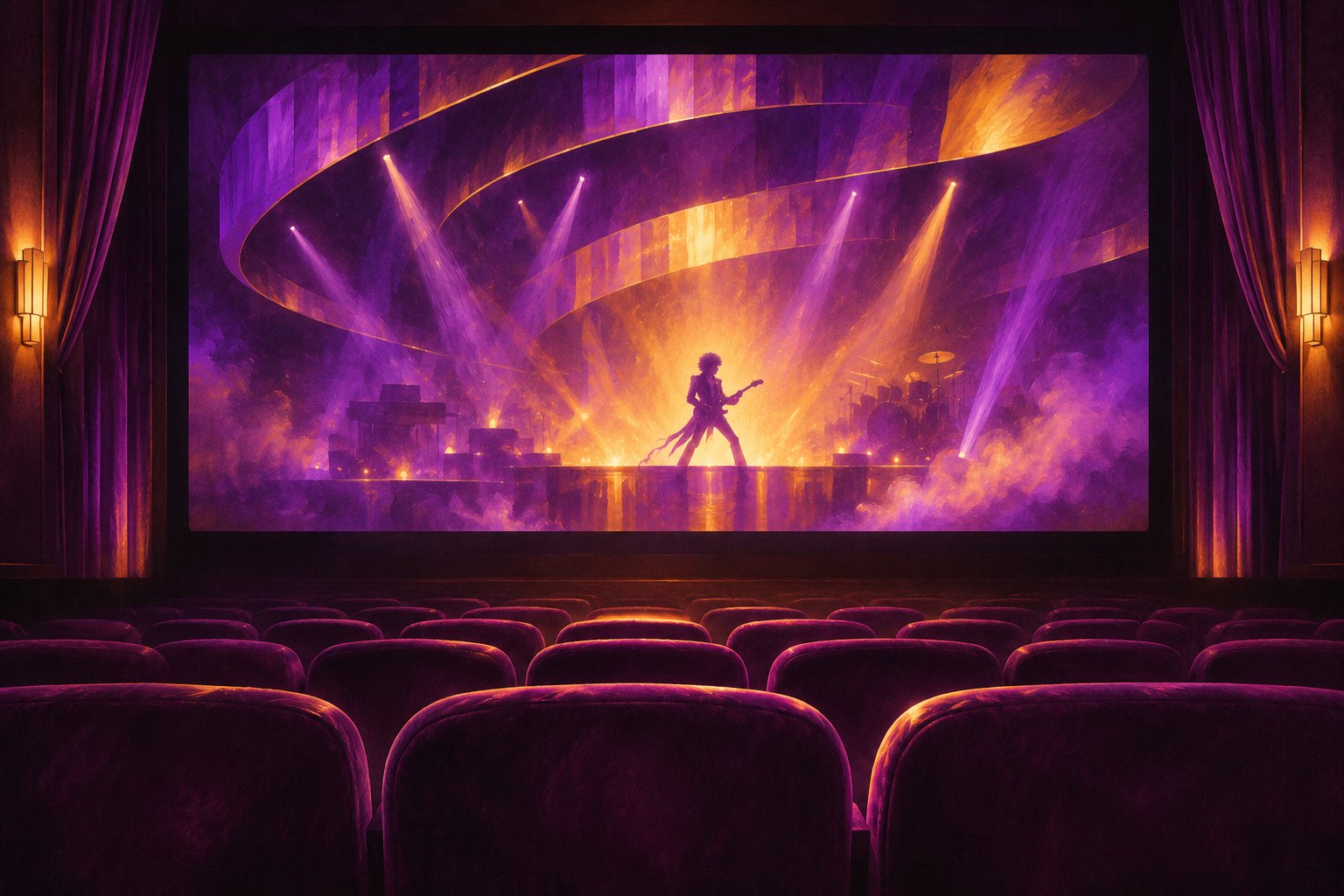
Prince’s 3121 Las Vegas Live is headed to theaters, according to Ultimate Classic Rock. For viewers drawn to the possibility of seeing Prince perform on a cinema screen, the announcement raises an appealing question: how much closer can a concert movie bring us to the decisions inside a performance?
The attraction is easy to understand. A theater gives music a dedicated space, a large image, and an audience gathered for the same experience. But those advantages do not automatically make an effective film. The camera and the edit determine whether we can follow the music being made or merely admire the spectacle surrounding it.
This is a critical preview, not a review based on a screening. It offers no verdict on the finished film’s performances, sound mix, or editing. Nor does it presume a particular set list, spoken exchange, or sequence. The useful question at this stage is what a film centered on Prince should allow its audience to see and hear.
What the theatrical announcement establishes
The reported news is the theatrical destination of 3121 Las Vegas Live. That is distinct from a promise of screenings in every market. Anyone planning to attend should check the exact title, date, venue, and available presentation in their local cinema’s current listings before making arrangements.
A concert movie also deserves a different set of expectations from a biographical drama. The subject’s presence does not establish that the film will explain his life, reconstruct private conversations, or organize events into a conventional character arc. Performance can be the central subject without functioning as a comprehensive biography.
That distinction matters here. Approaching a Prince concert film primarily as an explanation of Prince risks overlooking the activity immediately before us: a musician shaping an experience in time. A revealing film can make that activity intelligible without supplying a narrator to tell us what it means.
Prince as a performer, rather than a fictional character
A character-centered reading of a concert movie has to begin with restraint. A gesture onstage is observable; the private motive behind it may not be. Confidence, playfulness, tension, or distance can register as qualities of a performance without becoming evidence of what the performer felt away from the stage.
For 3121 Las Vegas Live, the most productive perspective would therefore be to follow Prince’s choices. Where does attention move? What changes when a vocal phrase ends and an instrumental passage begins? Does the film provide enough continuity to understand how a moment develops?
These are questions for the eventual screening, not descriptions of scenes already established. Their value is that they keep criticism attached to visible and audible evidence. Calling a musician magnetic tells us relatively little unless the review can explain how timing, movement, phrasing, or interaction produces that effect.
My preference is for concert filmmaking that allows charisma to emerge through work. A sustained shot can reveal the relationship between bodily movement and musical timing. A close-up can clarify a tiny adjustment. Either becomes more meaningful when the film preserves the surrounding action that gives it a purpose.
The camera needs to show relationships
The central performer may draw the eye, but a concert image can also explain relationships within the music. A shot that includes several players gives viewers a chance to notice attention passing between them. Cutting to another musician can be illuminating when it helps us hear something newly significant.
There is a difference between showing an instrument and showing its contribution. A guitar close-up is visually attractive, but its greater value lies in connecting a movement to a sound. Likewise, a wider frame can make an arrangement easier to follow by showing how individual actions occupy the same space.
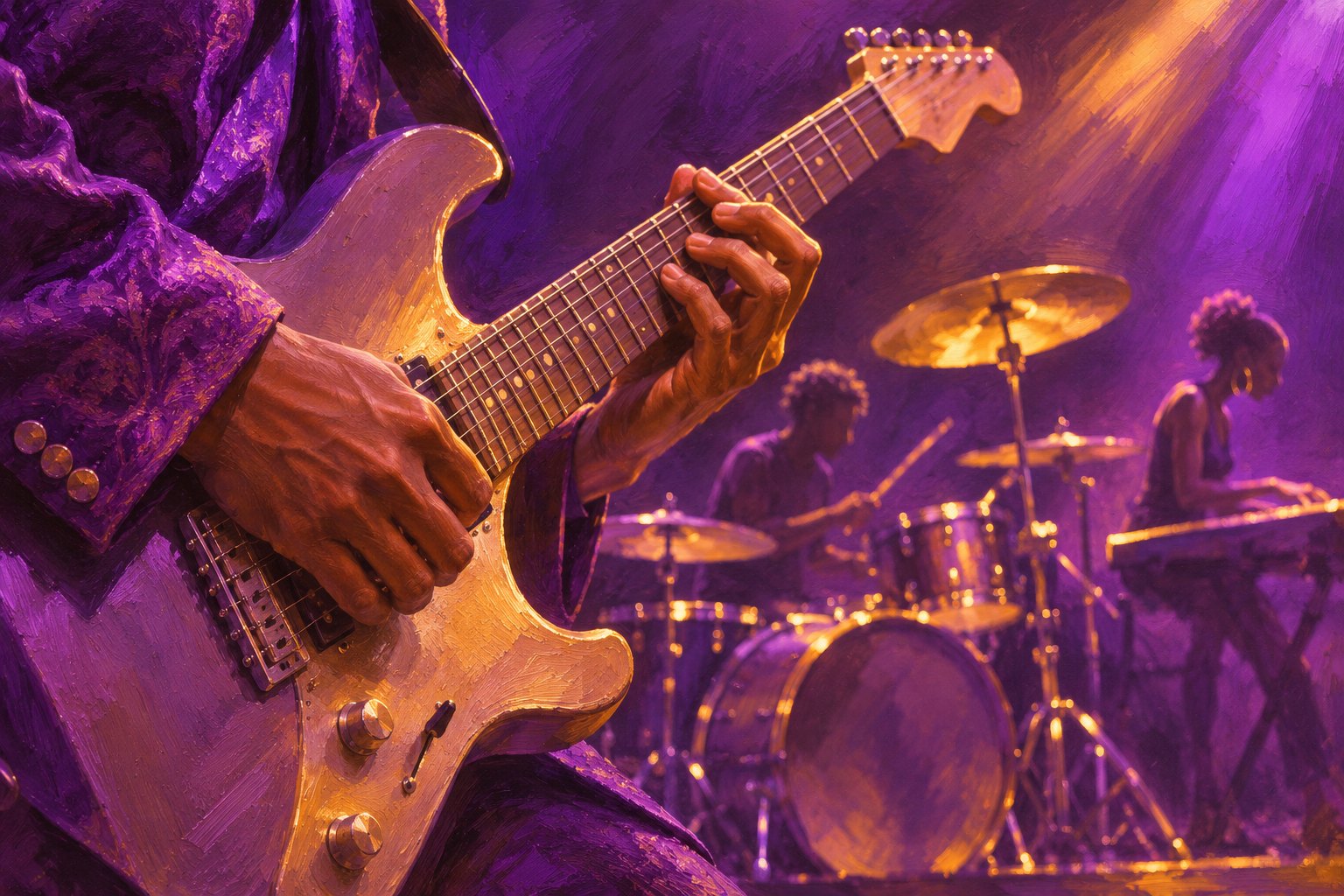
This is where a Prince concert movie could offer something beyond an enlarged performance clip. The opportunity is to make musical interaction readable while preserving its pleasure. Viewers should not need technical training to recognize that one sound answers another, or that a moment gains force because the musicians leave space around it.
Our discussion of how a new score shapes the experience of The Flying Ace approaches the connection between sound and image from another direction. In a concert film, the relationship is especially immediate: the image can direct our listening, while the sound gives the image its urgency.
Editing should let musical time register
Rapid cutting is not inherently exciting, and a long take is not inherently perceptive. Each earns its place through what it reveals. An edit can sharpen a change in musical emphasis; it can also interrupt the very action we were trying to follow.
For a viewer, one practical test is whether a passage remains understandable after the initial rush. Can you follow its development, or do you mainly remember a succession of angles? Does the film let anticipation accumulate before a release? Those questions help distinguish musical momentum from visual busyness.
The issue connects with our analysis of duration and observation in Railway Sleepers. The subjects are very different, but both invite attention to what becomes perceptible when a film lets time unfold. In concert cinema, patience can give a small variation room to become a dramatic event.
What the theater audience brings
The audience in a concert recording and the audience watching it in a cinema occupy different positions. One responds inside the original event; the other encounters an event already framed and edited. A concert movie connects those rooms without making them identical.
Reaction shots can help communicate the atmosphere, but they also influence judgment. An ecstatic face tells us that someone responded strongly; it does not replace showing the performance that prompted the response. I would want 3121 Las Vegas Live to leave viewers enough room to form their own relationship with what they hear.
Longtime listeners and newcomers can approach that experience differently. Familiarity may draw attention to phrasing or arrangement. A first encounter may begin with movement, texture, or an unexpected change in energy. An effective concert film should make both kinds of attention possible without requiring advance knowledge as an entrance fee.
The deeper promise: making artistry visible
The most compelling possibility behind 3121 Las Vegas Live is an encounter with Prince through the details of performing. A familiar name can establish interest before the lights go down. The film’s task is to turn that interest into sustained attention.
That is also the deeper interpretive opportunity. Performance is a sequence of choices experienced as something continuous: a sound arrives, a response follows, a moment changes. Cinema can preserve those relationships or break them apart. Its achievement lies in helping us perceive how they work while still letting us feel their effect.
The theatrical announcement makes this a release to watch for. A final critical judgment must wait for the film itself. The standard, though, is clear: the strongest version of this experience would leave us with a more precise understanding of Prince’s artistry, alongside the pleasure of having listened.
Original content by this site's editorial team. Published: November 11, 2026 at 13:17:27 PST (Los Angeles time)