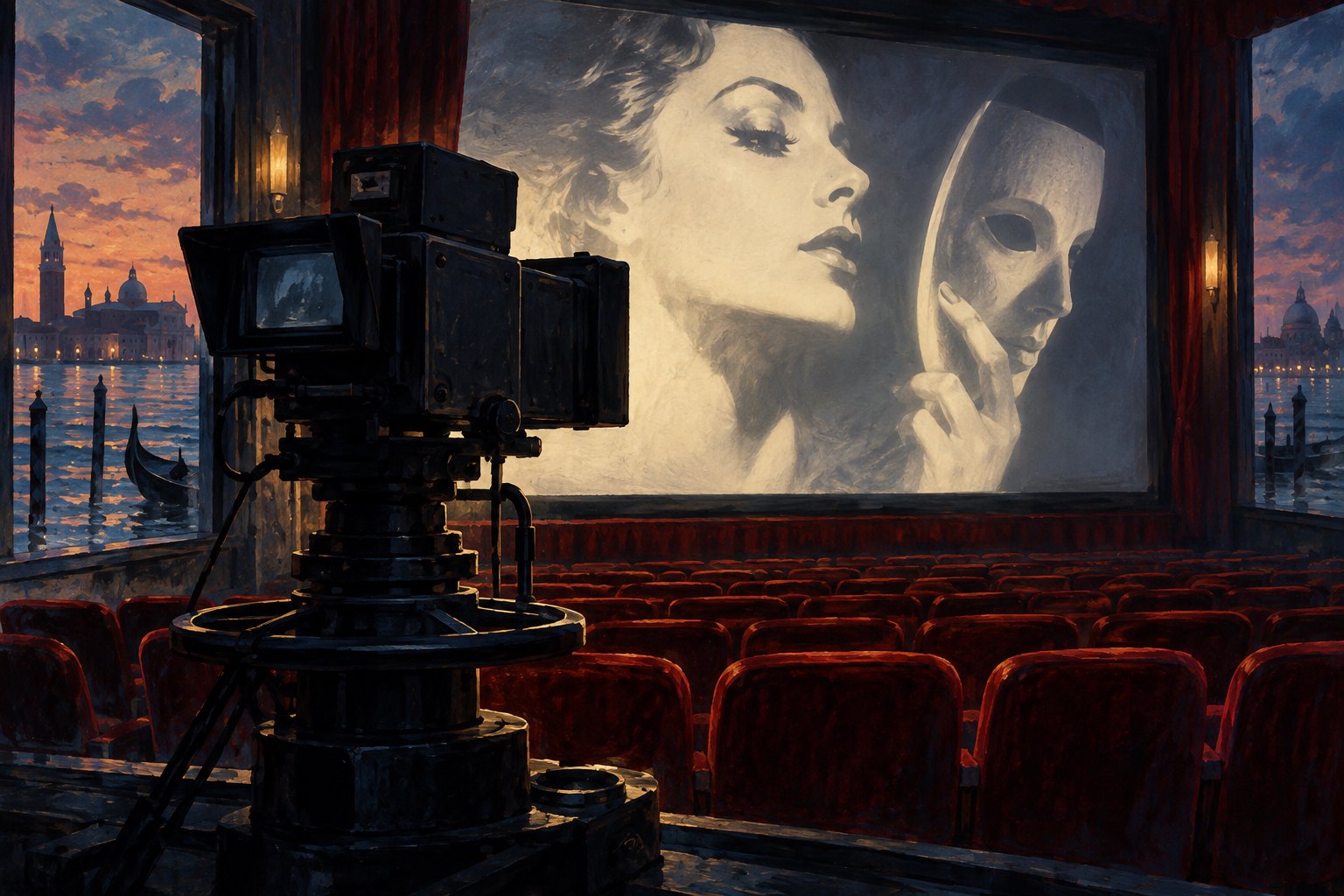
Primetime and Flesh Impact make an intriguing pairing in the 2026 Venice Film Festival’s Oscar conversation. Their shared subject is the power of a public image. One approaches that power through a television personality whose authority depends on exposing other people; the other imagines an actress outliving the image that made her famous. Together, they invite a sharper question than who might collect a trophy: what happens when being watched becomes the condition of someone’s working life?
This is a character-focused critical companion to those two films, drawing on documented story material and festival reporting. Awards prospects remain predictions. The interpretation below concerns the films’ dramatic constructions, including their fictionalized versions of public figures.
Spoiler note: Discussion includes character motivations, the audition premise of Flesh Impact, and selected dialogue. Major endings are not described.
Primetime: When the presenter becomes the product
Lance Oppenheim’s Primetime stars Robert Pattinson as a dramatized Chris Hansen during the making of To Catch a Predator. The production of televised sting operations supplies its narrative machinery. Yet the character’s relationship with his own importance offers the more revealing point of entry: he needs the audience to believe that his presence makes an indispensable difference.
Ben Croll’s festival review reports a recurring question from the film: “What would happen if I weren’t here?” It is an economical statement of the character’s dilemma. On its surface, the question asks viewers to imagine danger going unchecked. Underneath, it makes the presenter himself the answer. The line and production-centered storyline are documented in [TheWrap’s Venice review of Primetime](https://www.thewrap.com/creative-content/movies/primetime-review-robert-pattinson-chris-hansen/).
My reading is that the wording exposes a confusion between responsibility and indispensability. Someone accepting responsibility asks whether the work helps. Someone demanding indispensability asks whether the work can exist without them. The difference matters because a public mission can become a remarkably effective shelter for private ambition.
That gives viewers something specific to examine in Pattinson’s characterization: the distance between reassurance and self-advertisement. A controlled voice can communicate competence, but it can also make a speaker appear immune to uncertainty. The dramatic question is whether the character’s certainty survives contact with consequences he cannot arrange for the camera.
Andie and Dan make ambition a shared problem
The film also gives substantial roles to producer Andie, played by Merritt Wever, and sting decoy Dan, played by Skyler Gisondo. Croll describes both characters wrestling with the production’s ethical compromises. Their involvement expands the story beyond the psychology of its most recognizable face.
From a character perspective, this is fertile territory. A presenter’s ambition needs other people to become television. Someone organizes the operation; someone enters the situation; someone helps transform an encounter into material an audience will consume. Following those participants changes the scale of the moral problem.
The useful distinction is between understanding a compromise and excusing it. Career opportunities, professional loyalty, and the desire to be valued can make a choice intelligible. They cannot settle whether it was defensible. A compelling supporting character allows both judgments to remain present.
That tension also connects with our discussion of the danger of organizing a life around an audience. Recognition becomes dramatically interesting when a character begins using it as evidence that their decisions must be right.
Flesh Impact: Marilyn Monroe asks to be heard
Maggie Gyllenhaal’s Flesh Impact approaches public identity through a deliberately imagined possibility. Dakota Johnson portrays Marilyn Monroe at the height of her fame, while Ellen Burstyn embodies an older Marilyn the world never knew. Venice’s official synopsis establishes that dual portrayal; Gyllenhaal’s accompanying statement identifies artistic life under public scrutiny as a central concern. See the [festival’s synopsis and director’s statement](https://www.labiennale.org/en/cinema/2026/venice-open-out-competition/flesh-impact).
The premise matters before any question of resemblance. Giving Marilyn an older self allows desire, memory, and professional purpose to continue beyond the familiar boundaries of her image. Age becomes an imaginative resource. This woman can still want something.

Steve Pond’s account of the film describes Burstyn’s Marilyn arriving to audition for Carol Cutrere in Tennessee Williams’ Orpheus Descending. Told that the character is young and beautiful, she answers, “I’m aware.” The exchange is documented in [TheWrap’s review of Flesh Impact](https://www.thewrap.com/creative-content/movies/flesh-impact-maggie-gyllenhaal-marilyn-monroe-review/).
Those two words give the premise its edge. The response does not require us to imagine that Marilyn has misunderstood the room. It permits the opposite reading: she understands its assumptions perfectly and has entered anyway. Her awareness becomes a form of resistance.
An audition is especially useful here because it brings artistic aspiration into direct contact with permission. The performer arrives with something to offer; other people decide whether she fits. In this setting, being universally recognizable need not translate into being taken seriously as a working artist.
The title turns admiration into a boundary question
Pond also records Marilyn’s explanation of her screen presence: “You could reach out and touch me.” She follows it with “And everybody did.” The movement between those sentences gives the title an unsettling second meaning.
The first statement describes the apparent intimacy of cinema. The second introduces the possibility that intimacy has been mistaken for access. My interpretation is that the exchange challenges the viewer to distinguish emotional connection from possession. Feeling close to a performer does not make that performer available.
Read alongside the audition, the thought becomes more specific. Marilyn’s image can circulate freely while her ambition still encounters a gatekeeper. She can be familiar to everyone and remain insufficiently heard. The younger and older embodiments make that contradiction visible without requiring her identity to fit inside one permanently preserved face.
For a related discussion of whose experience gets narrative space, our character analysis of Closing Night considers how attention to women’s competing needs changes a personal story.
What this pairing adds to the Oscar conversation
The most productive comparison lies in the direction of each character’s demand. The dramatized Hansen asks the audience to recognize the necessity of his presence. The imagined older Marilyn asks a room to recognize the continuing value of her work. Both seek acknowledgment, but acknowledgment serves different purposes.
This distinction gives awards-minded viewers a useful way to assess performance beyond imitation. Watch how a character seeks permission, occupies silence, or responds when another person defines the situation. An accurate hairstyle cannot supply those relationships. Dramatic characterization depends on what the performer makes us understand about wanting, defending, and withholding.
It also explains why these films belong in a conversation together without needing to become equivalent achievements or identical Oscar prospects. Their premises expose different arrangements of visibility: the authority to put someone on display, and the struggle to exist beyond the display others have made of you.
The deeper question is who gets to determine the terms of an encounter. A camera can make a person recognizable while leaving their interior life obscure. The lasting value of this pairing is its invitation to notice that gap—and to ask whether the person commanding our attention is also allowing another person to be understood.
Original content by this site's editorial team. Published: September 12, 2026 at 12:25:26 PDT (Los Angeles time)