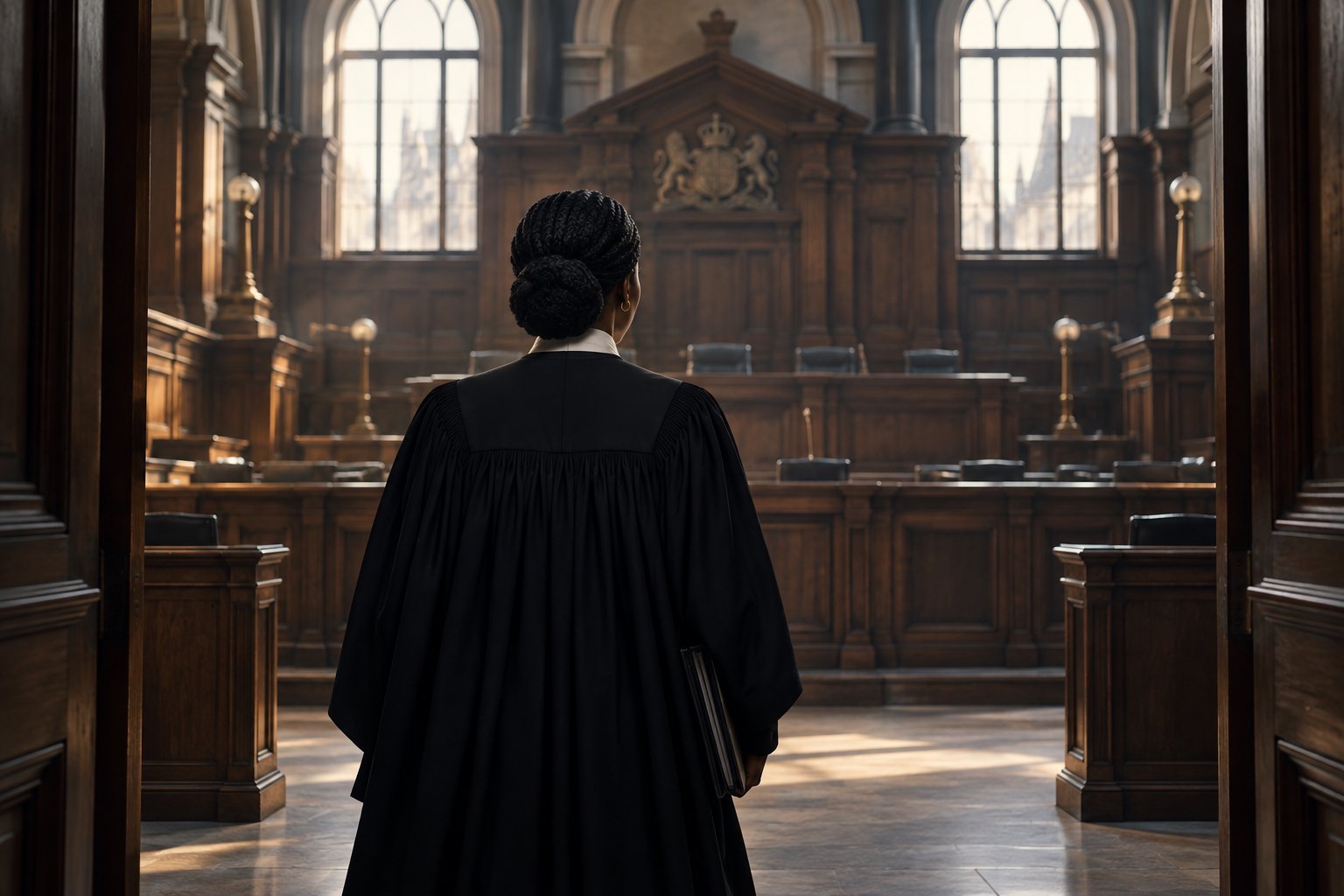
Prima Facie brings Cynthia Erivo to a story with an immediately disturbing reversal: a lawyer becomes a sexual-assault victim facing a rape trial. Its theatrical pedigree establishes expectations, but the move to cinema creates a separate artistic test. Deadline’s Toronto Film Festival review characterizes the adaptation as uneven. That is one publication’s assessment, rather than a settled verdict, and it raises a useful question: what must this story preserve when it changes form?
The answer begins with the relationship between speaking and being heard. A courtroom drama can give its central character substantial dialogue while allowing the surrounding spectacle to determine what audiences believe. For this particular premise, that distinction matters. The challenge is to make the lawyer’s experience emotionally legible without reducing her to an illustration of the film’s argument.
Content note and spoiler scope: This commentary discusses sexual assault and the central premise, without describing the assault or revealing a trial outcome. It examines the adaptation’s dramatic stakes and reported reception; it does not offer a firsthand assessment of individual scenes.
What the mixed reception actually tells us
A description such as uneven identifies a judgment about consistency. By itself, it does not establish whether the concern lies in pacing, dialogue, visual choices, supporting characters, or the relationship between different sections. Those are distinct possibilities, and assigning any of them to Prima Facie without evidence would turn a broad assessment into an invented account of the movie.
Still, the theatrical success behind the film makes the question of consistency especially interesting. An acclaimed stage work arrives with an existing reputation for emotional force. A screen adaptation must create that force through its own decisions. Awards attached to the earlier work cannot tell viewers whether the new version finds an effective rhythm or gives its central performance enough space.
My view is that this is the fairest framework for approaching the reception: take the subject seriously while keeping the artistic judgment open. Respect for a story about sexual violence should sharpen criticism. It should encourage attention to how the experience is represented, whose perspective organizes it, and whether emotional emphasis feels earned.
Why showing more can change what testimony means
Theater and cinema offer different relationships with a speaker. In a theater, an audience can remain conscious of a person sharing physical space with them. Film can bring a face much closer, but it can also interrupt that encounter through a cut, a reaction shot, or a change of location. Each choice redistributes attention.
For Prima Facie, that creates a particularly consequential adaptation problem. The central premise puts a legal professional in a position where her own experience becomes the subject of examination. How a film presents that examination can influence whether viewers feel beside her, opposite her, or at a supposedly neutral distance.
Consider the difference between holding on someone as she speaks and cutting to another person evaluating her words. The first can ask viewers to listen through discomfort. The second can introduce an additional authority into the moment. Neither technique has a fixed meaning, but both shape the audience’s relationship with testimony. These are possibilities of the medium, not claims about specific shots in this adaptation.

The character needs continuity across the reversal
The lawyer-to-victim premise is powerful because professional knowledge and personal exposure occupy the same character. It also carries a dramatic risk: an adaptation could make the reversal so emphatic that the woman appears to become an entirely different person.
A more compelling interpretation allows continuity. Knowledge does not vanish when someone becomes vulnerable. Intelligence does not prevent suffering. Professional competence and the need for support can coexist. Keeping those qualities together would give the role greater depth than a simple movement from confidence to collapse.
That is the performance challenge suggested by Erivo’s role, rather than a verdict on how she meets it. The audience needs room to recognize a complete person across changing circumstances. If strength is defined only as control, any loss of control can be mistaken for the disappearance of character. A richer drama makes room for hesitation, anger, calculation, exhaustion, and resolve without arranging them into an easy hierarchy.
Our earlier character-focused discussion of Cynthia Erivo’s Prima Facie considers the reversal itself. The adaptation question goes further: how does the film’s structure allow audiences to experience that continuity, rather than merely understand the premise?
Memorable speech is only part of the equation
Language is an obvious attraction in a story centered on a lawyer. Yet a film about testimony needs to make space for more than eloquence. A polished speech can communicate an argument; the moments around it can reveal what making that argument costs.
No dialogue is quoted here because exact wording from the finished film has not been verified. Lines associated with another version of a work should not automatically be presented as movie dialogue. That distinction matters especially for an adaptation whose handling of speech is central to its artistic identity.
The useful critical question is therefore broader than whether the screenplay contains a memorable declaration. Does language express the character’s changing relationship with her experience? Can uncertainty remain meaningful? Does the audience attend to the person when she is less fluent, or only when she can deliver a persuasive account? Those questions reach the heart of the premise without inventing a speech to answer them.
A strong lead and a strong adaptation are separate judgments
Star-centered coverage often compresses several assessments into one. Admiration for a performer becomes approval of the movie, or dissatisfaction with the movie becomes an implied dismissal of the performer. Both shortcuts obscure how screen acting depends on framing, editing, scene construction, and the surrounding performances.
That distinction also informs our discussion of Ellen Burstyn and the storytelling around her in Place to Be. A central role and the film containing it deserve related but separate consideration. For Prima Facie, the useful response to mixed reception is to keep those questions distinct until there is evidence to answer each.
The deeper issue is how an audience listens
The most productive interpretation of Prima Facie’s premise concerns the audience as much as the courtroom. Viewers routinely read confidence as authority, hesitation as uncertainty, and coherence as credibility. A drama built around a lawyer’s experience of becoming a victim has the potential to unsettle those habits.
Its artistic task is demanding: sustain a person’s complexity while presenting an argument about the circumstances in which she must speak. Too much explanation could narrow the character into a lesson; too little attention to her perspective could leave the surrounding machinery in control of her story. The balance must be achieved moment by moment.
That is why the adaptation deserves scrutiny beyond its stage honors and its star’s name. The premise asks us to consider the distance between having something to say and being granted a meaningful hearing. Cinema can make that distance visible. The measure of this Prima Facie is how fully it lets the person inside that distance remain a person.
Original content by this site's editorial team. Published: September 13, 2026 at 20:12:15 PDT (Los Angeles time)