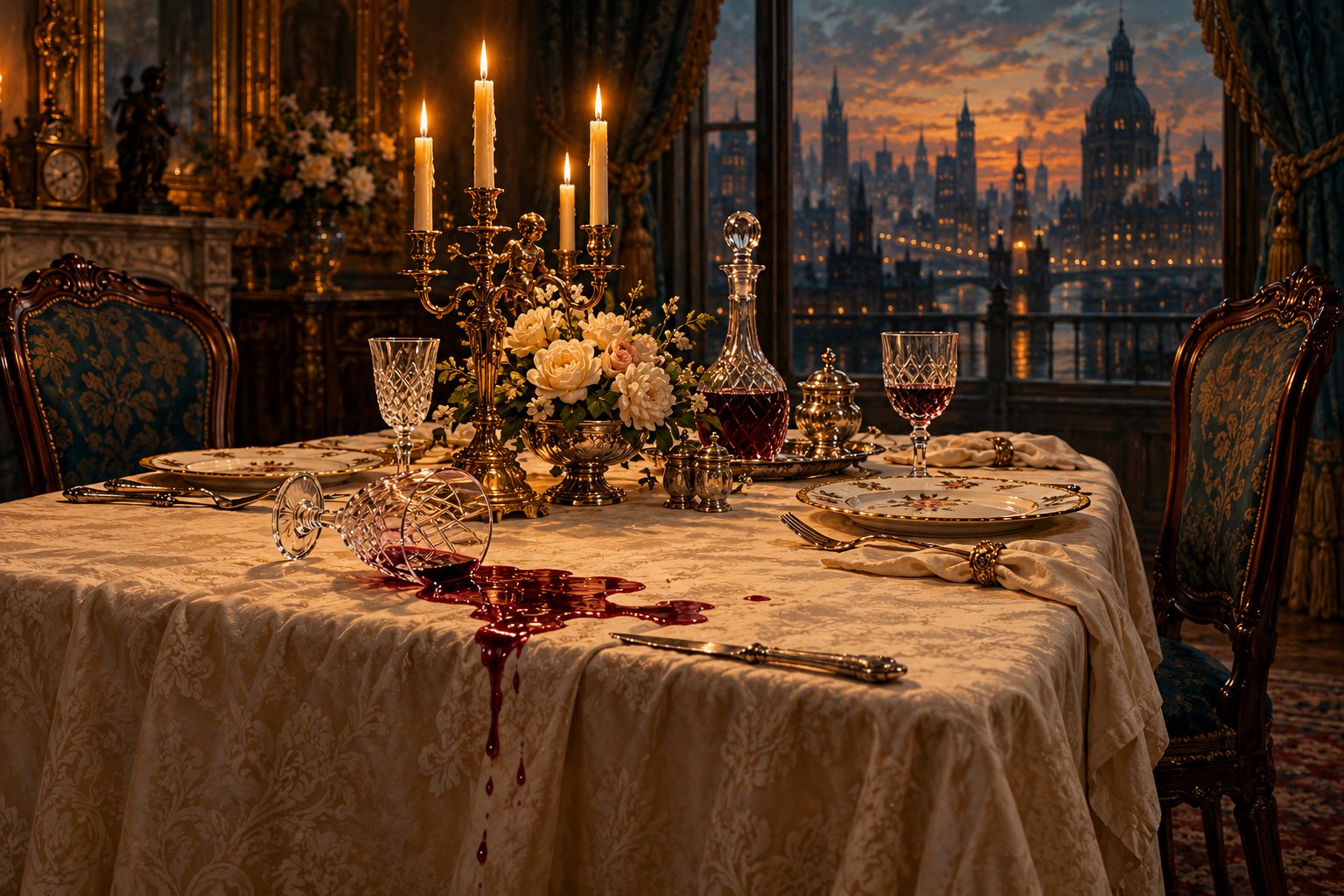
Plucked builds its dark comedy around an especially uncomfortable collision: Katherine Greene wants to end her marriage, while an important dinner requires the household to maintain its respectable appearance. Directed and written by Katie Vincent and Usher Morgan, the film places private resentment inside the public rituals of Gilded Age New York. Its attraction is the tension between a relationship coming apart and an evening that depends on everyone pretending otherwise.
Scope and spoilers: This is a critical preview based on verified film information and published reviews, rather than a firsthand screening verdict. It discusses the marital conflict and the advertised escalation into violence without revealing the ending.
A Dinner Party With Incompatible Purposes
The official synopsis establishes Katherine’s decision to divorce her husband as the disruption that sends a carefully managed evening toward jealousy and revenge. Vincent plays Katherine; Jared Canfield plays Peter. J. Anthony Crane appears as James, Peter’s brother. The central situation makes the home both an intimate space and a place where other people’s opinions carry weight.
Brittany Frederick’s review adds a useful distinction: Peter is hosting the dinner with his career in mind. For him, domestic composure has a professional purpose. Katherine’s unhappiness therefore threatens more than his feelings; it threatens the presentation of himself that he wants his guests to accept.
That difference gives the premise its dramatic force. One spouse needs the evening to preserve continuity. The other wants a rupture. Even before considering the advertised mayhem, those objectives cannot comfortably coexist. A successful dinner and an honest conversation may be mutually exclusive.
Katherine’s Perspective: Freedom Does Not Require Perfection
Katherine is the most productive starting point for interpreting the story because her decision changes what everyone else can take for granted. A wife who continues performing contentment allows a household to proceed on familiar terms. A wife who withdraws that performance forces the people around her to respond.
Frederick describes Katherine as self-centered as well as defiant. That combination invites a more interesting reading than an uncomplicated celebration of rebellion. Wanting to leave a marriage does not automatically make someone generous, patient, or wise. Equally, being difficult does not invalidate the wish to leave.
For viewers, the useful distinction is between evaluating a character’s conduct and evaluating her right to make a decision. Those judgments need not produce the same answer. Dark comedy has room for that discomfort: a person can be justified in rejecting a situation while behaving badly within it.
This connects with the question of agency explored in our commentary on how films give women meaningful perspectives. Here, the relevant question is specific: does Katherine’s choice remain the center of her story, or does the spectacle of other people’s reactions threaten to overwhelm it?

Peter’s Perspective: When Appearances Become an Investment
Peter’s professional ambitions complicate the dinner’s emotional meaning. The guests are an audience before they become witnesses to a deteriorating evening. If he needs their approval, maintaining domestic harmony becomes a form of work—and Katherine’s cooperation becomes something he may assume he can count on.
My reading of that setup is that the conflict concerns ownership of the couple’s public story. Who gets to decide when a marriage is acknowledged as broken? Who bears the cost of keeping its failure private? The person asking for another evening of politeness may experience that request as reasonable. The person expected to provide it may experience the same request as another postponement of freedom.
Peter’s distress can be understandable without making every response defensible. That distinction matters especially when a story moves toward violence. Humiliation explains pressure; it does not settle responsibility. A character-focused interpretation should keep track of choices rather than treating an escalating temper as an inevitable force of nature.
What the Period Setting Adds
Jason Knight’s published review places the action in Westchester in 1886 and describes Katherine receiving confirmation that her divorce request has been granted. That detail makes the conflict more precise than a simple question of whether she will dare to leave. A formal change in status and the willingness of others to accept it are different things.
The setting also raises the stakes of social performance. Elegant rooms and formal hospitality can suggest stability, yet neither tells us whether the people inside feel safe, respected, or free. In this reading, the household’s polish becomes an unreliable guide to its emotional condition.
Frederick reports that motherhood is described as a woman’s “greatest privilege.” The phrase is revealing because it presents an expectation as a gift. Without a verified transcript, it would be misleading to extend that fragment into a speech or assign it additional context. Even in its reported form, however, it identifies a pressure worth considering: praise can restrict a person when it defines the only acceptable life available to her.
From Social Embarrassment to Physical Danger
Both the official synopsis and published reviews establish that the evening becomes violent. Knight describes a substantial shift from domestic drama toward survival suspense. That change matters for prospective viewers: the period costumes should not be mistaken for a promise of gentle drawing-room entertainment.
The critical question is whether the escalation preserves the characters’ motives. Farce can enlarge a recognizable grievance until behavior becomes absurd. Violence changes the consequences of that behavior. When the two overlap, laughter may depend on our awareness that someone is taking a petty grievance disastrously seriously.
A viewer can follow that transition by watching what each person still wants as circumstances deteriorate. Is the priority escape, control, vindication, or the avoidance of embarrassment? Those aims help distinguish meaningful escalation from a sequence of increasingly noisy incidents.
Our discussion of reading film images beyond recognizable faces offers another useful approach: notice how space organizes power. In a domestic conflict, who can leave a room—and who expects someone else to stay—can matter as much as an insult.
A Deeper Reading: Ending the Performance
The most compelling interpretation of Plucked begins with the difference between ending a relationship and ending the performance of one. Katherine’s decision challenges both. The dinner makes that challenge public, turning something the couple might prefer to control into an event other people can observe.
The official promotional line, “Love is for the Birds,” is a tagline rather than verified character dialogue. Its dismissive humor fits the advertised premise, but the richer question lies beneath it: what survives when the language of love no longer conceals resentment, dependence, or wounded pride?
That is the reason to approach Plucked with interest. Its premise allows marriage to be examined through conflicting needs rather than a single moral label. A final judgment on its performances, comic timing, and ending requires a screening. The verified setup nevertheless offers a sharp subject for dark comedy: people demanding that a relationship look intact after someone has stopped agreeing to keep it that way.
Original content by this site's editorial team. Published: November 1, 2026 at 22:23:33 PST (Los Angeles time)