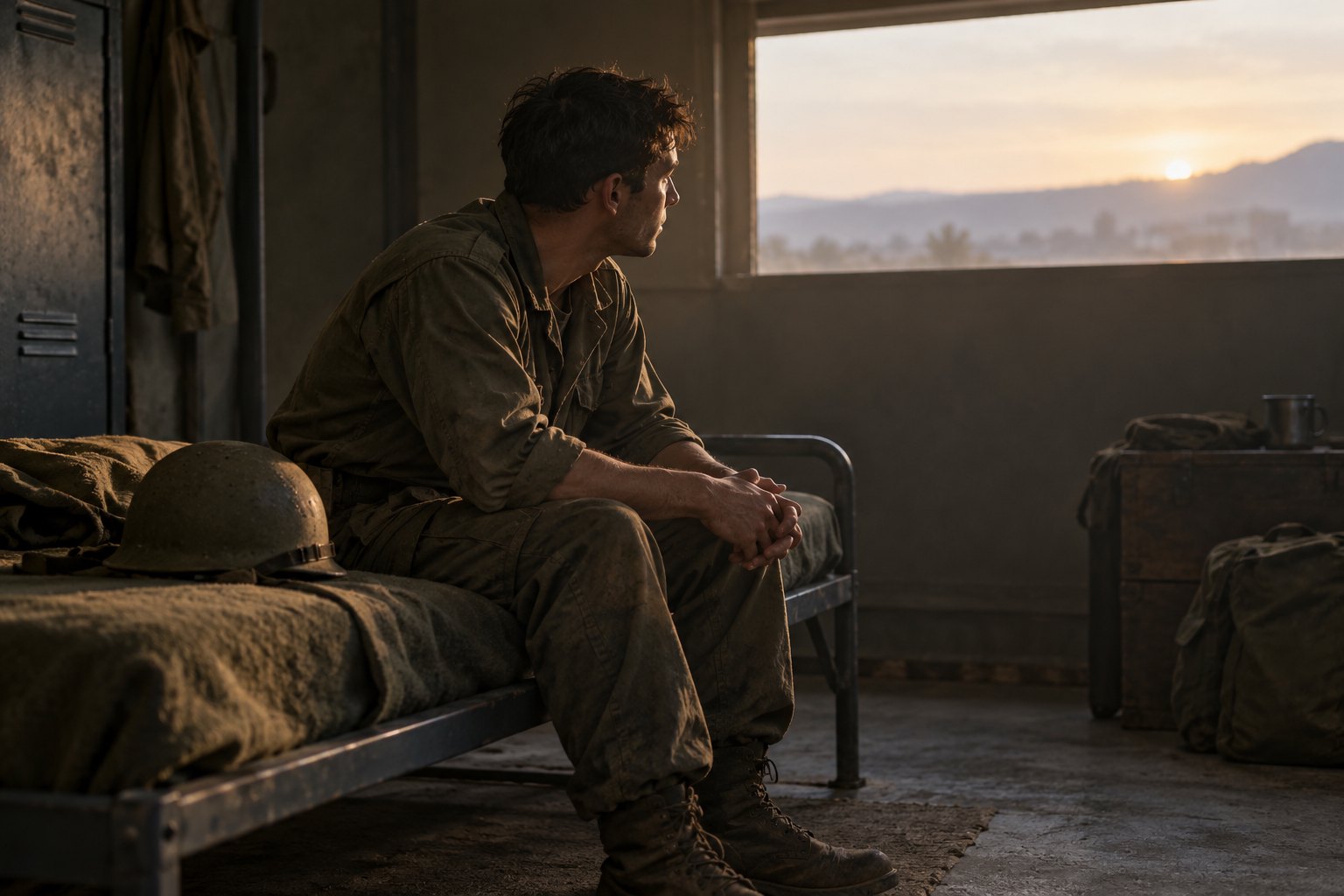
Peter Berg says his Call of Duty movie will seriously explore “the cost of war,” according to Fox News. That ambition makes the film’s perspective especially important. A battlefield can look entirely different to the person issuing an order, the person carrying it out, and the person whose home stands in its path.
The most interesting question is therefore whose experience will organize the movie. Will viewers understand war primarily through a soldier’s endurance? Through the responsibility of command? Through lives interrupted beyond the mission? Each choice could produce a compelling film, but each would give Berg’s stated theme a different meaning.
This is a spoiler-free assessment of that creative direction, not a review of a finished film. It makes no claims about specific scenes, character appearances, dialogue, or an ending. The promise is worth examining; its execution remains something the movie must demonstrate.
Whose experience gives the action meaning?
A camera’s position is an argument. Following someone through danger encourages us to understand their immediate priorities: find cover, locate a missing companion, decide whether a movement ahead signals a threat. That intimacy can create powerful empathy. It also limits what we know.
For a Call of Duty adaptation, that limitation could become a dramatic strength. A soldier does not need a complete understanding of a conflict to experience its consequences. Confusion, conflicting obligations, and incomplete information can make a character’s decisions more revealing than a speech explaining the film’s message.
But restricted perspective should remain recognizable as restricted. When everything outside the central squad exists only as a target, obstacle, or rescue opportunity, the story risks treating the protagonists’ understanding as the whole truth. A serious approach would give viewers reason to notice what those protagonists cannot see.
Our earlier discussion of the challenge of making war’s cost matter in Call of Duty provides a broader starting point. Perspective makes that challenge concrete: who gets enough screen time to have a life beyond the operation?
The soldier needs a personality beyond endurance
Physical hardship is easy to recognize on screen. A damaged uniform, exhaustion, or a difficult march can communicate strain immediately. Those details become meaningful characterization only when we understand the individual experiencing them.
My preference would be for a soldier whose habits establish a recognizable person before the narrative asks us to fear for their survival. How do they respond to embarrassment? Can they accept help? Do they interpret loyalty as protecting a friend, obeying an instruction, or telling an unwelcome truth?
These are possibilities for character construction, not descriptions of Berg’s screenplay. Their value is that they turn an abstract burden into choices. Someone who believes competence means never asking for assistance might experience dependence as a crisis. Someone who defines themselves through loyalty might discover that different loyalties demand incompatible actions.
Such conflicts also give actors something more specific to play than solemnity. A restrained expression means little by itself. It becomes legible when an earlier scene has taught us what this person normally reveals, conceals, or turns into a joke.
Command should create responsibility, not automatic wisdom
A commander offers a different route into the same subject. The central pressure is not simply exposure to danger but the authority to expose other people to it. That distinction could give a war film considerable dramatic depth.
Authority becomes interesting when it requires judgment. If every order is obviously correct, leadership functions mainly as reassurance. If every order is obviously corrupt, the moral problem is equally straightforward. More difficult drama allows a decision to be understandable while leaving its consequences painful and open to scrutiny.
The crucial follow-through would come after that decision. Does the leader listen when someone challenges the account of what happened? Does the unit’s trust change? Can an explanation be reasonable without satisfying the people who must live with the outcome?
A film does not need a courtroom scene or a long confrontation to explore those questions. A changed relationship can carry them. The person who once answered immediately may now hesitate. Someone who used to speak freely may become formal. Consequence becomes visible in behavior.
Civilians need purposes of their own
If the phrase “cost of war” is to encompass more than military sacrifice, civilian characters deserve particular attention. Their presence alone would not establish a broad perspective. What matters is whether they possess intentions that the story respects.
A frightened face can register danger. A character trying to keep a household functioning, preserve a livelihood, or make a difficult decision about leaving can reveal what danger interrupts. The difference is agency: viewers encounter someone pursuing a life, rather than someone introduced solely to illustrate another person’s anguish.

That approach could also complicate the meaning of a successful mission. An operation may accomplish its immediate objective while leaving the surrounding community with uncertainty. Recognizing both experiences would not require denying anyone’s courage. It would require allowing different people to measure the same event differently.
These illustrations are conceptual companions to the discussion, not depictions of announced scenes. The civilian image emphasizes an ordinary activity because rebuilding a routine can express consequences that spectacular destruction leaves unexplored.
A serious tone needs room for ordinary life
Unbroken grimness would be an incomplete answer to Berg’s ambition. A character becomes worth following through distinctions: generosity alongside irritation, confidence alongside doubt, humor alongside fear. Removing those variations can flatten people into symbols of suffering.
Humor, in particular, need not undermine gravity. Its effect depends on who makes the joke, who hears it, and what happens afterward. Shared amusement can establish intimacy. An unanswered joke can expose distance. The same behavior can acquire a different meaning as relationships change.
Quiet scenes matter for similar reasons. They give the audience a baseline against which later choices can register. If everyone is permanently operating at maximum emotional intensity, the film has fewer ways to show that something has changed.
The ending must belong to the people who survive it
The strongest test of this approach would arrive when the immediate objective is settled. A plot can finish while a character’s central problem remains unresolved. Our character-focused reading of The Graduate considers that distinction in a very different setting: reaching a destination does not automatically explain how to live afterward.
For Call of Duty, an emotionally persuasive conclusion would grow from the specific people the film has established. It might offer reconciliation, estrangement, renewed purpose, or uncertainty; none of those outcomes should be assumed in advance. What matters is whether the ending acknowledges the choices that preceded it.
My measure of Berg’s stated ambition is ultimately simple: do the characters retain the consequences of their experiences when the action stops? “The cost of war” becomes meaningful cinema when it changes what someone can believe, whom they can trust, or how they understand their duty. The serious tone may introduce that intention. The people on screen will have to make it felt.
Original content by this site's editorial team. Published: November 1, 2026 at 01:44:18 PST (Los Angeles time)