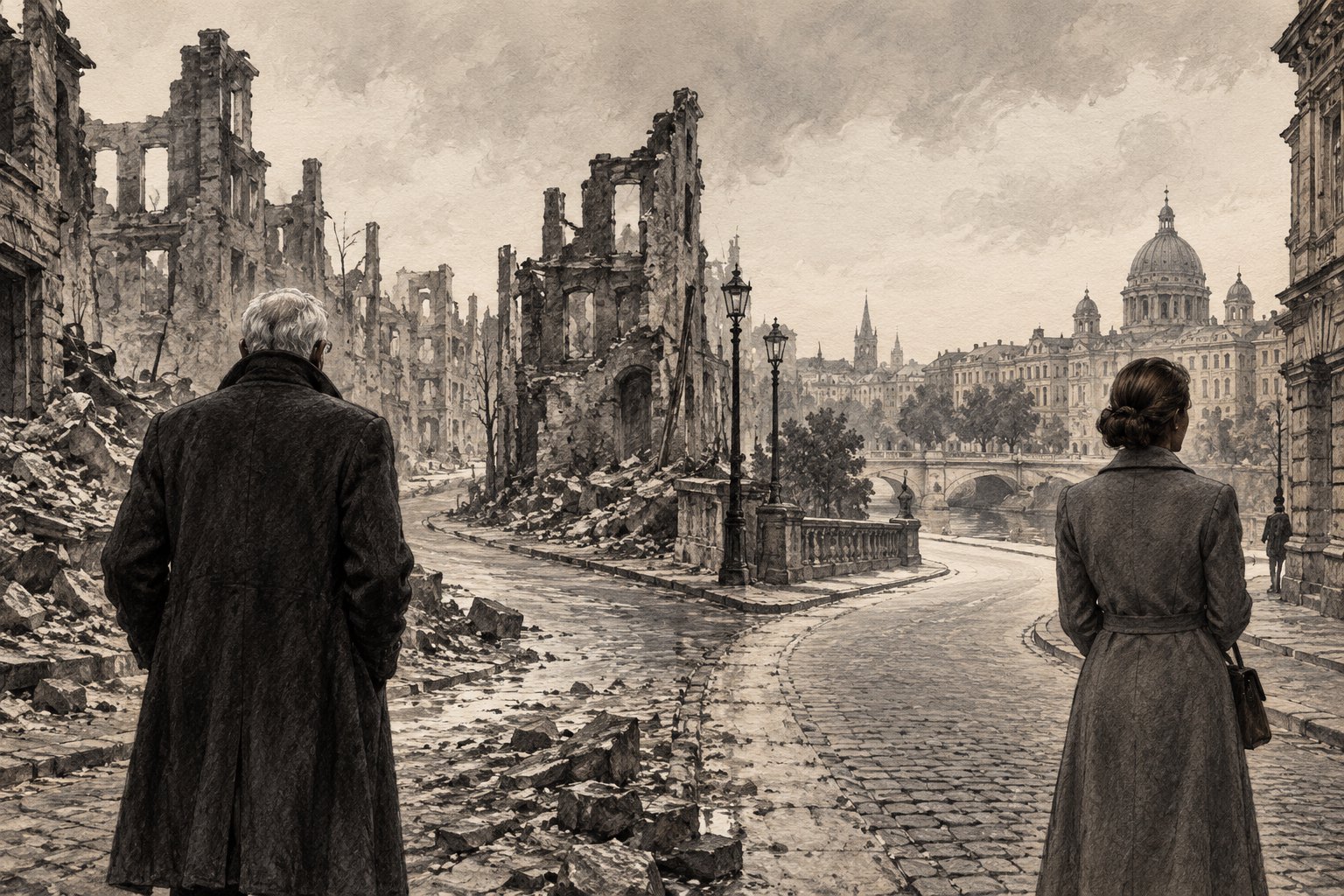
Paweł Pawlikowski’s Fatherland, the subject of his conversation with NPR’s Scott Simon, turns Thomas Mann’s return to Germany into a confrontation between public stature and private responsibility. The biographical drama follows the writer through a divided postwar homeland, accompanied in the film by his daughter Erika. Its central tension is immediately compelling: a man can speak eloquently about civilization while struggling to respond to the people closest to him.
Hanns Zischler plays Thomas, with Sandra Hüller as Erika and August Diehl as her brother Klaus. The following character analysis draws on documented story details and Pawlikowski’s interviews. It examines the film’s dramatic choices without treating its invented encounters as historical evidence.
Spoiler notice: The discussion includes Klaus’s death by suicide and its consequences for the father-daughter relationship.
A homecoming shaped into a family confrontation
The setting is 1949. Thomas travels through Germany to receive honors associated with Goethe, moving between Frankfurt and Weimar as competing political interests seek his approval. A celebrated exile’s presence carries meaning beyond anything he intends to say. Accepting hospitality, appearing before an audience, or crossing into another zone can become an endorsement in someone else’s account.
Pawlikowski makes a consequential alteration to the historical journey: Thomas traveled with his wife, whereas Fatherland places Erika beside him. The director has also explained that he brings events together that occurred at different times. The family crisis belongs to this constructed dramatic chronology.
That distinction changes how the movie should be read. Its father-daughter pairing creates an argument about dependence, authority, and emotional obligation. It should not become evidence that these exact conversations happened. As in our discussion of who gets to shape another person’s story, the persuasive force of a portrayal and its historical accuracy remain separate questions.
Thomas Mann: cultural conviction and emotional retreat
“Literature knows no zones,” Thomas declares. The line crystallizes his claim that German culture cannot be reduced to the political divisions governing German territory. There is courage in that position: he refuses to surrender a shared intellectual inheritance to whichever authority happens to control an audience.
Yet the same conviction invites a more uncomfortable reading. If literature exists above borders, can its representative also imagine himself above ordinary demands? The film’s family relationships test whether cultural seriousness enlarges Thomas’s capacity for care or gives him somewhere dignified to hide.
My reading is that the character becomes most interesting when those possibilities coexist. His attachment to art need not be fraudulent for it to provide an escape. Someone can sincerely believe in humane ideals and still disappoint a grieving daughter. Reducing him to a hypocrite would make the contradiction easier to dismiss.
Watch the distinction between what Thomas can express publicly and what he can acknowledge privately. A prepared speech offers structure, precedent, and control. Another person’s pain offers none of those protections. His professional authority therefore becomes a poor guide to his emotional competence.
Erika: the daughter who keeps the public figure functioning
Erika accompanies her father as both family member and practical support. The film gives her tasks that sustain his public appearance, including helping with his speeches and personal care. Those details make an unequal relationship visible without requiring a declaration about it.
From her perspective, the journey has two schedules. One consists of ceremonies, travel, and obligations. The other consists of feelings that cannot be made convenient for those appointments. Her father’s reputation gives the first schedule an authority the second struggles to acquire.
This is where a character-focused reading should resist treating Erika merely as the person who exposes Thomas’s faults. Her attachment to Klaus gives her an emotional world beyond her father. Her loyalty, anger, and exhaustion deserve attention as experiences in themselves, rather than clues to the psychology of a famous man.
Hüller’s role also provides a useful reminder of why an acting achievement is best understood through a character’s choices. Here, the revealing question is when assistance remains an expression of love and when it becomes an obligation Erika can no longer bear.

Klaus and the question that public honors cannot answer
The opening telephone conversation between Erika and Klaus establishes a different measure of value from the ceremonies awaiting Thomas. Discussing that scene, Pawlikowski cites Klaus asking, “When was the last time you really felt anything”. The question challenges a life measured by accomplishment, reputation, and dutiful activity.
Klaus’s death subsequently changes the meaning of the journey. For Erika, continuing cannot simply mean completing the itinerary. The ordinary machinery of travel and recognition now operates beside an absence it cannot address.
It would be reductive to turn this tragedy into a simple accusation that Thomas’s parenting explains everything. The more responsible interpretation concerns the survivors: what they recognize, what they suppress, and what they can offer each other afterward.
In an Associated Press interview, Pawlikowski described replacing a more elaborate exchange with a scene in which Erika opens a window and shouts toward the street. That choice gives grief an action rather than an explanation. Read through her character, the outburst suggests the unbearable friction between an inner catastrophe and a world continuing at its usual volume.
What the film’s restraint makes possible—and what it risks
Fatherland uses black-and-white photography and a compact frame, continuing formal interests familiar from Pawlikowski’s Ida and Cold War. In his discussion with The Film Stage, the director describes performances working within precisely arranged shots. That approach makes placement, duration, and small changes in behavior especially consequential.
The potential strength is concentration. When the image does not continually redirect attention, viewers can study the distance between characters and decide what a silence contains. Emotional interpretation becomes part of watching.
The risk is that formal beauty can make historical devastation feel too orderly. An elegant image of damage does not automatically explain the lives behind it. Likewise, compression can make a complicated person seem defined by a few decisive failures. These are useful pressures to bring to the film, even while appreciating the clarity of its central relationship.
The deeper meaning of Fatherland
The title brings country and parent into the same word. Both can promise belonging; both can demand loyalty while withholding recognition. Erika’s position beside Thomas makes that overlap especially painful. She can accompany her father without feeling emotionally met by him, just as returning to Germany does not guarantee that he has recovered a home.
For me, the richest interpretation concerns the limits of substitution. Cultural achievement cannot substitute for tenderness. Public recognition cannot substitute for reconciliation. A journey across a familiar landscape cannot substitute for the feeling of being welcomed.
That does not make art worthless. It makes its value more specific. Literature can preserve possibilities that politics tries to close down, while remaining unable to perform the intimate work its admirers avoid. Fatherland becomes most compelling at that boundary: where a great writer’s language reaches its limit and his daughter still needs an answer.
Original content by this site's editorial team. Published: October 31, 2026 at 06:40:11 PDT (Los Angeles time)