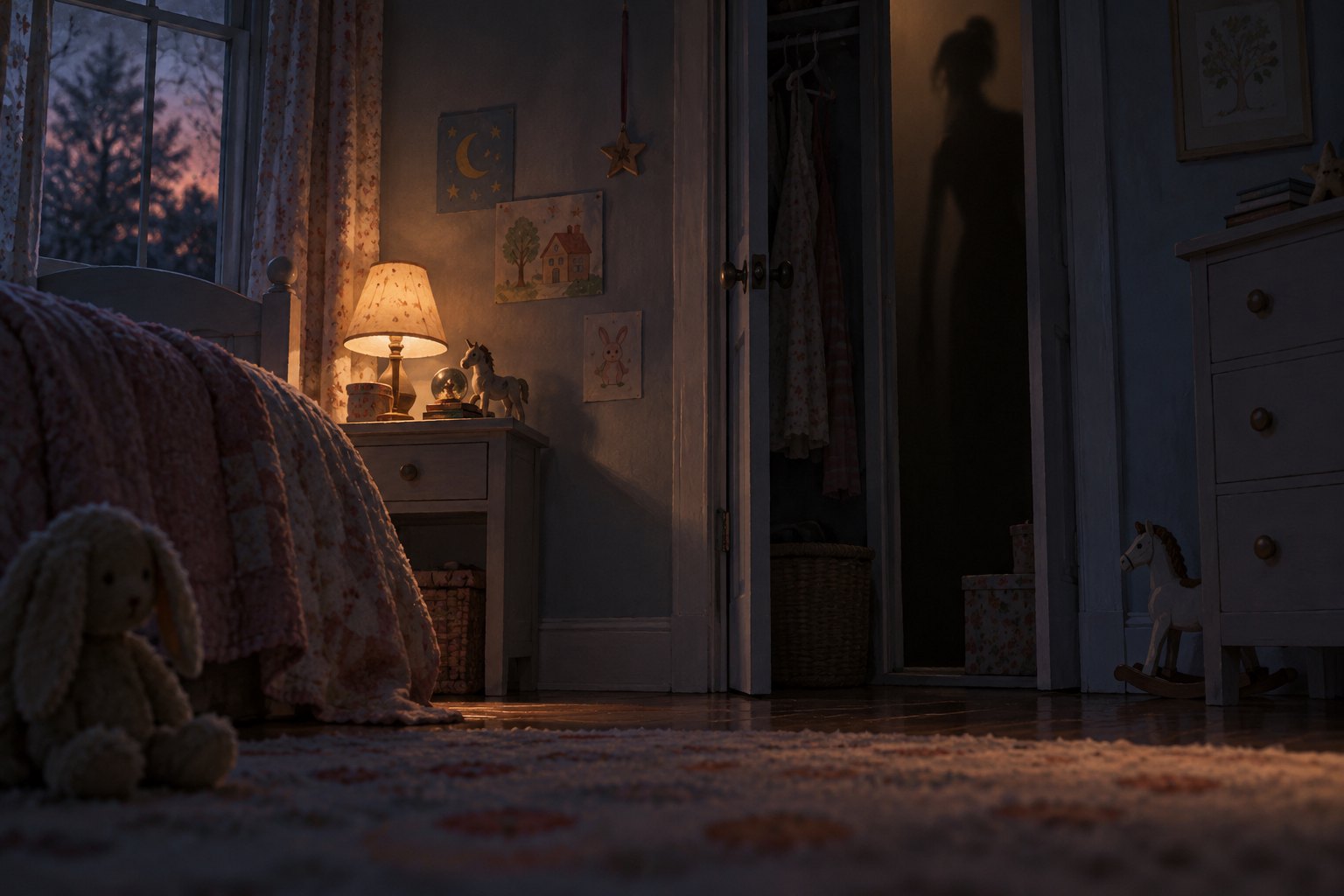
Other Mommy won the North American box office weekend with an estimated $27.5 million, while The Social Reckoning debuted with $5.5 million, according to Sunday’s Associated Press report carried by ABC News. That gives the horror film a five-to-one advantage in opening receipts. It does not establish a five-to-one advantage in quality, audience satisfaction, or staying power.
The more interesting question is what Other Mommy offers beneath that commercial victory. Its central threat is immediately understandable: a child encounters something dangerous wearing the face of someone she should be able to trust. Reading the film through that child’s predicament reveals a more substantial subject than the weekend’s winner-and-loser framing allows.
Spoiler note: The following analysis discusses the premise, family relationships, and an early supernatural encounter described in published reviews. It does not reveal the ending. Critical interpretations draw on those documented details rather than a firsthand screening assessment.
What the opening weekend actually tells us
The reported figures are estimates for the weekend of October 9–11, 2026. Their clearest meaning is straightforward: Other Mommy generated substantially more initial ticket revenue than The Social Reckoning. The numbers alone cannot explain each customer’s decision or tell us how satisfied those customers were afterward.
That distinction matters particularly here. The box office reporting describes a commercially strong start for Other Mommy alongside poor critical and audience reception. Buying a ticket expresses interest before the experience; recommending the movie expresses a judgment after it. Those are different stages of a film’s relationship with its audience.
One plausible interpretation is that this horror premise presents an especially direct theatrical invitation. A familiar face becomes frightening, and viewers can anticipate an immediate emotional experience. That is an interpretation of the film’s appeal, however, rather than a demonstrated explanation for the entire revenue gap.
Bela’s problem is recognizing safety
Rob Savage’s Other Mommy, adapted by Nathan Elston from Josh Malerman’s Incidents Around the House, centers on Bela, played by Arabella Olivia Clark. Jessica Chastain plays both her mother, Ursula, and the entity resembling her. The official film description establishes that Bela forms a relationship with this sinister presence inside her home.
From Bela’s perspective, resemblance complicates the task of recognizing danger. Children learn safety through repetition: a familiar voice, a face, a person who returns. A creature that copies a parent interferes with those basic signals. Bela must evaluate behavior when appearance can no longer provide a dependable answer.
My reading is that this gives the premise its strongest emotional foundation. Bela’s vulnerability does not require her to behave foolishly. She faces a situation in which an ordinary, necessary habit—trusting familiarity—has become unreliable. The monster exploits a relationship that existed before it arrived.
This is also why the child’s perspective deserves more attention than the creature’s design alone. As explored in our commentary on why perspective matters in The Babysitter adaptation, suspense becomes more specific when it grows from what a character can understand and what they feel responsible for protecting.
The question that makes affection threatening
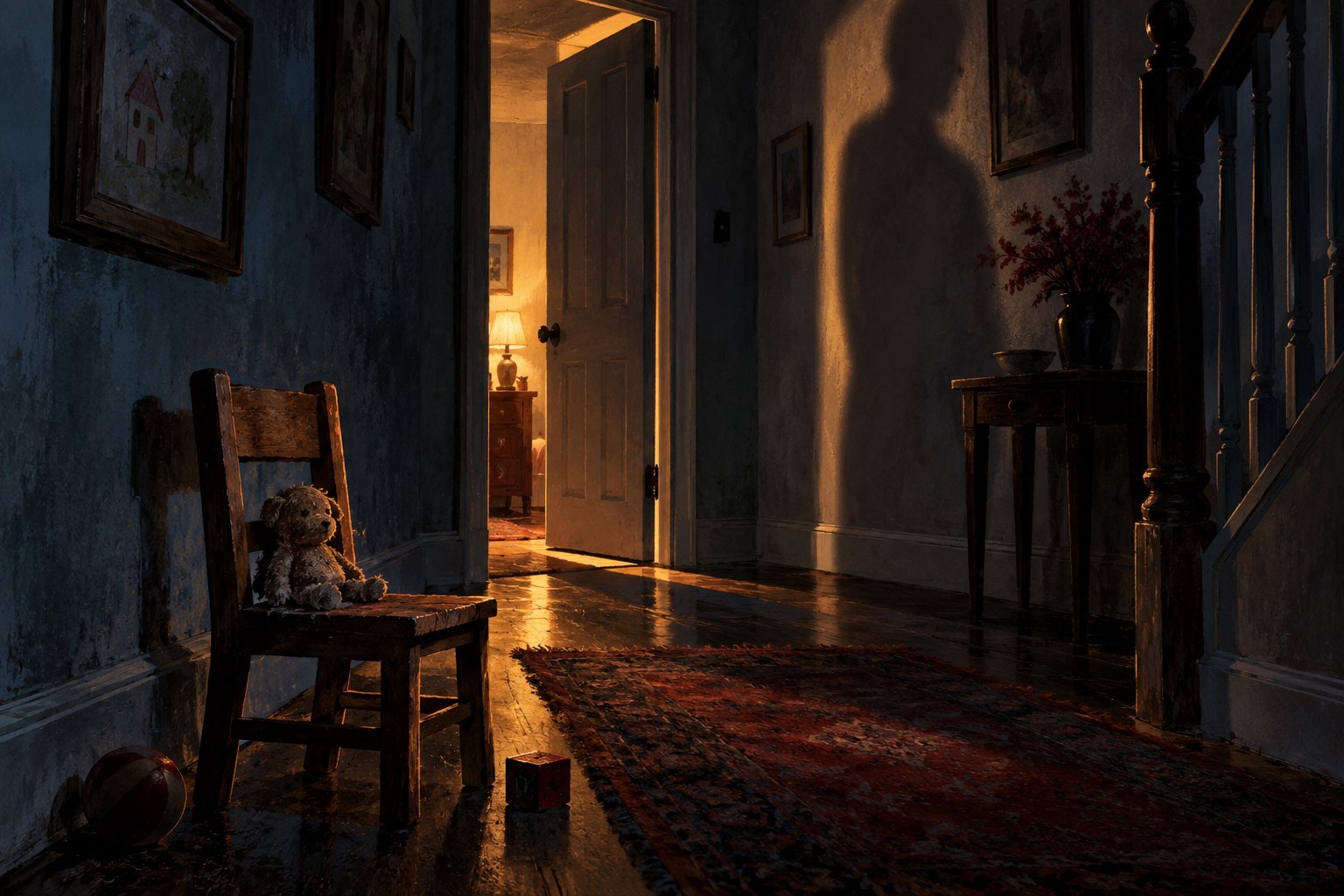
“Can I go inside your heart?” is the question featured in the film’s official promotional materials. Its effectiveness begins with the collision between affectionate language and an invasive request.
A heart usually suggests love or attachment. Here, the wording also suggests an interior space that someone else wants to occupy. The sentence asks Bela to treat access to herself as a gesture of kindness. That makes the threat more intimate than a monster merely forcing open a door.
Read through Bela’s position, the question creates a disturbing imbalance. The speaker borrows the emotional authority of a mother while placing responsibility for the next step on a child. A request can sound gentle while still carrying pressure. Politeness offers no guarantee that the person asking will respect the answer.
This is the line’s most useful interpretive function: it makes the audience listen for the difference between an expression of love and a demand for possession. The horror depends on how easily those two things can share a vocabulary.
Ursula should remain a person beneath the double
Chastain’s dual casting puts the human mother and the supernatural imitation in direct visual relation. That choice creates a productive question: which aspects of familiarity survive when the intentions behind them change?
It also creates a critical hazard. In his review for TheWrap, William Bibbiani describes a household with a working mother and a father who stays home, and questions the tendency to frame the mother’s employment as a failing. That observation deserves consideration without turning it into a complete verdict on Ursula.
From a child’s viewpoint, a parent’s absence can hurt regardless of its practical explanation. From an adult viewpoint, earning a living does not establish emotional indifference. A thoughtful reading should hold both perspectives together. Bela’s feelings matter, but they need not become an exhaustive judgment of her mother.
The double is therefore most interesting as a distortion of a relationship. Treating it as proof that an imperfect mother is inherently monstrous would flatten the human tension that makes the resemblance disturbing.
When the adults see the threat
Published reviews describe an early encounter in which Bela’s father, Russell, played by Jay Duplass, also sees the entity. That development changes the dramatic question. The family cannot sustain its sense of normality simply by treating the child’s experience as imaginary.
For Russell, recognition brings responsibility without supplying expertise. Seeing that Bela faces something real does not automatically reveal how to protect her. This creates an unsettling version of parental helplessness: an adult can take a child seriously and still lack an effective response.
It also changes how viewers should assess the story’s progression. Once disbelief is removed, further encounters need to develop the family’s choices, relationships, or understanding. More evidence of the creature’s existence accomplishes less because that question has already been answered.
Why The Social Reckoning’s smaller debut needs a separate judgment
The Social Reckoning enters this conversation because of its $5.5 million opening, but that result cannot serve as a substitute for criticism. The AP report identifies Aaron Sorkin’s film as a drama about a Facebook whistleblower and a journalist. Its commercial performance tells us about its initial theatrical reach, not whether its account of institutional responsibility is persuasive.
The comparison is useful when it prompts questions about how films turn abstract concerns into personal stakes. A family horror story can embody mistrust in a face. A whistleblower drama must make knowledge, disclosure, and consequences dramatically tangible. Each still needs characters whose decisions matter.
Our discussion of human judgment and technological ambition in Artificial examines a related challenge: a consequential subject becomes compelling cinema through the people navigating it. Relevance creates an opportunity for drama; characterization determines what that opportunity becomes.
The deeper conflict is over the right to refuse
The strongest interpretation of Other Mommy begins with Bela’s ownership of herself. A child can want reassurance without granting someone unlimited access. She can recognize a familiar face without owing it obedience. The creature’s request makes those distinctions frighteningly urgent.
Returning to “Can I go inside your heart?” brings the film’s commercial hook and emotional premise together. The sentence is easy to remember because its tenderness is inseparable from its threat. Whether the finished film develops that tension satisfactorily remains a critical question that opening receipts cannot answer.
The $27.5 million weekend establishes that Other Mommy attracted attention. Its more lasting claim on that attention lies in an uncomfortable idea: learning whom to trust also means learning that love should leave room for refusal.
Original content by this site's editorial team. Published: October 11, 2026 at 22:25:16 PDT (Los Angeles time)