A new Optimus Prime short and The Transformers: The Movie are set for a special Black Friday event on YouTube, according to Animation Magazine’s announcement. The pairing invites an unusually pointed holiday rewatch: a celebration of the franchise’s defining hero alongside a film that asks its audience to imagine life without him. [Animation Magazine’s event announcement](https://www.animationmagazine.net/2026/11/new-optimus-prime-short-the-transformers-the-movie-set-for-special-youtube-event-on-black-friday/)
The event news establishes the pairing, but this article does not assume a start time, regional availability, or replay window. Check the event listing before arranging a watch party. For viewers also considering an outing, our guide to finding the right Thanksgiving movie screening explains which scheduling details deserve a second look.
Major spoilers follow for the 1986 film, including Optimus Prime’s fate and the ending. The discussion of the new short is limited to its announced inclusion.
Optimus Prime wins the battle and leaves an impossible vacancy
The most consequential thing The Transformers: The Movie does is make victory insufficient. Optimus Prime confronts Megatron during the attack on Autobot City, helps turn the battle, and nevertheless suffers fatal wounds. His strength cannot guarantee his survival. For an adventure built around powerful machines, that limitation is a startling source of vulnerability.
“One shall stand, one shall fall” sounds like a promise of clean resolution. The confrontation produces something messier: the enemy retreats, but the community loses the figure who made survival feel possible. The difference between winning an encounter and preserving a world becomes the film’s emotional foundation.
My reading is that Prime’s death works because it changes the meaning of every subsequent emergency. Before it, a crisis can still suggest that someone competent will arrive. Afterward, the Autobots must act without that reassurance. Prime becomes more influential through absence, because everyone else’s decisions expose the gap he leaves.
The deathbed scene also complicates his authority. He names Ultra Magnus as his successor, yet the film’s eventual solution lies elsewhere. Prime can offer judgment and hope; he cannot provide his followers with a complete instruction manual. That makes his legacy something they must interpret.
Hot Rod’s mistake is not his entire identity
Hot Rod intervenes in the confrontation with Megatron and becomes a hostage, obstructing Prime at a crucial moment. The action gives the younger Autobot a painful place in the catastrophe. But treating him simply as the character who got Optimus killed misses the distinction between a disastrous intervention and the villain’s deliberate violence.
Hot Rod wants to help. His problem is that urgency outruns judgment. That is a useful starting point for a successor because it separates courage from readiness: he already possesses the impulse to act, while lacking the experience to understand what an action will cost.
The film does not develop this into an extended psychological study. Its pace leaves relatively little room for sustained mourning or explicit self-examination. That is a real limitation. A viewer looking for a carefully articulated recovery from guilt will have to supply connections the screenplay only suggests.
Still, the ending gains force from the contrast. When Hot Rod becomes Rodimus Prime, the inexperienced character is not erased from the story. His earlier failure remains part of the history that makes the transformation meaningful. “Arise, Rodimus Prime” can be heard as recognition that a person is larger than his worst intervention. The film’s dialogue and sequence of events support that contrast, even if the emotional development between them is compressed. [Film dialogue transcript](https://www.springfieldspringfield.co.uk/movie_script.php?movie=the-transformers-the-movie)
Ultra Magnus makes succession feel like a burden
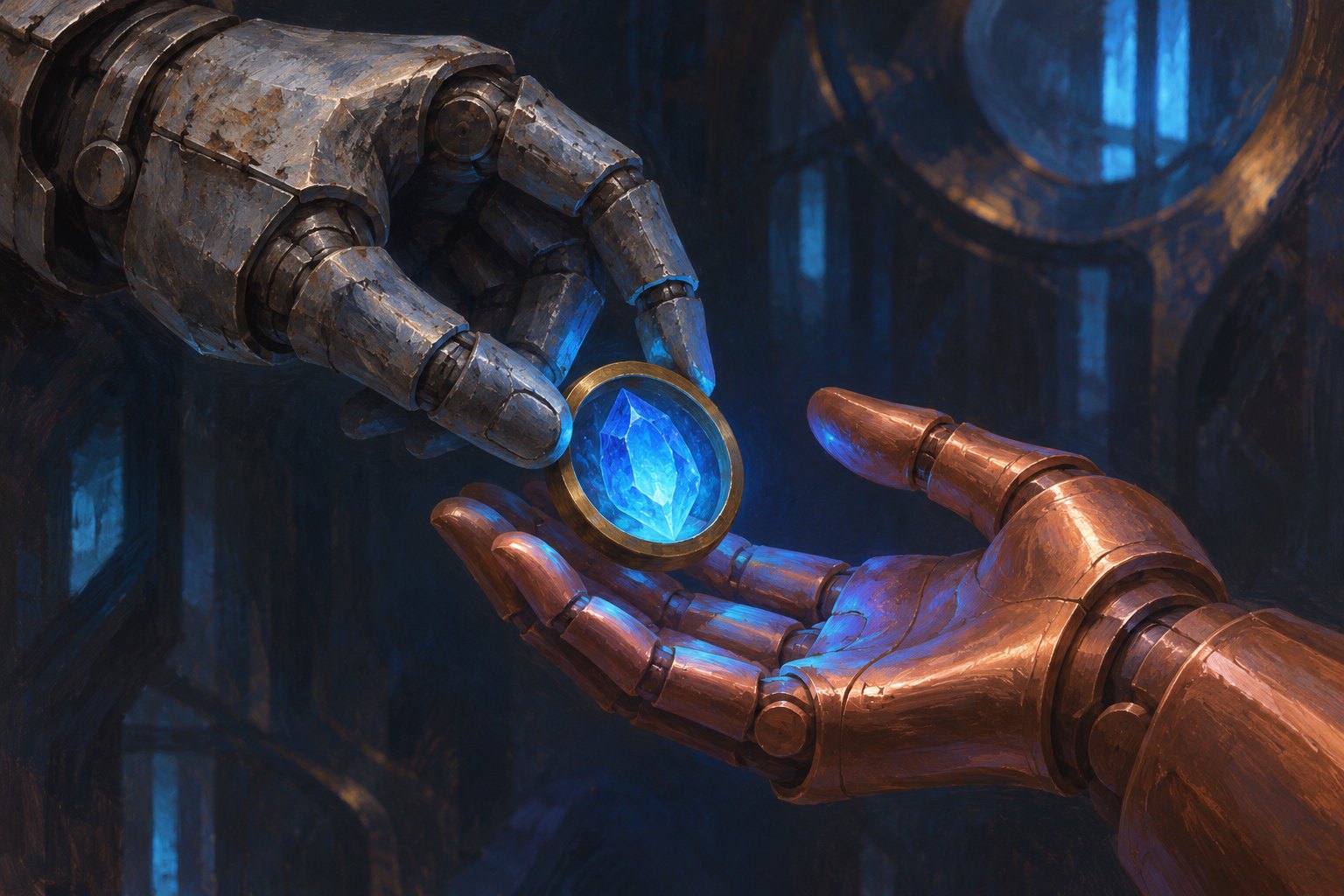
Ultra Magnus is especially interesting because he does not treat leadership as a prize. His uncertainty when Prime entrusts him with the Matrix distinguishes him from characters who assume power proves their superiority.
His inability to open the Matrix later is often easy to read as a simple rejection. I find it more compelling as the film’s clearest separation of appointment from destiny. Magnus receives legitimate responsibility, attempts to fulfill it, and discovers that possession of the symbol does not make him the person who can unlock its power.
That does not render his service meaningless. Organizations need people who keep others moving through danger, not only the exceptional figure who resolves the final crisis. The movie gives its greatest visual reward to transformation, but Magnus represents the less glamorous work of carrying responsibility before certainty arrives.
Galvatron receives power at the price of freedom
The villains offer a dark parallel. After the wounded Megatron is abandoned in space, Unicron remakes him as Galvatron. The new body brings renewed destructive capacity and a master whose demands cannot be ignored. Meanwhile, Hot Rod’s eventual transformation gives the Autobots a new leader. Both sides change, but the relationships behind those changes differ profoundly. [Film plot overview](https://en.wikipedia.org/wiki/The_Transformers:_The_Movie)
Viewed through Galvatron’s perspective, survival becomes humiliating dependence. He wants the advantages of Unicron’s intervention without accepting subordination. His predicament turns the familiar fantasy of becoming stronger into a trap: increased force does not necessarily create increased agency.
This contrast sharpens Prime’s legacy. One model of authority creates successors; the other creates instruments. Prime’s followers must learn to function beyond him, while Unicron demands obedience to his continuing appetite. The conflict becomes more interesting when read as a struggle over what power permits other people to become.
The spectacle is exhilarating, but grief gets crowded out
As a movie, this is an uneven mixture of loss, frantic adventure, grotesque threats, and comedy. Its rapid movement gives the universe an appealingly excessive scale. There is always another strange place or personality beyond the immediate battlefield.
That abundance also works against emotional continuity. The film can make a death feel momentous and then hurry into the next attraction before the survivors have absorbed it. Some supporting characters register more strongly as designs or comic rhythms than as people with sustained inner lives.
For me, the movie remains compelling because its central emotional structure survives that overcrowding. The viewer keeps measuring the new adventure against the security that disappeared with Prime. The spectacle supplies momentum; the vacancy supplies meaning.
Presentation can change how those qualities land. A shared viewing event may amplify the communal response, while a quiet rewatch makes the abrupt tonal changes easier to notice. Our discussion of how presentation shapes a film’s reception explores why the viewing setting deserves consideration alongside the title itself.
The ending turns remembrance into responsibility
“Till all are one” gives the film a collective aspiration beyond its individual duels. Against Unicron’s consumption and the villains’ struggles for dominance, the phrase imagines belonging without reducing everyone to a possession.
The Matrix embodies that possibility. Its importance is not exhausted by its usefulness against a threat. As an inherited object, it connects the living to predecessors while demanding action in the present. Memory becomes valuable because somebody does something with it.
That is why the Black Friday pairing has critical interest beyond nostalgia. A new short centered on Optimus Prime can invite renewed attention to the hero; the feature asks what his influence means when others must carry it. Whether the short deepens that tension requires judging the short itself.
The enduring achievement of The Transformers: The Movie is its willingness to make admiration uncomfortable. Loving a leader does not remove the need to outlive his protection. Hot Rod’s final transformation offers the film’s hopeful answer: honoring Optimus means accepting responsibility for a future he cannot personally secure.
Original content by this site's editorial team. Published: November 26, 2026 at 03:18:14 PST (Los Angeles time)