Once Upon a Time in Harlem has been awarded the eighth annual Library of Congress Lavine/Ken Burns Prize for Film. The recognition brings fresh attention to a documentary whose central attraction is wonderfully human: artists and intellectuals gathering to discuss a cultural movement they helped shape, with different memories of what happened and different ideas about what it meant.
The award offers a reason to discover the film. Its people offer a reason to stay interested. Behind the historical importance lies a more intimate question: what happens when the people who become someone else’s history get a chance to argue back?
Critical commentary: The analysis below draws on documented scenes and filmmakers’ accounts, rather than a firsthand screening. It includes discussion of conversations and the closing montage.
A reunion gives history a human scale
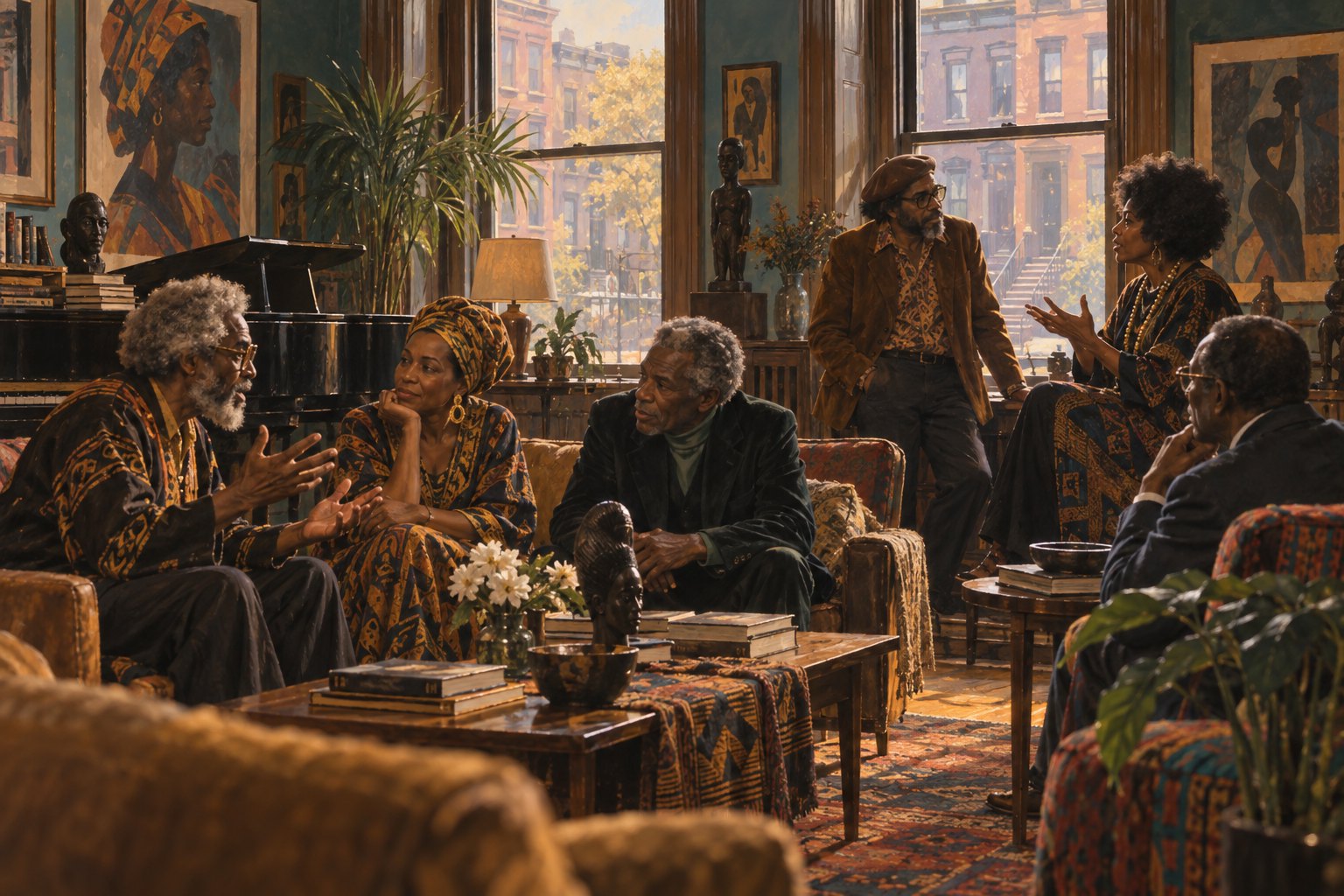
The documentary centers on a gathering William Greaves organized in 1972 at Duke Ellington’s Harlem home. Its participants include artists, writers, musicians, and other figures associated with the Harlem Renaissance. William’s son David, who worked behind a camera at the gathering, subsequently brought the project to completion.
That premise changes the usual relationship between historical subject and audience. These people are meeting one another as well as addressing a camera. A recollection has listeners who may remember things differently. An assertion can encounter resistance before it becomes the authoritative version of events.
For character-centered criticism, this is fertile territory. The participants are real people, not scripted characters, but their competing priorities create dramatic stakes. Some want recognition for overlooked contributions. Others want to define the movement’s artistic purpose. Still others worry about whether anyone younger will care.
My reading of this structure is that its value lies in preserving those differences. A cultural movement becomes easier to understand when its members are allowed to have incompatible views. Agreement can establish a shared position; disagreement reveals what each person believes is worth defending.
Arna Bontemps and the freedom to speak for yourself
In a conversation with Hammer to Nail, David Greaves identifies a moment in which Arna Bontemps invokes Langston Hughes: “we young artists came to be ourselves and speak in our own voice.” It is a compact statement of artistic independence, and a useful starting point for understanding the film’s concerns.
Consider the emphasis on “ourselves.” It claims room for individual expression within a collective cultural awakening. Artists can participate in a shared struggle without agreeing on a style, a political position, or an appropriate audience. The freedom being asserted includes the freedom to be difficult to categorize.
From Bontemps’s perspective, remembering the Renaissance means remembering an ambition. A list of achievements can tell us what survived. His formulation asks us to consider what making those works allowed their creators to become.
This also suggests a productive way to watch the documentary: listen for differences in how people define artistic success. Recognition, self-expression, community, and independence can overlap, but they do not always pull in the same direction. The tensions between them give an apparently retrospective conversation present-tense urgency.
Leigh Whipper’s impatience makes inheritance uncomfortable
Another exchange documented in the same filmmaker interview concerns actor Leigh Whipper’s assessment of younger generations. His blunt response includes: “They don’t give a damn.” Richard B. Moore raises the possibility that the older generation has not sufficiently passed its knowledge along.
That contrast matters. Whipper’s frustration expresses the pain of feeling forgotten. Moore’s response introduces responsibility on the other side of the relationship. If knowledge has failed to travel, indifference may be only part of the explanation.
I find this the most compelling critical question raised by the documented discussion. People understandably want their work remembered, but inheritance requires opportunities to encounter that work. A younger audience cannot form a relationship with an artistic tradition through admonishment alone.
The film’s very existence gives this disagreement another dimension. Recording a conversation creates a possible route between generations. Completing and presenting that recording makes the route usable. The participants’ anxiety about remembrance therefore extends into the practical life of the documentary itself.
It also connects with the question of spectatorship explored in our commentary on NAZA and the responsibility of watching: attention has value, but what viewers do with that attention remains an open question.
Preserving the conversation means preserving choices
The International Documentary Association’s interview with David and producer Liani Greaves describes the importance of Louise Greaves’s work in keeping the project alive. That account gives the film’s preservation a personal dimension: its eventual audience depends on sustained effort across a family and its collaborators.
Preservation is also an artistic problem. Footage does not organize itself into a film. Selecting a response, determining how long a speaker remains on screen, and deciding where a conversation resumes all influence our understanding of the people involved.
For that reason, historical importance and cinematic effectiveness deserve separate consideration. An irreplaceable recording can still require difficult editorial decisions. The meaningful question is whether the finished structure gives viewers enough room to recognize distinct personalities and follow their competing ideas.
Audiences interested in that process may also appreciate our discussion of what filmmaker and performer appearances can add to festival viewing. Hearing how creative choices were made can sharpen a response without dictating it.
What the prize changes—and what viewers should consider
The Lavine/Ken Burns Prize gives Once Upon a Time in Harlem a prominent point of entry for audiences discovering it. The most useful response to that recognition is curiosity about the people on screen and the form through which we encounter them.
Three questions offer a practical viewing guide. Who gets to define the movement? Whose contribution needs another person to bring it into the discussion? And when the participants disagree, does the conversation expand our understanding of what they shared?
Those questions help avoid treating every participant as an interchangeable representative of an era. They also leave space for a measured judgment about the documentary’s accessibility. Viewers seeking a chronological introduction may want something different from viewers drawn to an extended encounter with personalities and memories.
The closing family detail deepens the film’s meaning
One small detail is especially revealing. In the International Documentary Association interview, Liani Greaves identifies herself as one of the children in the closing montage, pointing toward her father. It is a personal connection that many viewers would have no reason to recognize unaided.
That detail supports a deeper interpretation of the project. Cultural inheritance is often discussed abstractly, as something passed from one generation to another. Here, the people doing the passing are connected through actual relationships, recorded images, and later acts of care.
Read through that connection, Once Upon a Time in Harlem asks us to think beyond whether history has been saved. It asks whether history remains available for a new relationship. The prize recognizes the film publicly; its more intimate promise is the opportunity to listen to people whose ideas are still capable of provoking an answer.
Original content by this site's editorial team. Published: September 18, 2026 at 09:50:02 PDT (Los Angeles time)