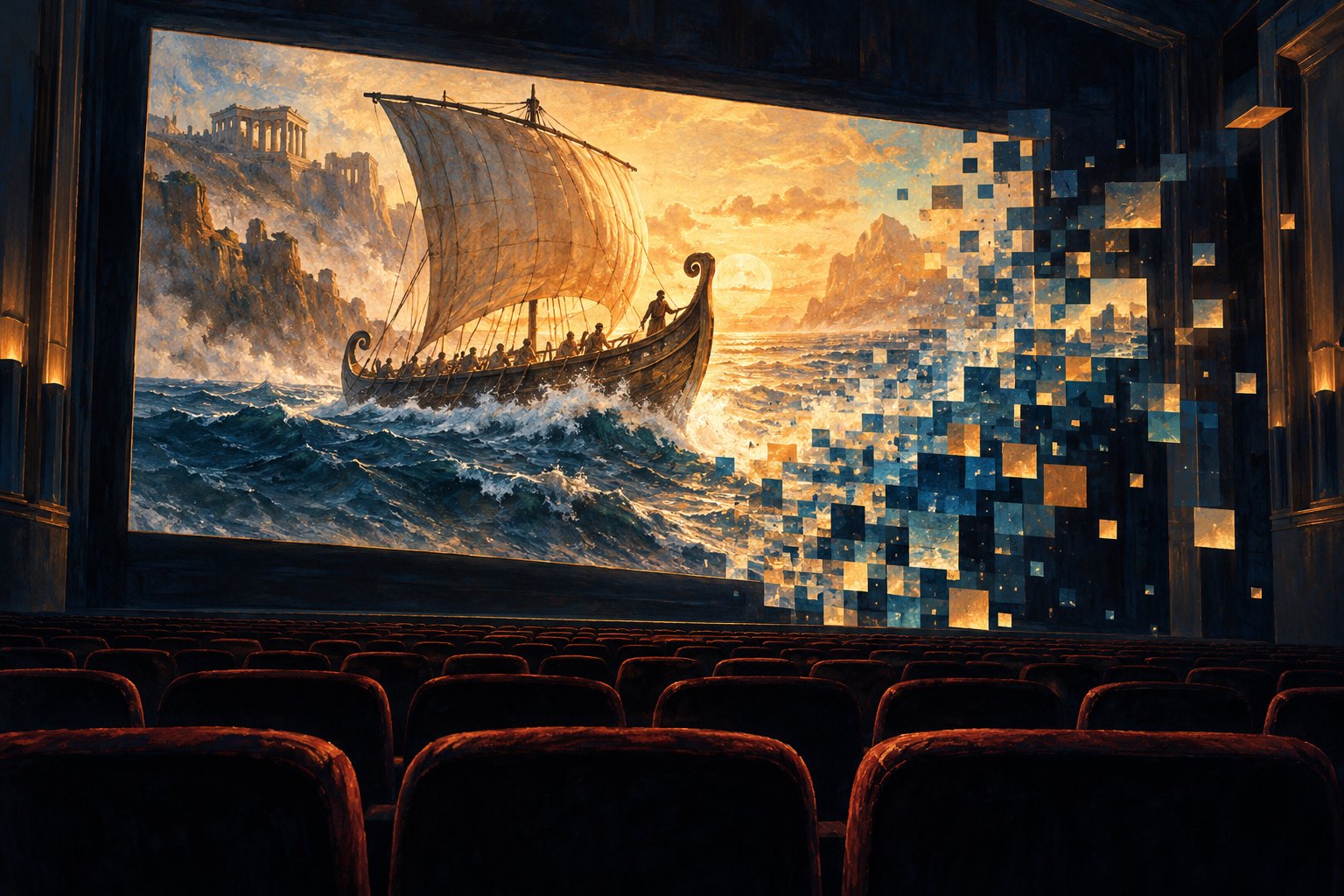
Elon Musk’s AI-made Odyssey has attracted harsh criticism, with The Guardian reporting reviewers’ unfavorable reactions. The most pointed comparison in its headline—“meaningless as a laptop screensaver”—frames the objection as something deeper than an unconvincing image. It suggests movement without dramatic purpose: pictures that occupy the eye without giving the viewer a reason to care.
That is a serious charge against any film, especially one carrying the name Odyssey. An epic promises more than scale. It asks us to follow someone through experiences that change what survival, loyalty, and belonging mean. The useful question behind this backlash is whether technological spectacle can sustain that investment.
This is criticism of the reported reception and the storytelling questions it raises, rather than a firsthand, scene-by-scene review. Specific dialogue, performances, and plot choices cannot responsibly be evaluated here as though independently witnessed. The distinction matters: a memorable insult can identify a critical problem, but it cannot establish every detail of a movie’s failure.
What the Screensaver Comparison Actually Criticizes
A screensaver can be beautiful. Its colors may be carefully balanced, its movement fluid, its composition absorbing. What it generally lacks is consequence. One configuration replaces another without changing anything that matters to a person within it.
In dramatic filmmaking, a similar-looking movement can carry enormous weight. A figure crossing a room might be approaching reconciliation, walking into danger, or abandoning someone. The action becomes meaningful through what the audience understands about the person moving and the person waiting.
Read this way, the criticism surrounding Musk’s Odyssey concerns the relationship between images. Does one moment alter how we understand the next? Does a face register something specific? Does a departure leave an emotional absence? These questions are more revealing than whether an isolated frame looks expensive.
They also require evidence. A fair negative review should locate the moment when an intention becomes unclear, a reaction feels unearned, or an edit disconnects action from consequence. Otherwise, even a sharp comparison risks becoming an attractive substitute for analysis—the very problem it accuses the film of having.
Character Is Where an Epic Earns Its Scale
The title Odyssey brings expectations of travel, adversity, and a relationship to home. Those expectations create an opportunity for character-driven cinema, but they do not automatically provide it. Recognizing an epic framework is different from becoming invested in a particular telling.
From a protagonist’s perspective, distance should mean something personal. A dangerous crossing becomes compelling when we understand what the traveler risks losing, what makes retreat tempting, and why continuing has become necessary. Geography supplies the obstacle; character supplies its importance.
That distinction is particularly useful when approaching the reception of an AI-made adaptation. It redirects attention from the machinery behind the image toward the experience inside the story. The relevant test is whether the central figure appears to want, fear, misjudge, and reconsider specific things—not simply whether that figure remains visually recognizable.

Supporting characters need comparable attention. Someone awaiting a traveler’s return should possess desires beyond making the journey seem important. A companion should have a reason to follow that can survive scrutiny. When relationships contain competing needs, an epic acquires pressure that no landscape can supply.
These are evaluative standards, not claims about particular scenes in Musk’s film. They help explain why the reported accusation of emptiness matters: an adaptation can display the recognizable ingredients of a story while leaving their emotional relationships undeveloped.
Why Dialogue Needs More Than Memorable Words
Quoting a film’s strongest lines can illuminate character, but only when the wording and context are verified. No unverified dialogue belongs in a review of this project. More fundamentally, a line becomes memorable through the situation that makes speaking it difficult.
A declaration of loyalty has little force if loyalty has never been tested. A promise becomes dramatic when keeping it threatens another obligation. Even an ordinary acknowledgment can become devastating if the audience understands what a character has finally accepted.
Voice, timing, and response complete that meaning. A pause can suggest calculation or shame. Another character’s refusal to answer can change an apparent victory into a humiliation. Whether dialogue is recorded, synthesized, or otherwise constructed, the finished scene must communicate these relationships.
Our guide to how images and sound reveal character beyond dialogue develops this distinction. The same principle applies here: an audience should not need an explanatory speech to understand every emotional turn.
AI Is Relevant, but It Does Not Replace Film Criticism
The production method is central to this controversy. Nevertheless, treating the label “AI-made” as a complete aesthetic verdict would make criticism less useful. It would leave unexplained which artistic decisions succeeded, which failed, and how those decisions affected the viewer.
The reverse argument is equally weak. Technical novelty does not earn a film immunity from ordinary dramatic expectations. A difficult production process can be interesting without making its results moving. Viewers are entitled to judge the experience presented to them.
My view is that the strongest standard is specific and consistent: assess whether framing directs attention, whether editing develops relationships, and whether sound deepens the action. Apply that standard to an elaborate studio production, a modest independent film, or an experiment with generative tools.
Scale creates a related temptation in adaptations generally. Our discussion of why ambitious fantasy needs a compelling human perspective considers how expansive worlds can overwhelm the people who give them meaning. The Odyssey controversy sharpens that same concern around technological spectacle.
What Viewers Should Take From the Backlash
The reported negative reception gives prospective viewers useful context, but it should not dictate what they are allowed to notice. Agreement with a critic becomes more meaningful when it rests on an observable choice rather than a borrowed phrase.
For anyone evaluating the film, three questions provide a practical starting point:
- Can you describe what a character wants beyond completing the next visible action?
- Does a major event change a relationship, belief, or decision?
- Do the images and voices communicate those changes without requiring you to invent missing motivation?
These questions also leave room for a mixed response. A passage might be visually persuasive while dramatically thin. An experiment might contain an effective moment without sustaining a complete sequence. Precision makes room for those distinctions.
The Deeper Issue: Making a Journey Matter
The most productive interpretation of this controversy concerns attention. Spectacle attracts it; drama gives it somewhere to go. A viewer can admire the surface of an image while remaining entirely detached from the person inside it.
For an Odyssey, the deeper artistic challenge is to make distance measurable in human terms: attachment, regret, responsibility, and the possibility of change. The reported backlash against Musk’s version raises that challenge forcefully, even if a headline cannot settle the film’s merits.
A meaningful epic makes its audience understand why arriving matters—and why the person who arrives cannot experience home exactly as before. That is the standard worth defending when the argument moves beyond the spectacle of the technology itself.
Original content by this site's editorial team. Published: October 27, 2026 at 13:32:06 PDT (Los Angeles time)