
Moonlight reaches its tenth anniversary with its most radical achievement intact: it makes a quiet Black gay man’s emotional life feel worthy of sustained, beautiful, undivided attention. Barry Jenkins gives Chiron’s hesitations the dramatic weight other movies reserve for declarations. A glance can change a relationship; accepting a meal can become an act of trust.
The film’s public impact has a concrete marker: its Best Picture victory at the 2017 Academy Awards, alongside wins for supporting actor Mahershala Ali and adapted screenplay. Its continuing artistic importance, in this reading, lies in the intimacy behind that recognition. It asks audiences to stay with a person who has learned that being noticed can be dangerous. [The Academy’s 2017 awards record](https://www.oscars.org/oscars/ceremonies/2017) confirms those wins.
Spoiler warning: This review discusses the complete story, including Chiron and Kevin’s reunion and the final image.
Three chapters make identity feel unfinished
Written and directed by Jenkins from Tarell Alvin McCraney’s work, the 2016 film divides Chiron’s life into three chapters: Little, Chiron, and Black. Alex Hibbert, Ashton Sanders, and Trevante Rhodes portray him across childhood, adolescence, and adulthood. Those changes in performer give the structure its expressive force. Each new body initially requires us to look again. [A24’s film credits and synopsis](https://a24films.com/films/moonlight) establish the film’s principal creative credits and three-part premise.
The continuity emerges through watchfulness. Hibbert seems to measure the safety of every room. Sanders makes exposure physically uncomfortable, his posture suggesting someone who would disappear if he could. Rhodes presents an imposing adult whose careful pauses still carry the younger characters’ uncertainty.
For me, this is the movie’s finest formal decision. Chiron cannot be reduced to a childhood explanation followed by predictable consequences. The missing years leave room for experiences we never see. We recognize him without possessing a complete account of him, which is also how knowing another person usually works.
Little: Juan offers safety he cannot fully guarantee
As a child, Chiron finds protection with Juan, a drug dealer played by Ali, and Juan’s partner Teresa, played by Janelle Monáe. Juan’s swimming lesson becomes the first chapter’s defining image: an adult’s strength makes it possible for a frightened child to relax.
The scene treats dependence as something dignified. Learning to float requires Chiron to surrender control temporarily, trusting that another person will support him. That physical experience gives substance to the affection Juan offers. Care has to become something the boy can feel.
Juan also carries a devastating contradiction. His livelihood connects him to the drug use damaging Chiron’s home. The man capable of nurturing the child participates in the conditions that hurt him. Ali’s warmth makes this conflict harder to dismiss: Chiron’s attachment is understandable, and so is his disillusionment.
Juan’s recollection that “black boys look blue” introduces a gentler way of seeing. The words allow Blackness to hold surprise, beauty, and changing light. They also establish a question that will follow Chiron: how much of a person becomes visible only when the surroundings change? The phrase appears in Jenkins’s [shooting screenplay](https://www.dailyscript.com/scripts/MOONLIGHT.pdf).
Chiron: intimacy makes betrayal hurt differently
The adolescent chapter puts Chiron’s desire beside the social machinery that punishes it. His encounter with Kevin on the beach briefly creates a space where closeness feels possible. At school, Kevin subsequently participates in the violence against him. Chiron retaliates against the bully Terrel with a chair and is arrested. These are the central turns of the film’s middle chapter, documented in its [plot synopsis](https://en.wikipedia.org/wiki/Moonlight_(2016_film)).
From Chiron’s perspective, the betrayal threatens more than his confidence in one friend. It makes the experience of being wanted feel unreliable. The person associated with tenderness has helped turn his body into a public target.
Kevin’s conduct also exposes the demands of performed masculinity. Belonging to the group requires an act that damages someone with whom he has shared intimacy. Understanding that pressure does not absolve him. It explains why the assault carries such emotional specificity.
Sanders makes the retaliation frightening because the character’s familiar withdrawal has hardened into purpose. The scene offers little room for a satisfying revenge fantasy. Chiron can interrupt his humiliation, but the action cannot restore the trust that preceded it.
That distinction connects with the problem of recognition and human worth in Pretty Woman: making others reconsider their treatment of you does not necessarily give you the freedom to stop anticipating their judgment.
Black: the body becomes a defense
Adult Chiron’s muscular build, gold fronts, and controlled manner announce a transformation. The interesting question is how much freedom that transformation has bought him. Rhodes makes the impressive exterior coexist with an almost painfully cautious emotional presence.
Chiron’s adult appearance echoes Juan’s authority. My reading is that he has adopted a recognizable model of masculine security, assembling a self that other people are less likely to challenge. The cost becomes visible when Kevin reenters his life: protection against humiliation has also made intimacy difficult to approach.
Rhodes is especially good at letting confidence falter without collapsing the character. A slight smile can seem more revealing than a speech. Chiron is still choosing what to show, but someone has arrived who remembers him before those choices became habitual.
The diner turns ordinary attention into romance
The reunion gives the film permission to slow down. Kevin cooks. Chiron eats. Conversation approaches personal territory, retreats, and tries again. André Holland makes Kevin’s hospitality feel practiced while allowing his curiosity about Chiron to remain particular.
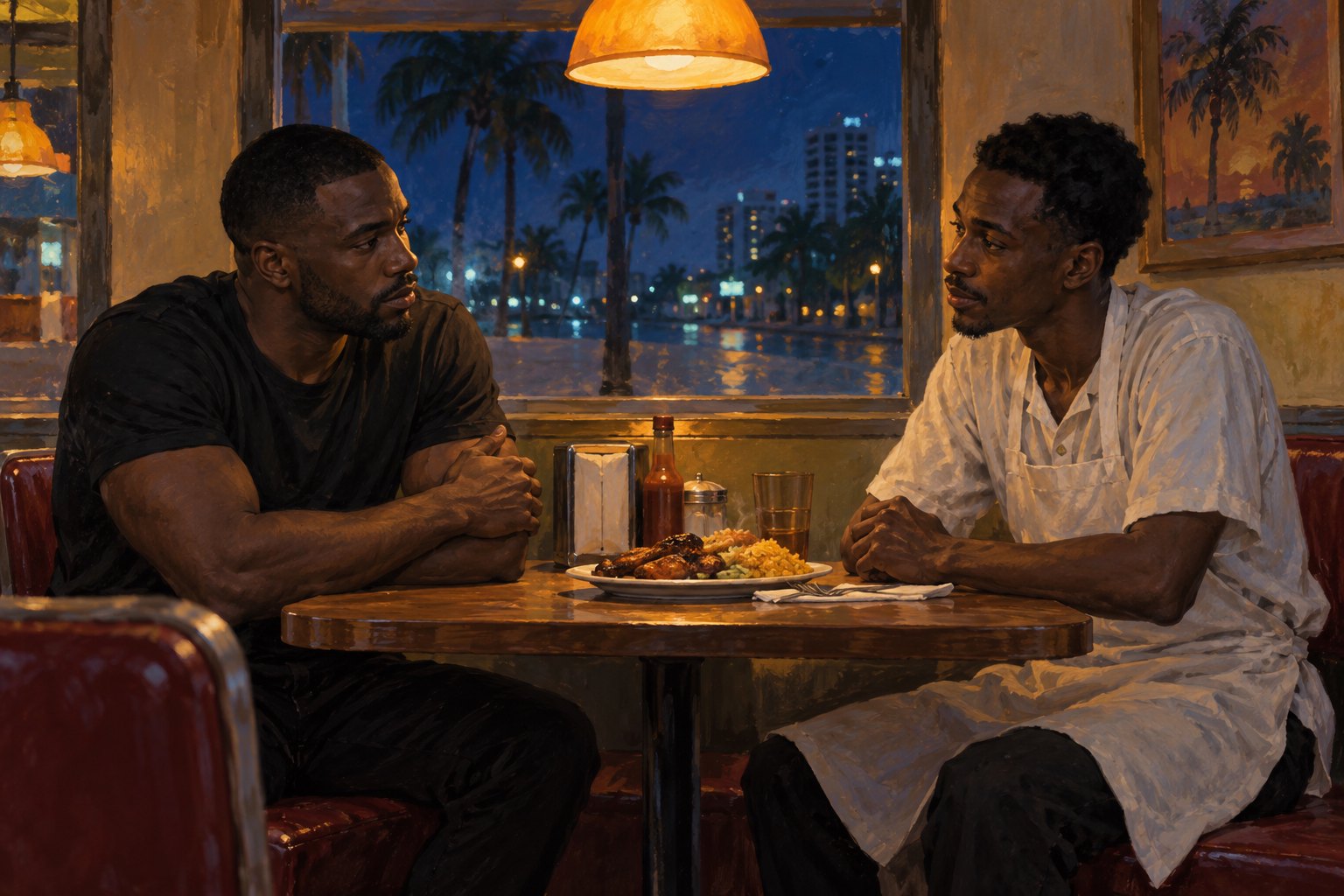
The meal matters because accepting attention is difficult for Chiron. He can display strength almost automatically; allowing someone to make something for him requires a different kind of courage. The scene makes waiting, serving, and listening part of its romantic vocabulary.
Kevin’s question, “Who is you, Chiron?”, reaches beyond his changed appearance. Later, Chiron answers with a disclosure of extraordinary loneliness: “You’re the only man who’s ever touched me.” Both lines appear in the [shooting screenplay](https://www.dailyscript.com/scripts/MOONLIGHT.pdf). The revelation makes the reunion’s emotional stakes unmistakable without determining what happens tomorrow.
Some viewers may find the long pauses withholding. To me, their duration is essential. A quicker exchange would make vulnerability seem readily available to someone who has spent years controlling its visibility. The film lets a difficult sentence take the time it needs.
Paula’s apology cannot return the missing years
Chiron’s relationship with his mother, Paula, gives the film another form of unfinished repair. Naomie Harris’s performance allows need, anger, shame, and love to coexist without making their consequences interchangeable.
The later apology matters because acknowledgment changes the terms of their relationship. Chiron no longer has to absorb the damage while pretending it has no name. Yet forgiveness cannot recreate a safer childhood. The scene’s force comes from allowing love to remain meaningful after recognizing its failures.
Teresa offers a quieter counterpoint. Her steadiness suggests the importance of care that does not depend on a spectacular reconciliation. In a film full of difficult recognition, simple reliability has moral weight.
What Moonlight’s ending asks us to see
The final return to young Chiron by the water resists the idea that adulthood replaces childhood. One way to read it is that the vulnerable boy remains present within the man who has learned to appear untouchable. Being held allows that continuity to become bearable.
The ocean, meals, names, and repeated acts of looking reward attention on a rewatch. Their significance grows through relationships rather than hidden clues: water permits trust, food offers welcome, and a familiar name can reach someone beneath an intimidating appearance.
As our discussion of unconventional cinema and attentive audiences considers, rhythm and perspective can carry meaning that plot summary misses. Moonlight makes that principle emotionally immediate.
Ten years on, its deepest achievement is the patience it extends to Chiron. He does not have to become articulate, successful, or easily understood to deserve a great love scene. The film grants him beauty while he is still uncertain—and leaves us with the possibility that being known can finally feel safe.
Original content by this site's editorial team. Published: October 11, 2026 at 00:01:01 PDT (Los Angeles time)