Maya Hawke has joined the Magic: The Gathering movie from Legendary and Hasbro, according to Deadline. That is the central casting development. It gives the project a recognizable performer while leaving an equally interesting artistic question open: what will this fantasy world feel like when a camera gets close enough to catch someone breathing?
The most promising possibility, in our view, is a film whose spectacular images have physical presence. Magic should change the light on a face, interrupt a movement, or alter the atmosphere of a room. Hawke’s involvement makes the relationship between performance and spectacle especially worth watching, although the casting news alone cannot tell us how that relationship will work.
This is spoiler-free casting commentary, not a review of the finished film. No specific character assignment, scene, dialogue, or release date is established here. The examples below describe cinematic possibilities rather than events from the movie.
What Hawke’s casting tells us—and what it leaves open
The reported news establishes Hawke’s involvement and identifies Legendary and Hasbro with the project. It does not, by itself, establish the movie’s tone or visual style. Casting can spark expectations, but an actor’s name cannot reveal whether a film will favor intimate exchanges, sweeping adventure, comedy, or some combination of those approaches.
That distinction matters because anticipation tends to move faster than evidence. An appealing casting announcement can quickly become an imagined performance, complete with assumptions about costumes, temperament, and story importance. Those assumptions may be enjoyable fan speculation, but they are a shaky foundation for criticism.
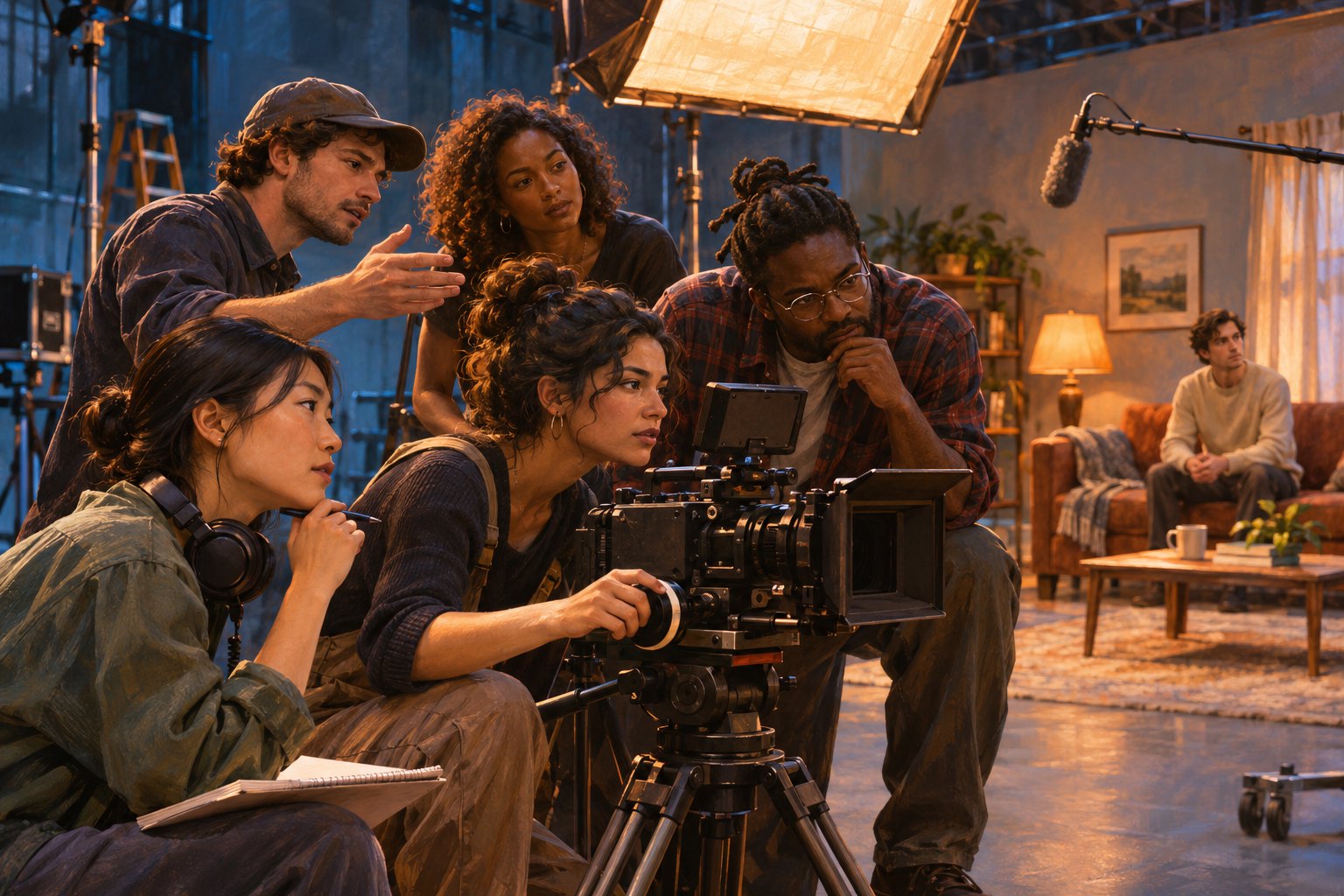
Our earlier examination of Hawke’s casting and the importance of character perspective considered whose choices might anchor the adaptation. A separate issue deserves attention now: how filmmaking itself could make those choices visible. A screenplay may describe hesitation, confidence, or fear. Framing, timing, sound, and movement determine whether an audience experiences them.
The close-up could be as important as the spectacle
Fantasy has an obvious attraction to the wide shot. Vast environments promise discovery; extraordinary sights announce that ordinary boundaries no longer apply. Yet scale becomes more expressive when a film also knows when to move closer.
Consider a hypothetical encounter with something impossible. A distant view could establish its dimensions. A close-up might reveal that the person watching it is suppressing panic, recognizing an old danger, or trying to conceal delight. The second image changes how we interpret the first. The spectacle acquires a point of view.
For Hawke, as for any performer in an effects-heavy production, the useful question is whether the film provides enough uninterrupted screen time for a response to develop. A reaction need not arrive fully formed. There can be a beat of disbelief, an involuntary movement, and then a deliberate attempt to regain composure. Editing that preserves this progression gives the actor room to contribute something beyond a single expression of astonishment.
Our preference would be for an adaptation confident enough to hold those moments. Constant cutting can communicate urgency, but it can also erase the small transitions through which a performance becomes specific. A memorable fantasy image should leave space for someone to inhabit it.
Magic needs contact with ordinary things
One useful standard for fantasy filmmaking is contact: does an extraordinary event seem to occupy the same space as the people and objects around it? This is a question about the finished image, regardless of which production techniques create it.
Imagine, purely as an illustration, a small magical light above a table. Its brightness might pick out the cracks in a cup, warm the color of a sleeve, and make a hand cast a moving shadow. Those modest interactions help establish a shared environment. The effect becomes something a person could notice and respond to.

Texture can do similar work. Worn fabric, uneven surfaces, and objects handled with familiarity suggest that a place has existed before the current scene. They also give performers practical opportunities: something to grip, avoid, adjust, or examine. These actions can carry emotion without requiring an explanatory speech.
This is not a prediction about the production’s design. It is an aesthetic hope for the film Hawke has joined. A world becomes persuasive through the consistency of its details, including the unremarkable ones. If everything demands equal amazement, amazement loses its shape.
Readable action gives performances somewhere to go
Clarity is another underappreciated pleasure of cinematic spectacle. During an action sequence, viewers benefit from understanding where people stand, what they can see, and how far they must travel. That basic geography allows an actor’s glance or sudden change of direction to carry meaning.
A film can establish a doorway, an obstacle, and a gap between two people before movement accelerates. Once those relationships are clear, a close-up can sharpen suspense without leaving the audience disoriented. We know what lies outside the frame, so looking toward it becomes an action in itself.
For Magic: The Gathering, our preferred approach would make extraordinary action understandable through ordinary spatial relationships. Surprise can then come from an inventive reversal rather than uncertainty about what happened. This connects with the broader question of what gives an epic meaning beyond spectacle: scale has greater force when individual actions remain legible within it.
Sound can give the impossible weight
The visual discussion should not crowd out sound. An extraordinary event can announce itself through a change in ambience before it becomes visible. A familiar room may suddenly feel exposed if its background noise disappears. A small sound can seem enormous when the mix creates space around it.
Again, these are possible techniques, not descriptions of this movie. Their value lies in directing attention. If every effect competes at maximum volume, viewers receive little guidance about what deserves their focus. Variation gives a scene rhythm and lets a performer’s breath, pause, or unfinished sentence remain audible.
That balance would be particularly welcome in an adaptation carrying expectations of visual abundance. Silence can invite scrutiny. A restrained sound cue can make the audience lean forward. The film need not explain every sensation for us to understand that something has changed.
What would make this casting pay off?
Hawke’s involvement is a concrete reason to follow the project, but a judgment on the result must wait for the work itself. When footage becomes available, the most revealing material may be a sustained exchange or a complete movement through a space. Those passages offer more evidence of filmmaking than an isolated image selected for impact.
The deeper opportunity is to make fantasy a particular way of experiencing the world. Camera distance can express vulnerability; texture can establish familiarity; sound can turn certainty into unease. Together, these choices allow an invented environment to affect us before we understand every detail of it.
That is the possibility worth holding onto as Hawke joins Magic: The Gathering. The eventual film could give its wonders lasting power by showing exactly how they occupy a room, interrupt a gesture, and register on a human face.
Original content by this site's editorial team. Published: November 4, 2026 at 13:45:46 PST (Los Angeles time)