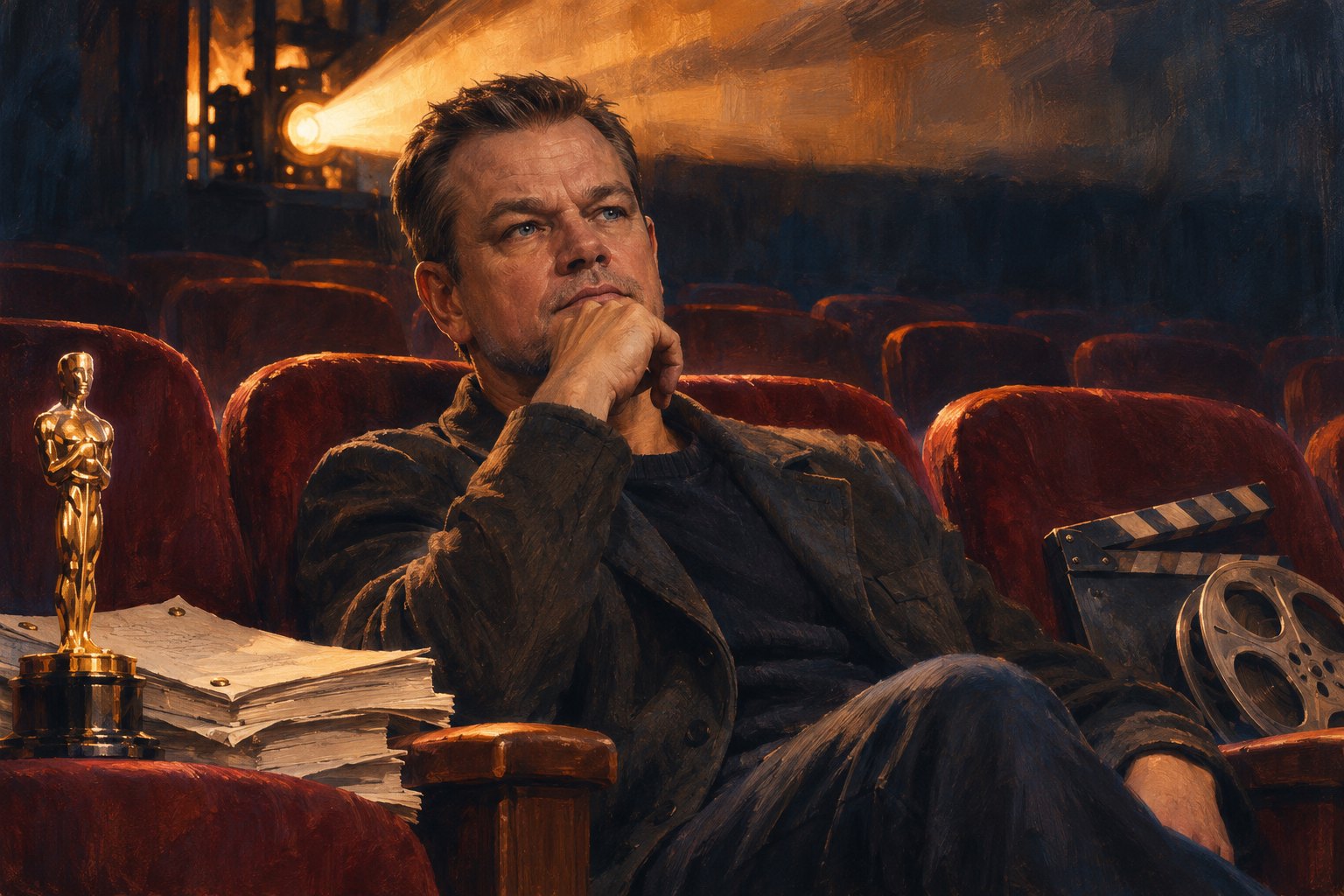
Matt Damon’s conversation with GQ brings together three ways of looking at an acting career: Oscar recognition, the judgment of another filmmaker, and the parts that never happened. He recalls celebrating Martin Scorsese’s Oscar victory, responds warmly to Quentin Tarantino’s praise, and confirms past possibilities involving Harvey Dent in The Dark Knight and Dan White in Milk. These are recollections, not new casting announcements.
What makes those subjects interesting together is their shared uncertainty. A career looks orderly when reduced to a filmography. Living it means making decisions without knowing the ending. For my money, Damon’s most revealing film about that predicament remains Good Will Hunting, where exceptional ability makes the future available but does very little to make it less frightening.
Spoilers follow for Good Will Hunting, including its ending.
The Oscar breakthrough that questions conventional success
Directed by Gus Van Sant and written by Damon and Ben Affleck, the 1997 drama earned its writers the original screenplay Oscar. Robin Williams won supporting actor, while Damon received a leading actor nomination. That distinction matters: Damon’s breakthrough was recognized for both the character he helped create and the performance through which audiences encountered him.
The film introduces Will as a gifted young man working as an MIT janitor. Mathematics opens a door, but his relationships determine whether he can walk through it. Professor Lambeau sees extraordinary intellectual promise; therapist Sean Maguire encounters someone whose confidence conceals profound injury.
My favorite tension in the film is that success keeps changing meaning depending on who is speaking. Lambeau imagines achievement. Sean wants Will to develop enough trust to make choices honestly. Will wants control over the terms of every encounter. Those ambitions overlap, but they are never interchangeable.
That makes the movie an unusually productive companion to Oscar discussion. Recognition can identify an accomplishment without explaining its emotional value. As our examination of prediction versus critical judgment argues, anticipating a winner and understanding a performance require different kinds of attention.
Will’s intelligence is also his defense
Damon makes Will’s brilliance attractive enough that the audience initially enjoys his evasions. The speed, mockery, and apparent certainty are entertaining. We want him to win arguments before we understand how much he depends on turning conversation into combat.
The bar sequence captures that appeal. Will uses his knowledge to puncture another young man’s intellectual posturing, defending his friend while establishing his own superiority. His later challenge, “How do you like them apples?”, lands as a victory lap. It is funny because his pleasure is so unguarded.
Yet the same facility becomes destructive when the stakes turn intimate. A person who can expose every weakness in someone else’s argument can avoid answering a much simpler question about himself. Damon’s performance works through this imbalance: Will can be verbally expansive while remaining emotionally inaccessible.
To me, the acting becomes most interesting when that rhythm fails. The character’s confidence is not a stable possession. It is something he continually performs. Watch how readily an invitation to be known becomes, for him, a threat requiring an immediate counterattack.
Sean changes the terms of the conversation
Williams gives Sean an authority that comes from experience rather than invulnerability. His warmth has limits, his grief remains present, and his encounters with Will are not demonstrations of effortless professional mastery. That roughness helps the relationship feel consequential.
The park-bench conversation is crucial because Sean refuses to confuse accumulated knowledge with lived understanding. Will can analyze an experience from the outside; Sean asks what that analysis leaves out. The scene creates room for Damon to listen, and listening becomes an event.

Later, “It’s not your fault” dismantles the verbal contest altogether. The words contain no cleverness for Will to admire and no complicated proposition for him to defeat. Their force lies in Sean’s insistence and Will’s changing ability to receive them.
I find the scene moving because Damon allows resistance to remain visible before the release. Understanding a statement intellectually and accepting it personally become two different actions. The film’s emotional climax depends on the distance between them.
There is a limitation here, too. The screenplay concentrates an enormous psychological shift into a highly legible dramatic breakthrough. As storytelling, that concentration is powerful; it can also make recovery look tidier than the character’s history warrants. The performance supplies the messiness that the structure sometimes compresses.
Skylar and Chuckie make leaving matter
Skylar, played by Minnie Driver, exposes another weakness in Will’s defensive system: affection cannot be secured by winning. When their relationship demands a future beyond familiar routines, his intelligence offers no protection against the possibility of rejection.
Driver makes Skylar direct and emotionally available without making her foolish. My reservation is that the film gives her less interior space than the men around Will. She sometimes carries the burden of representing a healthier future rather than receiving an equally developed story of her own.
Even so, her presence prevents Will’s behavior from becoming merely an appealing eccentricity. His fear affects another person. Understanding where his cruelty comes from does not erase its consequences.
Affleck’s Chuckie supplies the film’s clearest expression of friendship. His hope that Will might someday leave challenges the comforting assumption that loyalty requires permanent proximity. He can imagine losing daily access to his friend and still believe that departure would be good.
The chemistry matters because neither actor has to announce the friendship’s history in every exchange. Familiarity gives the serious moments weight. It also illustrates why an ensemble’s relationships matter more than a recognizable cast list: the drama emerges from what performers make possible for one another.
What Tarantino and the missed roles bring into focus
Tarantino’s place in the Damon conversation invites a useful question about familiarity. Once an actor becomes immediately recognizable, viewers can start treating recognition as understanding. We know the face, so we assume we know the performance.
Good Will Hunting rewards the opposite approach. Instead of watching for a recognizable Damon quality, watch what Will is trying to accomplish in each exchange. Sometimes he wants admiration. Sometimes he wants escape. Sometimes he wants someone to stay while doing everything possible to drive that person away.
The roles that got away raise a different temptation: imagining that an alternative filmography would explain the actor more completely. Such speculation can be entertaining, but an unmade performance cannot be evaluated. We can discuss the possibilities Damon recalls without deciding that his absence improved or diminished those movies.
The work that exists offers a firmer basis for judgment. Here, his achievement lies in making a gifted character compelling even when brilliance is the least useful thing that character possesses.
The ending chooses uncertainty over a perfect résumé
Will’s departure to pursue Skylar does not prove that romance will succeed or that his future has been solved. The ending withholds those assurances. What changes is his willingness to act without first making himself immune to disappointment.
The final echo of Sean’s “see about a girl” story is a deliberate callback. Earlier, another person’s experience was material Will could question. Now he carries something from that experience into a decision of his own. He has learned through a relationship, rather than through another display of intellectual mastery.
That is why the film remains worth revisiting alongside Damon’s career reflections. Oscars record recognition; unrealized roles preserve tantalizing alternatives. Good Will Hunting asks a more intimate question: who gets to decide what a worthwhile life looks like? Its strongest answer arrives when Will accepts that choosing for himself also means accepting what he cannot know.
Original content by this site's editorial team. Published: November 5, 2026 at 13:06:29 PST (Los Angeles time)