Matchbox: The Movie has an appealing question beneath its unlikely premise: what happens when the friend who disappeared returns with an exciting life that puts everyone else in danger? John Cena’s Sean supplies the spy credentials, but the old friends pulled into his orbit supply the more interesting conflict. For viewers choosing whether to stream it, the central attraction is an ensemble adventure built around childhood connections, vehicles, and wildly disproportionate trouble.
Viewing guidance: Consider it if you enjoy civilian friends stumbling into espionage; approach cautiously if you want a substantial exploration of the toys themselves. This is a character-focused analysis of the documented story, rather than a firsthand screening verdict. Spoilers follow for the setup, relationships, and selected action details.
What kind of Matchbox movie is this?
Directed by Sam Hargrave and written by David Coggeshall, the film premiered on Apple TV on October 9, 2026. Apple describes Sean as an undercover CIA agent whose homecoming entangles his childhood friends in an international pursuit. The streaming listing gives a runtime of two hours and six minutes and a PG-13 rating for action, violence, and language. The toy connection should therefore not be mistaken for a promise of entertainment aimed at very young children. [Apple’s film information](https://www.apple.com/tv-pr/originals/matchbox-the-movie/), [Apple’s viewing details](https://tv.apple.com/us/movie/matchbox-the-movie/umc.cmc.31qa8j1tn2cnpyk3fx43w928d)
The distinction matters aesthetically, too. Small vehicles invite children to invent their own adventures. A feature film must choose one adventure and persuade everyone to follow it. Here, espionage provides that structure. The more revealing question is whether the childhood friendship gives this particular mission emotional meaning.
Sean’s real problem is returning as someone nobody knows
The story begins with Sean and his friends as children in 1998. He wants to express his feelings for Aimee through a miniature version of her dream car, but hesitates before moving away. Decades later, he returns for her uncle’s funeral. Their reunion becomes a kidnapping, and the group finds itself implicated in a missing nuclear warhead. These plot points are described in William Bibbiani’s review. [Bibbiani’s account of the story](https://www.thewrap.com/creative-content/movies/matchbox-the-movie-review-john-cena/)
My reading is that Sean’s most useful contradiction lies between physical confidence and emotional avoidance. The adult can operate in extraordinary danger; the boy struggled to make a small, vulnerable gesture. Placing those versions of him beside each other raises a worthwhile possibility: professional competence can coexist with unfinished emotional development.
Returning home does not automatically resolve that problem. Old friends remember a person he may no longer know how to be. They also have a claim on him that professional contacts do not: an explanation for his absence. His extraordinary career cannot answer the ordinary question of why he stopped showing up.
Seen from the friends’ perspective, the reunion is even less flattering. Sean brings both the threat and the expertise needed to survive it. That creates dependence before it creates renewed trust. Protecting people after endangering them is not the same achievement as having been dependable all along.
Aimee gives the homecoming consequences
Jessica Biel’s Aimee connects Sean to a specific lost opportunity. Yet reducing her to the girl he once liked would flatten the more interesting relationship. She has lived through the intervening years, developed abilities, and suffered a loss that makes this reunion possible.
Her driving experience also matters. The story gives her a practical relationship with vehicles, allowing the childhood car motif to become adult capability. Through this lens, the romantic question should be whether Sean can recognize the woman in front of him, including the life she built without him.
There is a difference between remembering someone fondly and paying attention to them now. That distinction gives the miniature gift an emotional function beyond product recognition: an object can preserve a feeling, but it cannot do the work of a conversation.
The same attention to individual agency informs our discussion of what makes a central character pairing dramatically meaningful. Shared history becomes compelling when both people retain goals of their own.
The friends’ ordinary skills challenge Sean’s exceptionalism
The supporting group includes Sam Richardson’s Crosby, who works with construction machinery; Teyonah Parris’s Charmaine, a helicopter pilot; and Arturo Castro’s Ted, a science teacher. Crosby and Charmaine are married. After the kidnapping, recovering the weapon becomes a way to clear their names as well as prevent catastrophe. [Variety’s character and plot account](https://au.variety.com/2026/film/global/matchbox-the-movie-review-john-cena-41124/)
Those occupations give the ensemble a useful organizing principle. Sean possesses specialized combat knowledge, but useful knowledge is not confined to his profession. Teaching, flying, and operating machinery all demand attention, judgment, and the ability to respond when something goes wrong.
My interpretation is that the reunion becomes meaningful when Sean must accept competence he did not create. His friends have not spent their adult lives waiting to become supporting characters in his adventure. They arrive with their own experience, even if the circumstances force that experience into unfamiliar uses.
The brief exchange “I work alone” and “Not anymore,” quoted in Nell Minow’s review, captures the underlying negotiation. The first line treats isolation as authority; the answer makes companionship a condition he must accept. [Minow’s discussion of the dialogue](https://www.rogerebert.com/reviews/matchbox-the-movie-john-cena-apple-tv-movie-review-2026)
Action matters most when it changes a relationship
Hargrave’s action includes Sean sliding down stairs while firing weapons and swinging from a building on a fire hose, according to Minow’s account. These are feats built to display extraordinary physical control. [Minow’s description of the action](https://www.rogerebert.com/reviews/matchbox-the-movie-john-cena-apple-tv-movie-review-2026)
For a character-centered viewing, watch what happens around that control. Who understands the plan? Who must trust someone without understanding it? Who contributes an idea? A rescue can strengthen a bond, reinforce an unequal relationship, or simply move everyone to the next location. The distinction determines whether spectacle develops the ensemble.
This is also the storytelling question behind our examination of how screen spectacle acquires emotional stakes. A strong physical reaction is one pleasure; caring about the person experiencing danger is another.
The deeper meaning of playing together
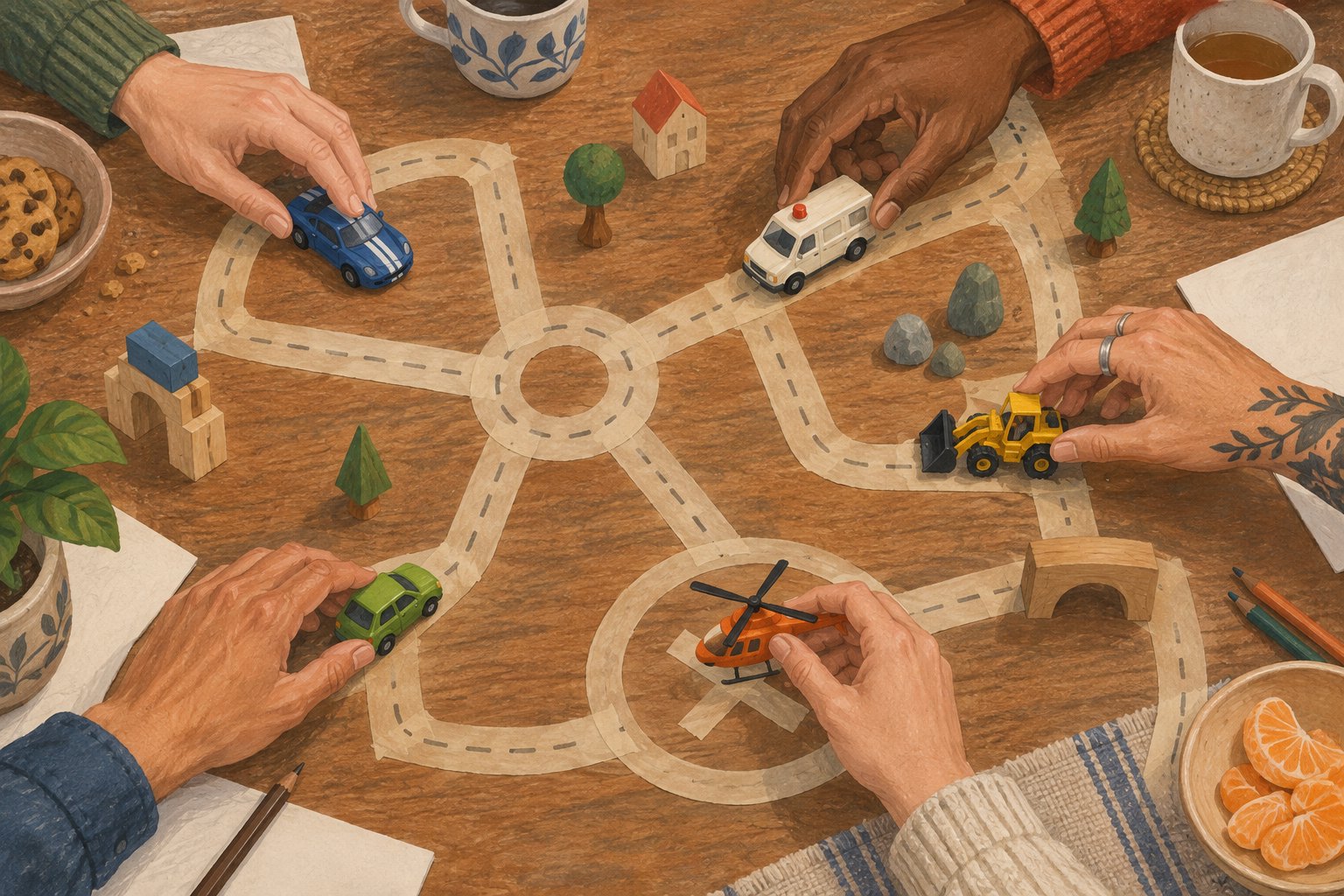
The most persuasive interpretation of Matchbox is that friendship requires surrendering some control. With a toy car, one person can determine the whole journey. With other people, the route becomes a negotiation. Sean’s return turns that childhood lesson into an adult problem: he cannot rebuild belonging while insisting on directing everyone.
The reply “Not anymore” therefore offers a useful lens for the entire adventure. It can sound like a promise of rescue, but it also challenges his preferred identity. Accepting help means acknowledging that the people he left behind became capable adults.
One playful visual callback reinforces the toy-to-adventure connection: Minow describes a child playing with miniature cars at an outdoor café while a real chase passes nearby. It is a visible thematic joke rather than evidence of a hidden franchise connection. [Minow’s account of the café moment](https://www.rogerebert.com/reviews/matchbox-the-movie-john-cena-apple-tv-movie-review-2026)
That image suggests the film’s most generous possibility. Growing up need not mean abandoning play, but playing together requires making room for someone else’s imagination. The cars supply movement. The friends give that movement a destination worth caring about.
Original content by this site's editorial team. Published: October 12, 2026 at 23:56:41 PDT (Los Angeles time)