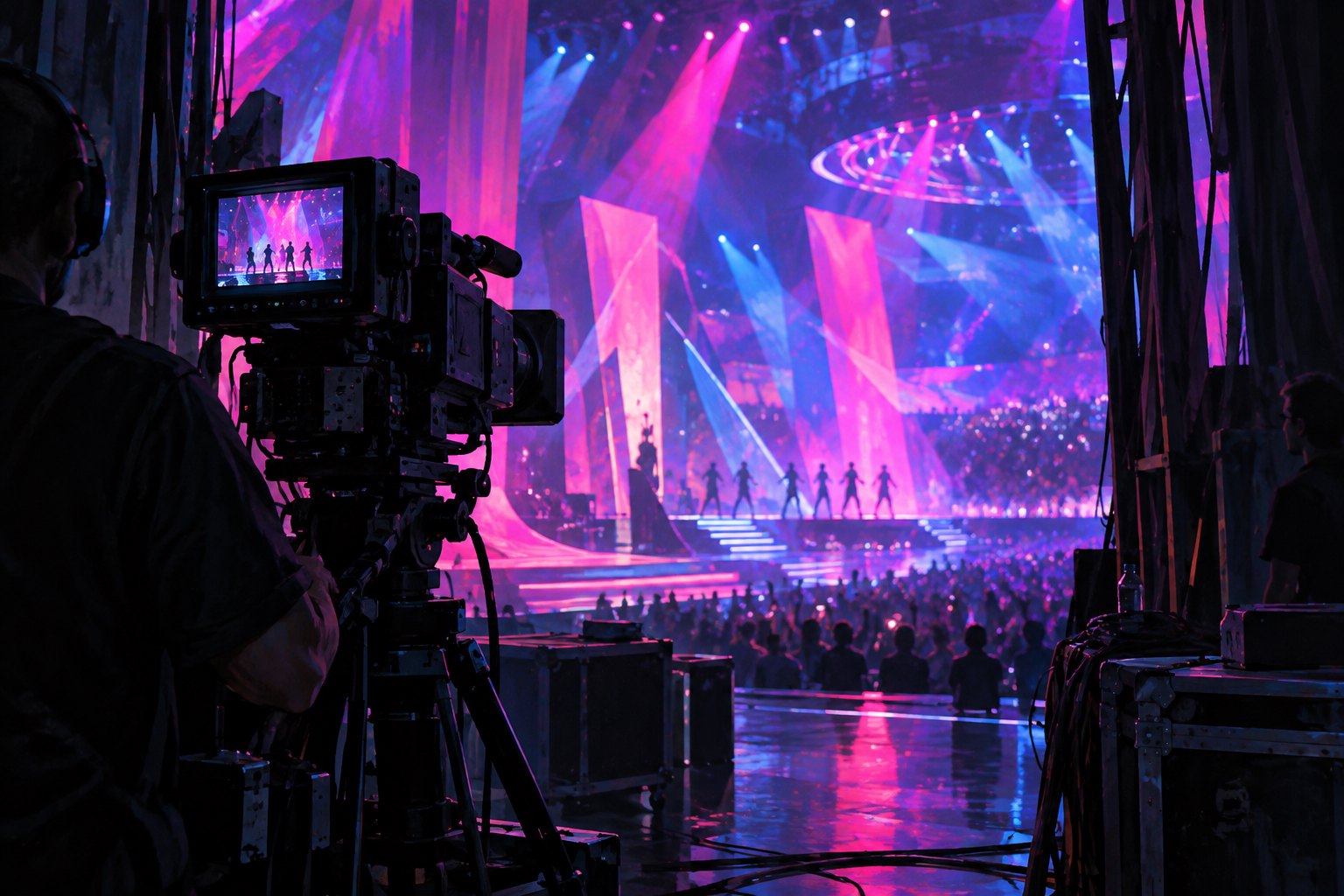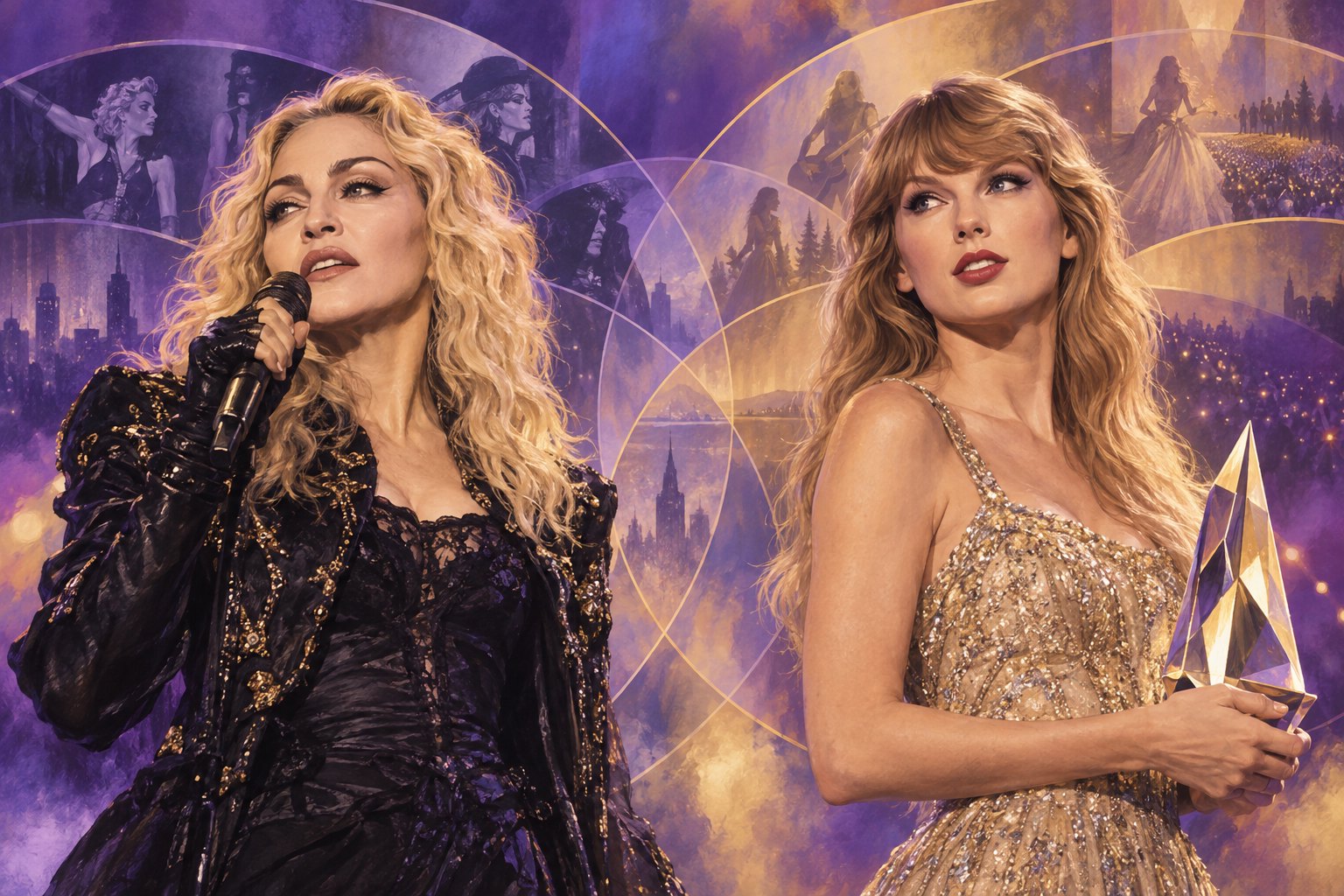
Madonna’s performance and Taylor Swift’s new record are the central attractions in USA Today’s account of the biggest moments from the 2026 MTV Video Music Awards. They also offer two different ways of thinking about a long career in pop: the artist who makes an occasion feel like a return, and the artist whose latest achievement extends an ongoing story.
Both invite celebration. Neither tells us everything about the work. A performance can matter beyond the career narrative attached to it, just as an awards milestone can be significant without settling an argument about artistic quality. The interesting question is what happens when those stories become the main way we watch.
This is commentary on the night’s headline narratives, rather than a performance-by-performance review. Its focus is the distinction between what the occasion recognizes and what a viewer might value after the celebration ends.
Madonna and the complicated appeal of a comeback
The appeal of a comeback story is easy to understand. It gives an audience a beginning, a period of uncertainty, and a satisfying moment of recognition. Where an ordinary performance asks whether an artist can hold our attention, a comeback asks whether our understanding of that artist needs to change.
That is a powerful frame for Madonna. It encourages viewers to connect the present appearance with their own memories, making the experience personal before any judgment about the performance has been formed. Someone encountering her work for the first time and someone who has followed her for decades may be watching the same event while experiencing very different emotional stakes.
But the comeback label can also shrink a career. It can imply that an artist stopped mattering whenever a particular institution stopped handing out trophies. An awards ceremony measures recognition within its own structure; it cannot provide a complete account of the creative life taking place between ceremonies.
For that reason, the more useful critical question is not simply whether Madonna has returned. It is what audiences are being invited to reconsider. Does the occasion encourage curiosity about the music and performance, or does recognition become the entire story?
My view is that the strongest version of a comeback narrative leaves room for discovery. It allows a familiar performer to be encountered in the present tense. The weaker version turns the artist into an exhibit, valued chiefly because the audience remembers having valued her before.
Taylor Swift and the narrative power of a record
Swift’s new record supplies a different dramatic structure. Instead of a return, it suggests continuation: another milestone added to a career already understood through achievement. The emotional satisfaction comes from watching an ongoing story reach a new point.
Records are especially effective awards-night shorthand because they make a sprawling career seem immediately legible. A viewer does not need to know every release or nomination to understand that a boundary has been crossed. The achievement becomes a compact introduction to the artist’s place within the institution.
Precision still matters. A category record, a cumulative wins record, and a first-time distinction describe different accomplishments. The phrase “new record” alone does not identify the measure, so it should not be expanded into a specific tally or an unrestricted claim of supremacy.
More fundamentally, a record answers a different question from criticism. It can establish that an artist has accumulated a particular kind of recognition. It cannot, by itself, explain why a visual idea works, why a performance feels emotionally persuasive, or why one viewer connects with a piece that leaves another unmoved.
Swift’s milestone is therefore best treated as an invitation to revisit the work. Celebration becomes more rewarding when it leads to a specific observation: a performance choice, a visual motif, or a moment when the relationship between sound and image changes how a song feels.

Why these stories should not become a rivalry
Placed together, Madonna’s performance and Swift’s milestone can tempt viewers into a generational contest. One artist becomes the representative of an earlier era, the other the embodiment of the present. That arrangement supplies an easy debate, but it narrows what either artist is allowed to mean.
A veteran performer does not have to stand for everyone who came before. A record-setting contemporary star does not have to represent the future of an entire medium. Those are roles imposed by the surrounding conversation, rather than reliable descriptions of individual creative intentions.
The more interesting comparison concerns time. The comeback narrative asks us to reconsider the distance between past and present. The record narrative asks us to imagine a line extending forward. Both can make longevity seem inevitable after the fact, smoothing away the uncertainty through which careers actually develop.
That is also why recognition and artistic judgment deserve separate attention. Our examination of what makes a VMAs snub or surprise meaningful considers the expectations surrounding awards. Here, the question comes afterward: once the achievement has been acknowledged, what remains worth discussing?
What to look for beyond the milestone
For viewers approaching the VMAs through an interest in film, music videos offer a useful bridge. They organize movement, performance, setting, and duration into an experience that can reinforce a song or complicate it. Their brevity does not remove the need for close attention.
A practical way to watch is to separate three judgments:
- The occasion: What makes this appearance or recognition significant within the artist’s public career?
- The execution: Which observable choices give the performance or video its particular character?
- The aftereffect: What image, gesture, or emotional shift stays with you once the excitement of the announcement has passed?
Those questions allow admiration to become specific. They also make disagreement more productive. Two viewers can agree that a milestone matters while responding differently to the work it celebrates.
The distinction between an event and its presentation matters here, too. Our commentary on what the VMAs broadcast leaves outside the frame explores another part of that problem: the limits of the version an audience gets to see.
The deeper story is permission to keep changing
What makes Madonna and Swift compelling subjects for the same conversation is not a simple transfer of status. It is the possibility that enduring visibility can support more than one relationship with the past.
An artist can revisit an established identity, complicate it, or ask audiences to follow a different direction. A comeback story becomes restrictive when it demands the restoration of a familiar self. A record story becomes restrictive when every new work must function as the next step upward.
The most generous response to these VMAs headlines is to celebrate the occasion while keeping those expectations flexible. Madonna’s performance deserves attention as a present creative act. Swift’s record deserves accurate recognition without becoming a substitute for looking closely. Pop history becomes richer when its milestones lead us back to the work—and when the work is still allowed to surprise us.
Original content by this site's editorial team. Published: September 28, 2026 at 05:31:55 PDT (Los Angeles time)