
Macaulay Culkin is reportedly returning for a seventh Home Alone film with Seth Rogen’s involvement. Pajiba’s report puts the original star back at the center of a franchise whose most recognizable attraction remains Kevin McCallister. But the prospect raises a more interesting question than which household objects might become weapons: what would make Kevin worth revisiting as a person?
The distinction matters. A reported return is not a finished movie, and it offers no basis for reviewing a new performance or treating an imagined storyline as established. What we can assess is the original Home Alone and the dramatic foundation any continuation would inherit. My view: its strongest idea was never that a child could defeat two burglars. It was that becoming capable does not eliminate the need to be loved.
Spoiler warning: The following review discusses the original film’s major scenes and ending. Suggestions about a future installment are critical judgments, not reported plot details.
Kevin wants recognition before he wants independence
The opening family chaos gives Kevin a recognizable grievance. Other people seem to decide what he can do, interrupt him, or dismiss his complaints. He is difficult, certainly, but the film lets us understand why being difficult has become his preferred way of making himself visible.
Culkin’s performance makes that contradiction entertaining. Kevin can sound extravagantly sure of himself while looking painfully small within the adult world. His confidence is partly an argument he is having with everyone around him. He wants the privileges of being older without understanding everything those privileges require.
When he discovers the empty house, his declaration—“I made my family disappear!”—turns an ordinary logistical disaster into a child’s apparent supernatural achievement. The line carries the film’s central misunderstanding: Kevin mistakes absence for evidence of his own power.
That is why the early freedom is funny and uneasy at once. Indulgence gives him immediate satisfaction, but there is nobody present to recognize his triumph. The house can supply possessions and entertainment; it cannot answer him. His wish succeeds only under the narrowest possible definition.
The house changes because Kevin’s perspective changes
The original’s most effective visual idea is that one familiar setting can feel oppressive, liberating, frightening, and comforting. Those changes do not require a different building. They require a different relationship between Kevin and the space around him.
Without his family, domestic routines become tests. Shopping and laundry are modest activities by adult standards, but the film gives them the importance they would have for a child proving he can function alone. These sequences make his later resourcefulness feel connected to a broader discovery of competence.
They also keep the character from becoming merely a delivery system for elaborate pranks. Kevin’s achievement is not exclusively destructive. He can maintain a household as well as defend it. That quieter ability helps explain why the home eventually feels like something he values rather than something he has temporarily conquered.
For a continuation involving an older Kevin, this is a useful standard. Recognizable locations and props can trigger affection, but character development requires a changed relationship to them. Our discussion of the storytelling challenge facing the Metal Slug movie raises a related issue: familiar imagery becomes dramatically useful when it expresses what someone wants or fears.
Kate gives the adventure its emotional consequences
From Kevin’s perspective, being left behind initially resembles liberation. From Kate’s, it is a catastrophe. The film needs both interpretations, because either one alone would flatten the experience.
Her effort to return supplies an emotional counterweight to his pleasure in being unsupervised. While Kevin experiments with freedom, Kate confronts the limits of her ability to protect him. The separation exposes their vulnerability in opposite directions: he discovers what care provides, while she discovers how frightening it is to be unable to provide it.
That structure also prevents the audience from accepting Kevin’s worst conclusion about his family. His feeling of being unwanted is real; his belief that he is unwanted is not the whole truth. We can sympathize with his hurt without endorsing his interpretation of every adult around him.
The eventual reunion works because the film has preserved that difference. Kevin does not need to lose his new competence to welcome his mother. Wanting someone back is compatible with having learned to manage without them.
Marley is the original film’s most important surprise
The church conversation with Marley changes the meaning of Kevin’s isolation. The neighbor he fears turns out to be another lonely person, separated from his own family. Kevin has been reading an adult through a frightening story; listening allows him to see a human being.
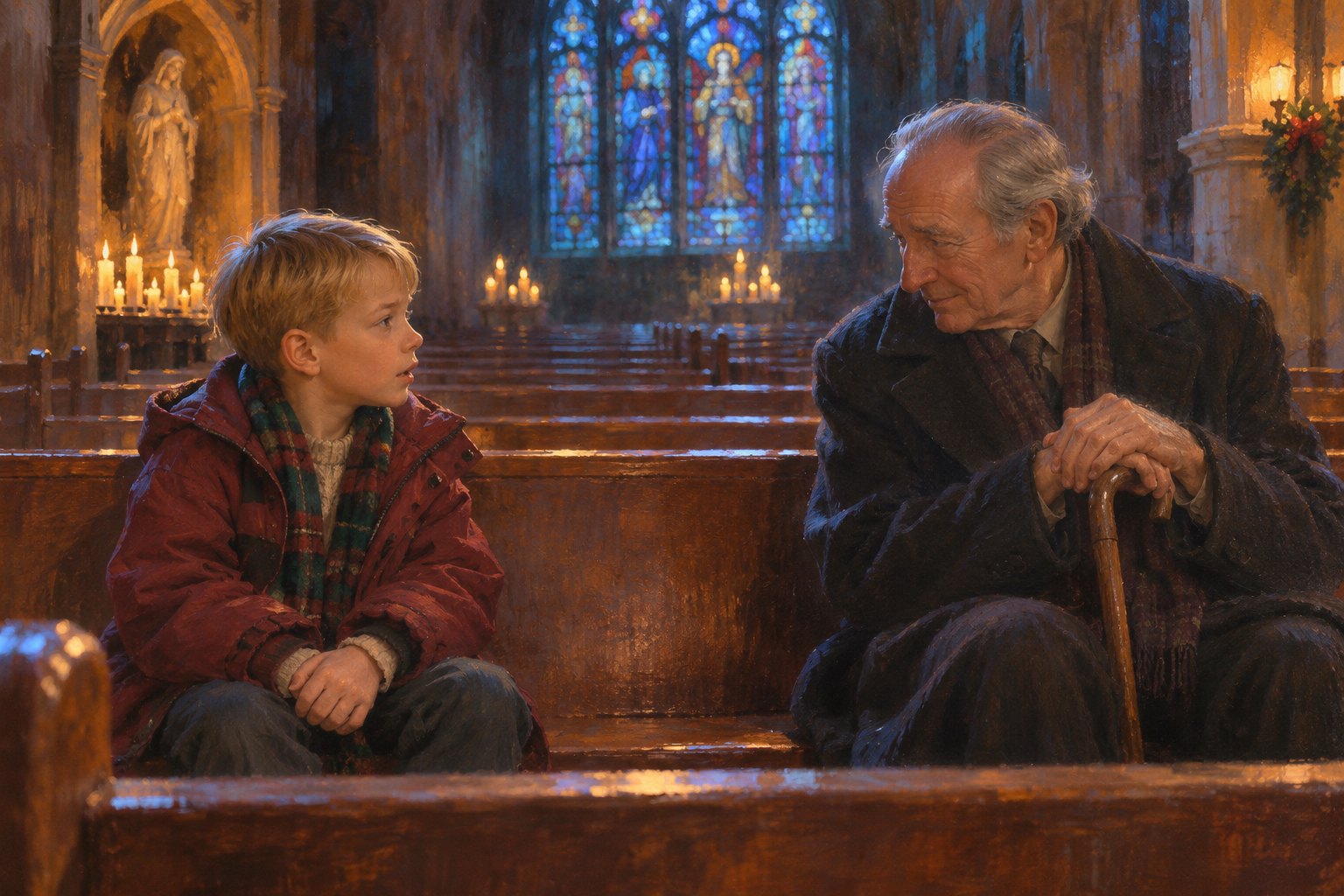
To me, this is the film’s richest scene because neither character possesses complete wisdom. Kevin can recognize the possibility of reconciliation for Marley more easily than he can resolve his own distress. Marley can reassure Kevin while still struggling with his own fear of rejection.
Their exchange makes age a poor measure of emotional certainty. A child can offer useful advice. An older person can need encouragement. Both can become less frightened by admitting that they need somebody.
Marley’s later intervention when the burglars catch Kevin gives that connection practical force. The boy’s ingenuity matters, but it does not make him invulnerable. Another person helps him survive. The resolution therefore complicates the fantasy of total self-sufficiency rather than simply rewarding it.
The traps work because Kevin is still vulnerable
“Do you guys give up?” is a wonderfully insolent question from a child confronting adults who expected an easy victim. Kevin briefly controls the terms of the encounter, and the comedy comes partly from watching the burglars fail to accept that reversal.
The physical punishment is deliberately excessive. Whether it delights or exhausts you will depend on your tolerance for cartoon violence, but its dramatic function is clear: adult strength repeatedly loses to a child’s preparation and knowledge of his surroundings.
My reservation is that the escalating impacts can overwhelm the more interesting Kevin—the boy discovering responsibility, loneliness, and empathy. Yet the original earns considerable goodwill by establishing him before the siege. The traps are the payoff to our investment in him, not the entirety of his personality.
That balance is the challenge suggested by Rogen’s reported involvement. The creative question is not simply whether the comedy can become bigger. It is whether laughter can still emerge from a specific character’s predicament. As our analysis of character drama beyond a familiar public image in Madden argues, recognition alone cannot supply an emotional arc.
What a meaningful Kevin McCallister return would understand
A new film would not need to repeat the original’s circumstances to preserve its insight. It would need to give Kevin something emotionally difficult that cleverness cannot immediately solve. That is a creative criterion, not a prediction about the reported project.
The original ultimately distinguishes controlling a house from belonging in a home. Kevin learns to defend boundaries, but he also learns to revise his judgments and accept help. Marley’s reconciliation extends that lesson beyond childhood: family estrangement and the fear of reaching out do not disappear with age.
That is why Culkin’s reported return has potential beyond nostalgia. An older Kevin could carry the memory of remarkable independence while still having something to learn about connection. The most satisfying continuation would understand that his victory was never simply getting everyone else out of the house. It was discovering why he wanted them to come back.
Original content by this site's editorial team. Published: November 24, 2026 at 23:45:22 PST (Los Angeles time)