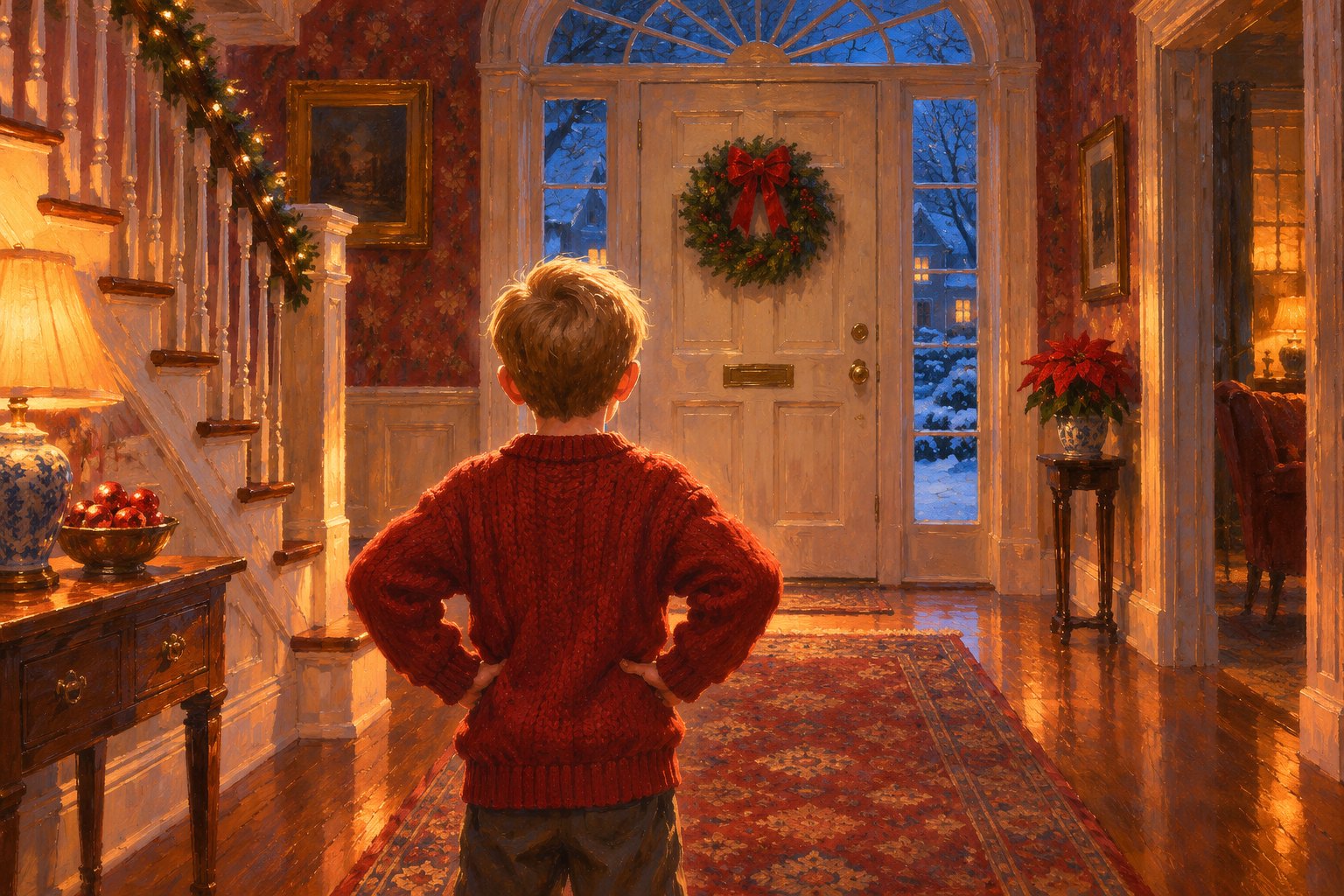
A Home Alone sequel involving Macaulay Culkin is in early development, with Seth Rogen and Evan Goldberg writing and producing, according to Deadline. That is an intriguing prospect because Culkin’s Kevin McCallister gave the original its particular mixture of wounded pride, reckless confidence, and vulnerability. Bringing that emotional complexity forward would matter more than devising another spectacular staircase injury.
The development report is not a finished-film announcement. It does not, by itself, establish a release date, completed screenplay, or production schedule. The useful question now is what makes Kevin worth revisiting. Looking closely at the original offers a more persuasive answer than nostalgia alone.
Spoilers follow for the original Home Alone. The sequel discussion is critical analysis, not a description of its unconfirmed story.
Kevin wants recognition before he wants independence
Directed by Chris Columbus and written by John Hughes, the 1990 film introduces Kevin inside a household that seems to have already decided who he is. He is the nuisance, the younger sibling, the child expected to get in the way. The crowded departure preparations give that frustration a physical shape: people move around him, talk over him, and leave little room for his version of events.
The film does not require us to consider Kevin blameless. His temper contributes to the family conflict. What matters is how Culkin makes being dismissed feel intolerable. Kevin wants the privileges of adulthood partly because adults appear to control whose complaints count.
His declaration, “I made my family disappear,” therefore lands as more than a joke about childish logic. He interprets an accidental separation as proof that his wishes possess enormous power. The line captures the intoxicating possibility that the world has finally arranged itself around him.
That fantasy is also the original’s strongest narrative device. Kevin gets precisely what he thinks he wants, allowing the movie to explore how little he understands the wish. A continuation would need an equally specific contradiction within its central character. Familiar surroundings cannot supply one on their own.
The empty house gradually changes meaning
At first, being alone gives Kevin unrestricted access to pleasures and spaces that usually come with rules. The house becomes a private kingdom. Culkin plays this freedom with an exaggerated assurance that is funny because we can still see the child performing beneath it.
Ordinary responsibilities complicate the fantasy. Shopping and managing the household require him to deal with people and problems without a family member stepping in. These sequences give his competence a progression. He does not become resourceful only when the burglars arrive; the film has already begun showing him discover what he can manage.
Yet practical ability does not eliminate loneliness. That distinction is essential. Kevin can learn how to look after himself and still desperately want his mother. The movie allows those needs to coexist without treating affection as a failure of independence.
For me, this is where Home Alone earns its lasting appeal. The enormous house initially promises unlimited freedom, then exposes the absence of the people who make it meaningful. Its rooms remain materially comfortable while becoming emotionally insufficient.
Kate’s journey gives Kevin’s adventure its consequences
From Kevin’s perspective, his family has vanished. From his mother Kate’s perspective, an ordinary parental responsibility has turned into an unbearable emergency. Catherine O’Hara’s performance gives the second viewpoint enough urgency to prevent the film from becoming merely a child’s holiday fantasy.
Kate’s determination to get home operates alongside Kevin’s growing confidence. The audience can enjoy his ingenuity while understanding something he cannot fully see: someone is working desperately to reach him. Those parallel experiences keep the separation painful even when the comedy becomes broad.
The eventual reunion succeeds because the film has invested in both sides of it. Kevin’s pleasure in freedom and Kate’s fear do not cancel each other out. They reveal the distance between a child wanting relief from family friction and a parent confronting the possibility of losing that child.
As in our analysis of how performance gives Casablanca its emotional authority, the decisive quality is how an actor makes a change of feeling believable. Culkin’s confidence matters because he can also let it fall away.
Marley offers the film’s most important reversal
Kevin initially understands his neighbor Marley through a frightening story passed down by his older brother. The church conversation replaces that inherited image with an actual person: a lonely man estranged from his son, watching his granddaughter from a distance.
The scene changes Kevin’s role. Usually the child whose perspective receives too little attention, he becomes someone capable of listening. He also offers advice. Their exchange gives both characters dignity without pretending they have equivalent life experience.
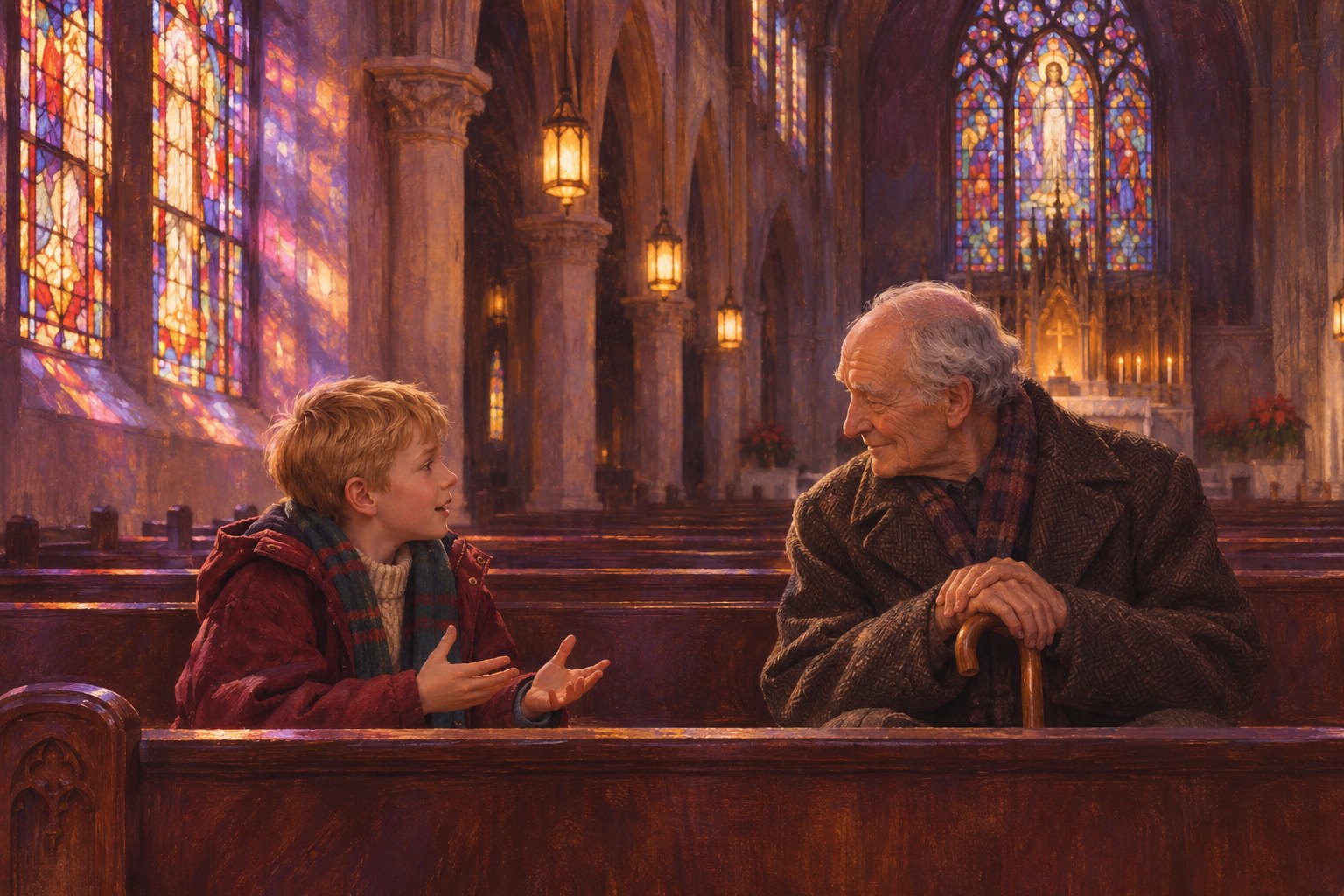
“You can be too old for a lot of things,” Marley tells him. His reassurance about fear connects their situations. Kevin is frightened by immediate dangers; Marley fears the emotional consequences of approaching his family. Growing older has not made uncertainty disappear.
This is a particularly valuable foundation for any return involving Culkin. The original already understands that vulnerability crosses generations. A later chapter would have room to explore that idea without simply enlarging the physical comedy.
The traps work because Kevin is still a child
Harry and Marv turn Kevin’s private adventure into a genuine threat. His preparations let him reorganize a world in which size and authority normally belong to adults. Household objects become extensions of his imagination, and the burglars’ confidence makes their humiliation satisfying.
The violence is extravagant, and viewers who find the prolonged punishment exhausting have a reasonable objection. My reading is that the sequence works best as an expression of Kevin’s desperate inventiveness. The pleasure comes from watching the apparently powerless character seize control of familiar space.
Crucially, that control has limits. The burglars eventually catch him, and Marley intervenes. Kevin’s ingenuity matters, but the ending does not establish that a sufficiently clever child needs nobody. Help arrives from the person he had misunderstood.
Remove that rescue and the film’s meaning changes. With it, courage includes accepting that survival and independence are not the same thing.
What Rogen and Goldberg’s involvement can—and cannot—tell us
The reported writing and producing team gives the project a creative identity to watch, but it does not establish the finished film’s tone. Assigning an age rating, comic style, or character arc at this stage would turn expectation into invented information.
The useful standard is whether the eventual story gives its characters desires that generate conflict. Our commentary on why casting news is not a creative verdict makes a related distinction: recognizable participants create interest, while the completed work must justify it.
For a new Home Alone, that means letting Culkin contribute more than recognition. Whatever form his involvement takes, the dramatic opportunity lies in revisiting a perspective that audiences remember, then discovering something they do not already know.
The deeper meaning: a home cannot be defended into completeness
The original ends with connection restored. Kevin reunites with his mother, and he sees Marley reunited with his family. These resolutions answer the same underlying problem from different stages of life: fear and hurt can make separation feel easier than reaching toward another person.
Kevin learns to protect the house, but protection cannot supply what he misses. Marley’s reconciliation gives that lesson an adult counterpart. Both characters need the courage to remain open to family after disappointment.
That is the emotional inheritance a sequel should take seriously. Kevin’s memorable achievement is surviving the burglars. His more meaningful discovery is that being capable of living without people does not make their return any less necessary.
Original content by this site's editorial team. Published: November 20, 2026 at 14:10:57 PST (Los Angeles time)