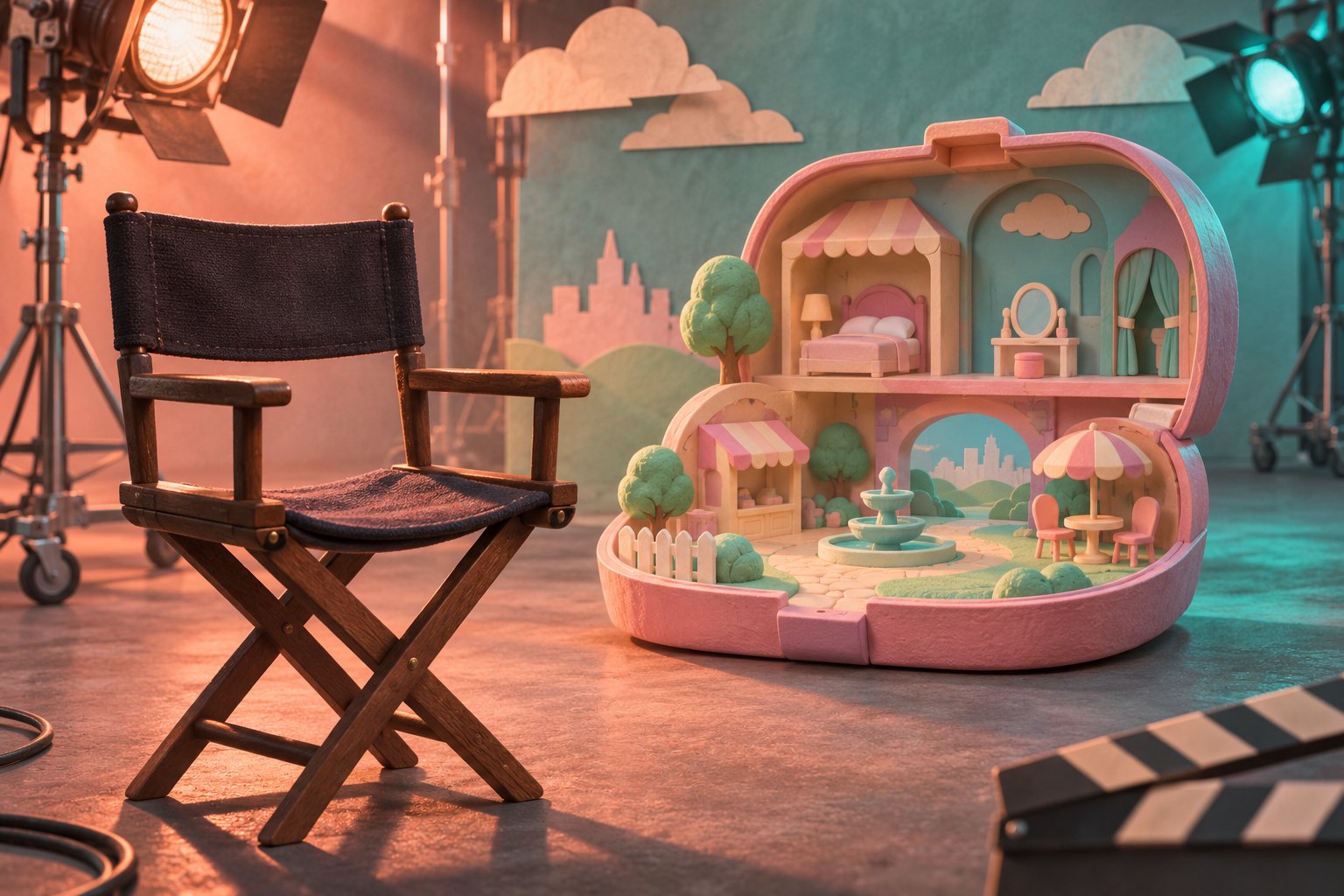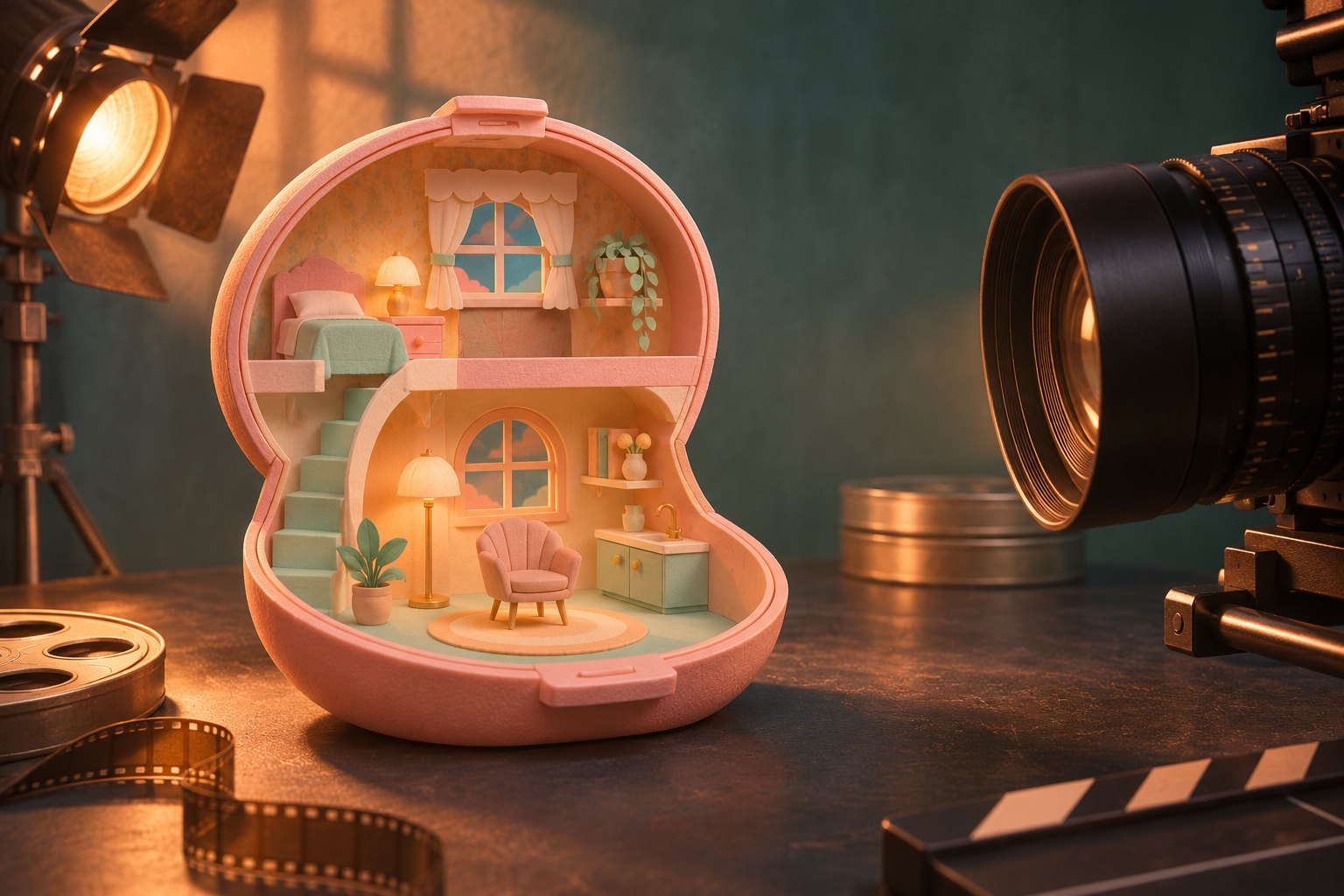
Lili Reinhart is in talks to join Polly Pocket following Lily Collins’ exit, according to Variety. That is a report of negotiations, not a completed casting agreement. For audiences wondering what Reinhart’s involvement might mean, the most interesting creative question extends beyond who appears on screen: how will the camera make a miniature world feel?
A tiny environment can be presented as an attractive object or experienced as somewhere a person lives. Those approaches invite very different relationships with a central character. One encourages us to inspect the scenery; the other asks us to share someone’s limited view of it. For this adaptation, that distinction offers a useful subject for criticism before there is a performance to assess.
This is spoiler-free development commentary, not a review of a completed film. The casting report does not establish scenes, dialogue, or a finished visual approach. The examples below describe possible filmmaking choices, not events attributed to the movie.
What the casting development can—and cannot—tell us
The immediate news concerns Reinhart’s possible participation after Collins’ departure. It does not, by itself, demonstrate a change in tone, explain the creative direction, or tell us how a character will behave. Reading any of those conclusions into an actor’s name would turn expectation into evidence.
Our earlier discussion of why the Polly Pocket casting change is not a creative verdict addresses that distinction. Here, the more specific question is how a production might place its eventual lead within the image. An actor’s contribution depends partly on whether the filmmaking gives viewers time and space to notice it.
A distant shot can make a performer one colorful element among many. A closer view can reveal attention, hesitation, or irritation. Neither approach is inherently superior. The meaningful choice is when the film moves between them—and whether that movement follows the character’s experience.
The difference between looking down and looking out
Imagine a hypothetical shot of a miniature room viewed from above. Every wall, furnishing, and passage is visible at once. The audience has an advantage over anyone standing inside: we understand the whole arrangement. That overview can be delightful, especially when it reveals an ingenious design or lets a joke unfold across several spaces.
Now imagine the camera lowered to the room’s floor. A table interrupts the view. A doorway conceals what lies beyond it. The same space acquires uncertainty because the audience can no longer inspect everything simultaneously. What looked manageable from above becomes a place that must be navigated.
This is where a miniature setting can become dramatically useful. Its size alone does not create identification. Restricted access to information does. If we discover an obstacle when the character discovers it, we participate in the moment instead of merely observing a demonstration.
My preference would be for a film that earns its overhead reveals by first establishing what the environment feels like from within. A change in scale could then deliver surprise, humor, or relief. Constantly announcing how tiny everything is might make the central visual idea wear out before the story has developed.

Scale should affect a scene’s timing
A successful size effect needs more than a convincing comparison between two objects. It needs consequences for movement and duration. If a familiar surface becomes a substantial distance to cross, the film has an opportunity to make effort visible. Cutting immediately to the destination could erase the very experience the setting makes possible.
That does not mean every journey needs elaborate suspense. Comedy can emerge from the gap between a task’s apparent simplicity and the concentration it demands. A pause before attempting something, followed by an unexpectedly awkward adjustment, may communicate more than an extended effects sequence.
For Reinhart, if negotiations lead to her participation, such passages could give physical performance a clear purpose. The relevant question would be how precisely a gesture responds to the environment: where attention goes, when confidence falters, and how someone recovers after a mistake. Those are things an audience could eventually evaluate in footage. A casting announcement cannot answer them.
The visual principle also connects with our essay on how photographic choices shape the way we read images. Texture and attractive surfaces can establish a look. Framing and duration determine what viewers are invited to notice within it.
Sound can make an ordinary object feel enormous
Sound offers another way to place an audience inside a miniature environment. Consider a hypothetical cup being set on a tabletop. From an ordinary listening position, that action might register as a small clink. From nearby at a dramatically reduced scale, a filmmaker could emphasize its vibration, resonance, or sudden interruption of quieter activity.
The creative value lies in the relationship between sounds. If every movement arrives with an overwhelming boom, scale becomes a repetitive effect. A restrained soundscape could reserve that force for moments when a character’s attention is genuinely seized. Quiet domestic sounds might establish comfort before something outside the room changes its atmosphere.
Such choices could also keep the setting emotionally flexible. An environment that feels inviting in one scene might feel exposed in another without requiring a complete visual redesign. Sound can suggest that the world continues beyond the edges of the frame—and that the person we are following has only partial control over it.
The close-up still has to matter
A miniature-world movie faces a practical expressive challenge: its broadest images may be its most immediately marketable, while its smallest changes in expression may carry the drama. The film needs room for both. Spectacle becomes exhausting when the audience is never allowed to settle on a face.
A close-up would be especially valuable after a complicated visual event. Rather than immediately introducing another novelty, the camera could remain with the character long enough to register what the experience meant. Was it embarrassing, exhilarating, unsettling? The answer might depend on a reaction that a wider shot would conceal.
Dialogue deserves similar breathing room. No verified lines from this project are established by the casting news, so there is no basis for quoting memorable exchanges. When dialogue can be assessed, its value will depend on delivery and context as well as wording. A brief remark can become memorable because of the silence before it or the expression that follows.
A small world with a life beyond the display
The deeper possibility in Polly Pocket, as an adaptation, is a shift in how we look at a contained world. From outside, an enclosed miniature space can suggest order: everything appears visible, arranged, and comprehensible. From within, that apparent simplicity could give way to distance, uncertainty, and private experience.
That is an interpretation of the premise’s cinematic potential, not a claim about the screenplay. It points toward a useful standard for the eventual film: does the visual design allow its inhabitants an existence beyond being admired?
Reinhart’s reported talks provide a reason to revisit that question, but the answer will come through filmmaking. The most revealing moment may be the point when viewers stop measuring how small the surroundings are and begin watching them with the same attention as the person inside.
Original content by this site's editorial team. Published: November 20, 2026 at 15:58:34 PST (Los Angeles time)