Spoilers for the Lanterns season finale follow.
Lanterns answers its central murder mystery with a painfully personal revelation: Sheriff Kerry Kane killed Hal Jordan, while her son Noah is revealed to be a Manhunter. Those discoveries connect the investigation to a mother’s fear for her child. The distinction matters: identifying the alien threat and identifying Hal’s killer are separate answers. The finale makes their relationship the emotional problem John Stewart must confront. [TheWrap’s ending breakdown](https://www.thewrap.com/creative-content/what-to-watch/lanterns-episode-8-ending-explained-who-killed-hal-jordan/)
My reading of the ending is that its strongest idea also produces its most uncomfortable weakness. Understanding why someone acts out of fear can deepen a tragedy. It cannot, by itself, settle whether that person should escape consequences. John’s emergence as a hero depends on navigating that difference, giving the conclusion something more demanding to resolve than the identity of a murderer.
Kerry’s Fear Explains the Murder Without Justifying It
Making Kerry responsible changes the emotional scale of Hal’s death. A cosmic conspiracy could position him as a casualty of an enormous conflict. A killing rooted in intimate fear asks us to consider the distance between knowing someone and trusting them when everything feels threatened.
From Kerry’s perspective, the danger concerns her son. That gives her panic a recognizable human shape. From Hal’s perspective, however, the same situation involves people he cares about. The tragedy emerges from those perspectives failing to meet: one person’s attempt to deal with a crisis can be experienced by another as the crisis itself.
The critical question is whether the story gives that misunderstanding enough dramatic weight. A character can make an irrational decision without the writing becoming irrational, but the transition must feel emotionally specific. Fear needs an object, a history, and a believable effect on judgment. Otherwise, it becomes an all-purpose explanation that can make any twist seem plausible after the fact.
That is where I find this ending most open to challenge. Sympathy for Kerry should coexist with attention to Hal’s loss. Viewers can understand the protective impulse and still reject the action. A tragedy becomes richer when it allows those responses to remain in conflict.
Noah’s Identity Makes John’s Judgment More Difficult
The Manhunter revelation turns Noah into a test of how John understands danger. Reporting on the finale describes John placing trust in the boy’s capacity to resist his programming and choose a different future. That choice gives the resolution its central ethical tension: how much should origin determine judgment? [The Daily Beast’s interview with Damon Lindelof](https://www.thedailybeast.com/obsessed/lanterns-creator-damon-lindelof-takes-us-inside-the-bombshell-finale-of-hbos-superhero-hit/)
For Noah, being identified means risking the collapse of every distinction between what he is and what he might become. For John, recognizing that distinction requires accepting uncertainty. He cannot prove a future good choice before allowing Noah the chance to make it.
I find that uncertainty more interesting than a simple declaration that compassion is always correct. Mercy has dramatic value because the person extending it cannot control the outcome. If the story guarantees that everyone spared will behave well, mercy becomes an easy calculation.
There is also a necessary limit to this reading. Treating Noah as capable of choice does not automatically resolve Kerry’s responsibility. Their situations raise related questions, but they involve different actions. The finale is most persuasive when we keep those moral accounts separate.
Sinestro Gives Fear a Physical Form
Sinestro’s creation brings the same concern into the machinery of superhero storytelling. His lantern is described as having been forged with fear, making it more powerful. John’s access to power therefore carries an uneasy association with the emotion driving the surrounding tragedy. [TV Insider’s finale recap](https://www.tvinsider.com/1294680/lanterns-finale-shocker-who-killed-hal-jordan/)
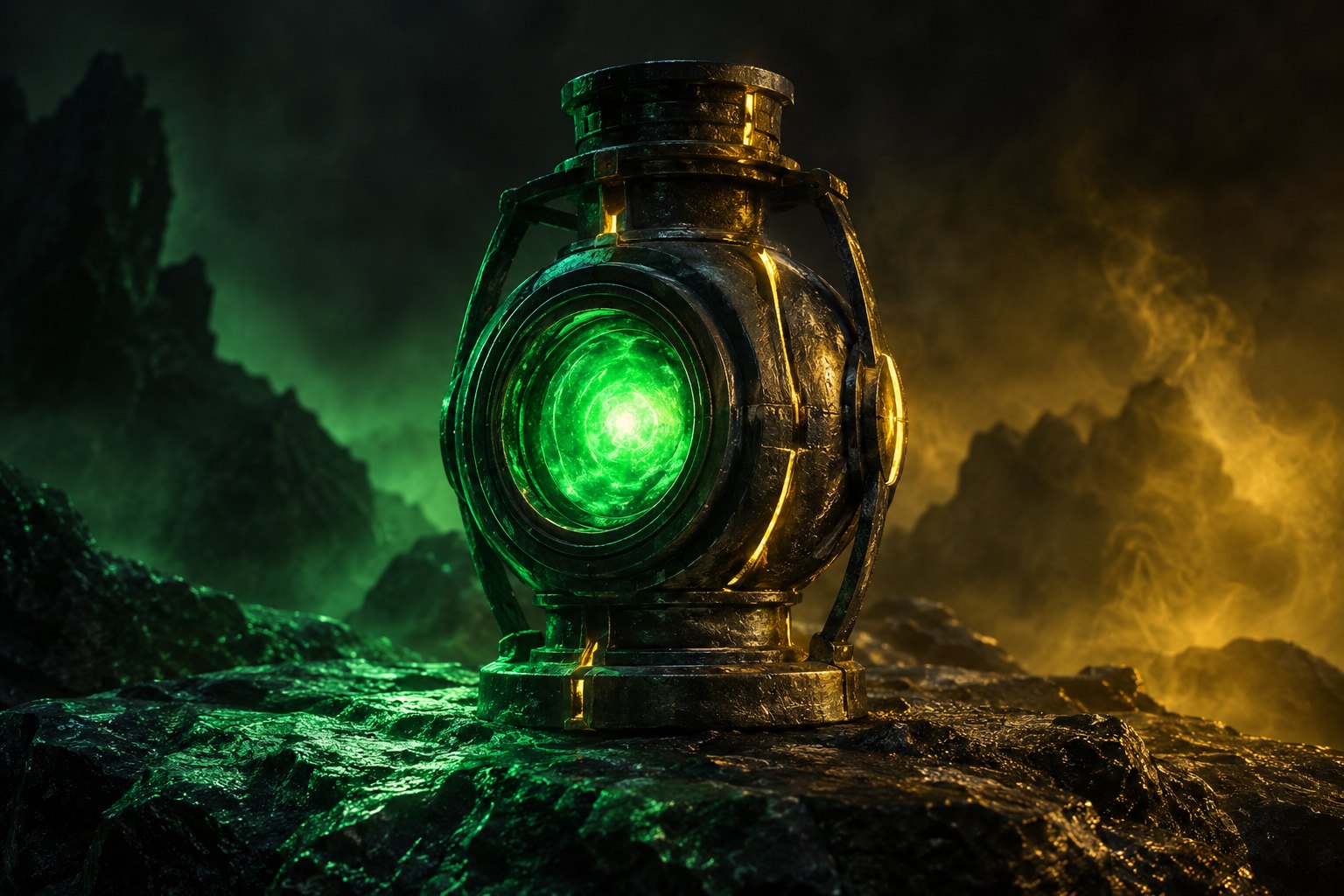
The illustration above interprets that tension symbolically; it is not an episode still or an exact reconstruction of the prop.
As a piece of dramatic construction, the lantern invites a useful question: does the origin of a tool determine the morality of its use? That parallels the question surrounding Noah. In both cases, John must decide how much inherited identity governs future possibility.
My reservation is that an ethically complicated object should remain complicated after it solves an immediate practical problem. If Sinestro’s involvement exists only to provide a convenient recharge, the symbolism does more work than the consequences. The stronger interpretation is that John accepts responsibility for what he uses, including the parts of its history he cannot erase.
Hal’s Best Advice Makes Room for Vulnerability
Hal’s farewell advice, “Don’t be afraid to be afraid,” supplies the clearest expression of the finale’s argument. The line appears in the closing exchange described by [TV Insider](https://www.tvinsider.com/1294680/lanterns-finale-shocker-who-killed-hal-jordan/).
Its repetition is the point. The first fear concerns the world; the second concerns the shame of experiencing fear at all. A hero who treats vulnerability as disqualification may hide it, deny it, or punish it in other people. Hal’s advice releases John from that demand.
That gives their relationship a different emphasis from the familiar story of an experienced hero approving a successor. Approval becomes useful when it allows the younger person to stop performing invulnerability. Our earlier examination of Hal’s legacy and John’s future provides a companion perspective on that transition.
The line also sharpens the criticism of Kerry’s choice. Feeling afraid is permitted. Surrendering judgment to fear still has consequences. The episode’s emotional generosity becomes meaningful only if both propositions remain true.
John’s New Oath Matters More Than a Sequel Tease
John makes that philosophy explicit in his revised oath: “I choose this ring. I choose this fight.” The finale’s creators discuss the personalized oath as part of his emergence as Earth’s Green Lantern. [TheWrap’s cast and creator interview](https://www.thewrap.com/creative-content/tv-shows/lanterns-ending-interview-creators-aaron-pierre-kyle-chandler/)
The repeated verb gives the moment its force. John accepts an obligation through a conscious decision. In my reading, that is the meaningful power-up: he can articulate what he is agreeing to do and take responsibility for agreeing to it.
His connection to the Superman sequel gives that decision a larger destination, but the ending’s value rests on whether John becomes legible as a person here. The same distinction informs our discussion of James Gunn’s work beyond Man of Tomorrow: a future project becomes interesting through character commitments, not its position on a release calendar.
The Deeper Meaning: Courage Requires Accountability
The finale’s characters suggest different relationships with fear. Kerry experiences it as an emergency demanding action. Noah faces the possibility that others will define him through it. Sinestro gives it practical utility. John attempts to acknowledge it while preserving his capacity to choose.
That pattern is my interpretation of the ending, and it explains why its moral discomfort deserves attention. Compassion cannot restore Hal’s life. Power cannot guarantee good judgment. A promise cannot establish that every future decision will be right.
The finale’s strongest achievement is making John’s heroism depend on accepting those limitations. Its unresolved challenge is accountability: allowing people to change must still leave room to reckon with what they have done. The light John carries becomes compelling when it illuminates that difficulty.
Original content by this site's editorial team. Published: October 5, 2026 at 04:56:40 PDT (Los Angeles time)