Ken Paxton’s “Come and Take It” tour has become the subject of an unusually specific media dispute: a Mother Jones writer says they were ejected for filming the breakfast buffet. The claim immediately raises a question about access and control. Why would recording something as ordinary as breakfast become a point of conflict at a political event?
The headline alone cannot settle that question. It presents the writer’s account of the reason for the ejection; it does not independently establish who made the decision, what instructions preceded it, or whether Paxton personally knew about it. Those distinctions matter. Still, the premise offers a revealing subject for screen-culture criticism: how a camera pointed away from the main attraction can change the story an audience receives.
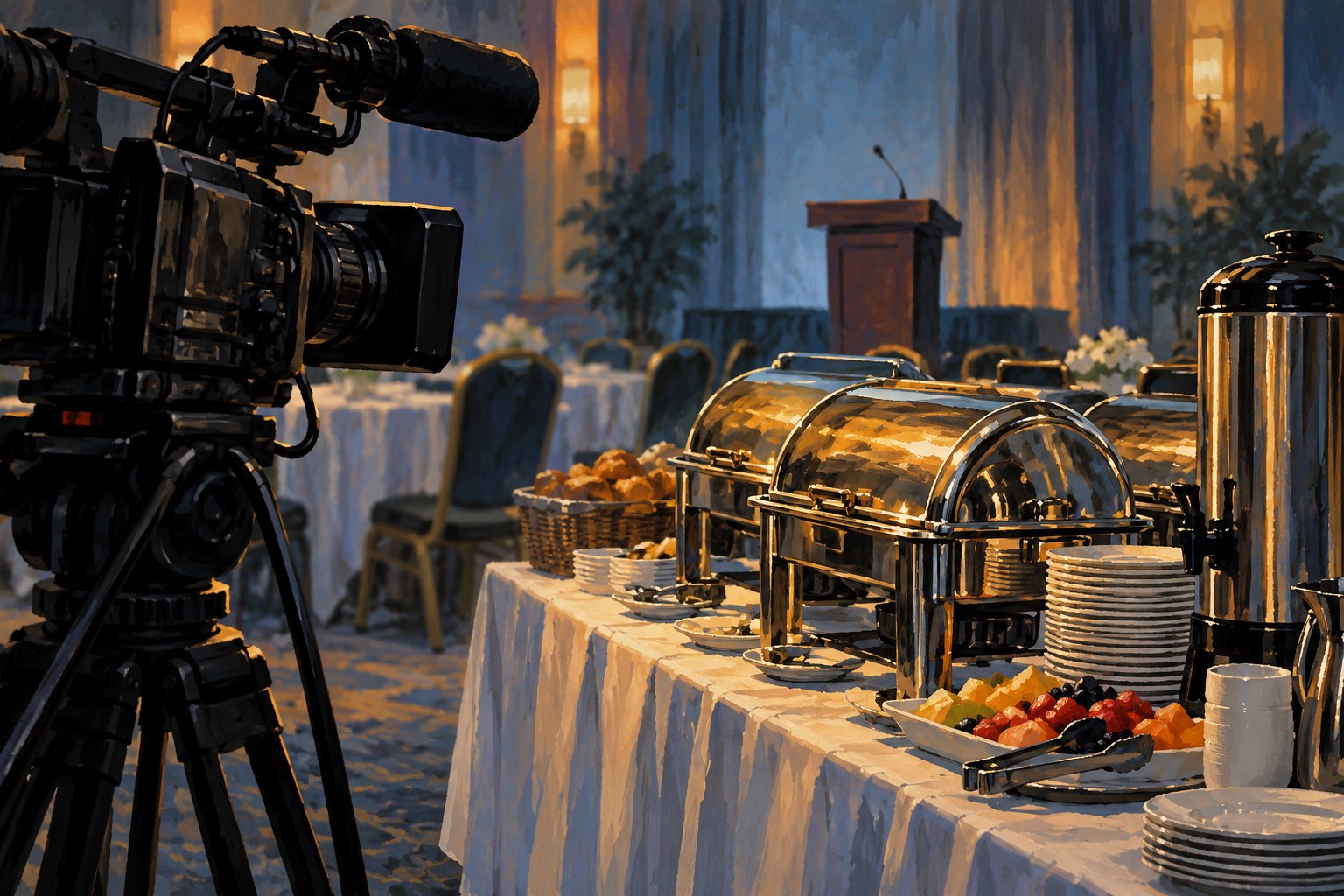
This is commentary on the framing of a reported incident, not a review of a film or an assessment of footage independently examined here. The accompanying illustrations are conceptual images, not records of the event.
Why the Breakfast Detail Makes the Story Stick
The buffet is the detail that gives this account its narrative force. A dispute over filming a speech would fit familiar expectations about political coverage. A dispute over filming breakfast introduces an apparent mismatch between a mundane activity and a consequential response. The reader encounters that mismatch before learning anything about the circumstances.
In cinematic terms, breakfast would usually belong to the background: the material that establishes a location while the principal action happens elsewhere. Moving it into the foreground changes our attention. We begin wondering about the room around the speech, the routines supporting the event, and the boundaries between what visitors can see and what they can record.
That shift can be valuable without proving misconduct. An ordinary detail may illuminate an event’s atmosphere; it may also acquire exaggerated significance through selection. The critical question is what the detail actually establishes. A buffet can show that food was being served. By itself, it cannot establish an organizer’s motives, a politician’s attitude toward scrutiny, or the justification for removing someone.
The Tour Name Supplies an Immediate Contrast
“Come and Take It” is forceful language. Read as a title, it projects challenge and confidence. Placed beside an account of someone being removed for filming breakfast, it creates an obvious interpretive tension: expansive rhetoric meets an apparently narrow boundary around observation.
My reading is that this contrast explains much of the story’s appeal. The tour name gives the encounter a dramatic frame before any footage enters the discussion. Readers may perceive irony in the distance between the public-facing phrase and the writer’s description of restricted access.
But rhetorical irony is not a finding of fact. The name does not establish the event’s recording policy, and an action taken at a tour stop cannot automatically be attributed to Paxton personally. Good criticism can identify the contrast while resisting the temptation to turn it into a complete account of responsibility.
Whose Point of View Shapes the Encounter?
The first-person presentation makes the writer both observer and participant. That gives the account immediacy: the person describing the event is also the person who says they were required to leave. It also means the description proceeds from a particular position within the encounter.
Documentary viewers recognize this structural change. When access becomes contested, the act of recording can become part of the subject. Instead of simply showing an event, the account begins to show—or describe—the conditions under which someone was allowed to observe it.
From the writer’s perspective, filming the buffet is presented as the action that prompted removal. From an organizer’s perspective, the relevant explanation would have to come from an attributable statement or documented instruction. It would be speculation to supply one, whether sympathetic or accusatory. Attendees, meanwhile, cannot be treated as a single audience with a shared reaction.
This is where a character-centered approach to real events needs restraint. We can examine positions, actions, and competing accounts. We cannot assign private thoughts as though these people were fictional characters whose motivations a screenplay has disclosed.
What a Camera Shows—and What an Edit Suggests

A wide shot of an event room and a close-up of a serving tray can both be accurate images while conveying very different impressions. The wide shot supplies spatial relationships. The close-up emphasizes an object and excludes much of its setting. Neither is inherently more honest; their usefulness depends on the question being asked.
For the Paxton tour account, footage of the buffet would answer only some questions. To understand the reported ejection, viewers would also need context around the interaction: what was said, when it was said, who was speaking, and whether the recording preserved the sequence continuously. These are criteria for assessing evidence, not claims that any particular recording contains those details.
Editing adds another layer. A cut from food to a confrontation can suggest a direct causal relationship. That relationship may be supported by the surrounding record, but the cut itself does not prove it. Our discussion of watching beyond the highlights in sports film study addresses a related viewing habit: the decisive-looking moment becomes more useful when we understand what surrounds it.
How to Assess the Claim Without Filling In the Gaps
The strongest response to this story is curiosity disciplined by specific questions. Before drawing a broad conclusion about the encounter, look for evidence that addresses the following:
- The stated reason: Does an attributable instruction connect the removal to filming the buffet, or is that connection the writer’s interpretation?
- The sequence: What happened immediately before the request to leave, and is that context available?
- The decision-maker: Who communicated or authorized the removal, and what establishes that person’s role?
- The response: Is there an explanation from the people responsible for access, and does it address the specific account?
These questions do not require assuming the writer is mistaken. They help distinguish testimony, corroboration, and interpretation. The same care matters when political material moves through distribution systems, as explored in our commentary on political labels and the circulation of film advertising. Access decisions and the explanations attached to them deserve separate examination.
The Larger Question Is Who Defines the Scene
The most interesting implication of the Paxton buffet account is about attention. A political event directs audiences toward certain subjects: a speaker, a message, a planned occasion. A camera can redirect that attention toward something peripheral. That choice may produce useful reporting, trivial distraction, or a mixture of both. Its value depends on what the resulting material supports.
The writer’s claim makes that struggle over attention the story. What sounds initially like an absurd breakfast anecdote becomes a question about the boundaries of observation. Yet the account’s memorable shape should not tempt us to imagine dialogue, reconstruct a confrontation, or declare motives that have not been established.
As a piece of narrative framing, the premise is exceptionally effective: an assertive tour name, an everyday subject, and a reported exclusion. As evidence, it still requires context. The thoughtful viewer’s task is to hold both judgments at once—to recognize why the story commands attention while asking precisely what happened beyond its most memorable detail.
Original content by this site's editorial team. Published: October 19, 2026 at 09:56:53 PDT (Los Angeles time)