
Jonathan Macri’s Five Alive concerns the New York Knicks, not a film with that title. Published in Knicks Film School, it discusses a victory over the Indiana Pacers through the contributions of several players. For readers interested in criticism, its subject offers a useful question: how do we describe a collective performance without making everyone except the most visible participant disappear?
This is a critical viewing companion to basketball commentary, not a movie review or an independent possession-by-possession assessment. There are no fictional characters, screenplay quotations, or cinematic Easter eggs to decode. The relevant connection to film criticism is attention: where we direct it, what it reveals, and how easily a compelling individual story can dominate our understanding of a group.
What Five Alive Is About
Macri reports a 113–106 Knicks victory over Indiana, their fifth consecutive win. His discussion highlights Josh Hart’s renewed impact, Karl-Anthony Towns’s excellence, and Landry Shamet’s contribution. Those are the principal subjects of his account; the interpretation here concerns how readers can examine such player-centered narratives.
An ensemble perspective is useful because it makes recognition more demanding. Instead of asking only who produced the most striking moment, it asks whose decisions made that moment possible. That distinction matters whenever an outcome has several contributors but an audience has room in its memory for only one face.
Josh Hart and the Appeal of a Return-to-Form Story
A return-to-form story offers a particular pleasure: recognition. The audience sees something familiar and feels that an earlier understanding has been restored. Applied to Hart, that framing invites a viewer to look for recognizable habits. It also creates a risk. Once we expect a comeback, every successful action can start to resemble proof.
A more useful approach is to identify the behavior before naming the transformation. Watch when a player commits to a decision, whether he stays involved after giving up the ball, and how he responds when a possession becomes untidy. These observations are more precise than saying that someone suddenly wanted to win more.
They also respect the boundary between visible action and private experience. A player’s hesitation may be observable; its emotional cause usually is not. Confidence, frustration, and resolve can be reasonable interpretations, but they should remain interpretations unless the athlete supplies the explanation.
My preference is for criticism that leaves this uncertainty intact. An athlete does not become less interesting when we admit that we cannot read his thoughts. The uncertainty makes the watching more attentive: we have to describe what happened instead of filling the gap with a familiar redemption script.
Karl-Anthony Towns and the Difference Between Dominance and Influence
A star-centered account naturally encourages viewers to follow the star. Yet a useful way to examine Towns is to divide attention between his actions and the choices available to the people around him. The first perspective identifies execution. The second investigates influence.
On a replay, pause before a pass or shot. Where are the defenders looking? Which routes remain open? Has someone moved away from a useful position to address a perceived threat? These are questions to test against the footage, not conclusions to assume because a player has a reputation.
The distinction resembles watching an ensemble scene in a movie. The person speaking may command attention, while another performer’s position or reaction changes the meaning of the exchange. In basketball, however, those relationships arise through live decisions rather than a director’s predetermined arrangement.
This is why an impressive finish should begin an inquiry rather than end it. Rewind far enough to see how the opportunity developed. Sometimes the scorer creates nearly everything. Sometimes the decisive contribution occurs earlier, belongs to another player, and looks unremarkable at full speed.
Landry Shamet and the Work Outside the Spotlight
Including Shamet in the discussion opens a broader question about supporting contributions. Viewers often use that phrase as though it means secondary importance. A better definition would describe work whose value depends on its relationship to someone else’s opportunity.
Try following one player away from the ball for an entire possession. Notice whether his defender stays close, changes position, or turns toward another threat. Then watch the same possession while following the ball. The two versions may tell substantially different stories about why a passing lane or shooting opportunity appeared.
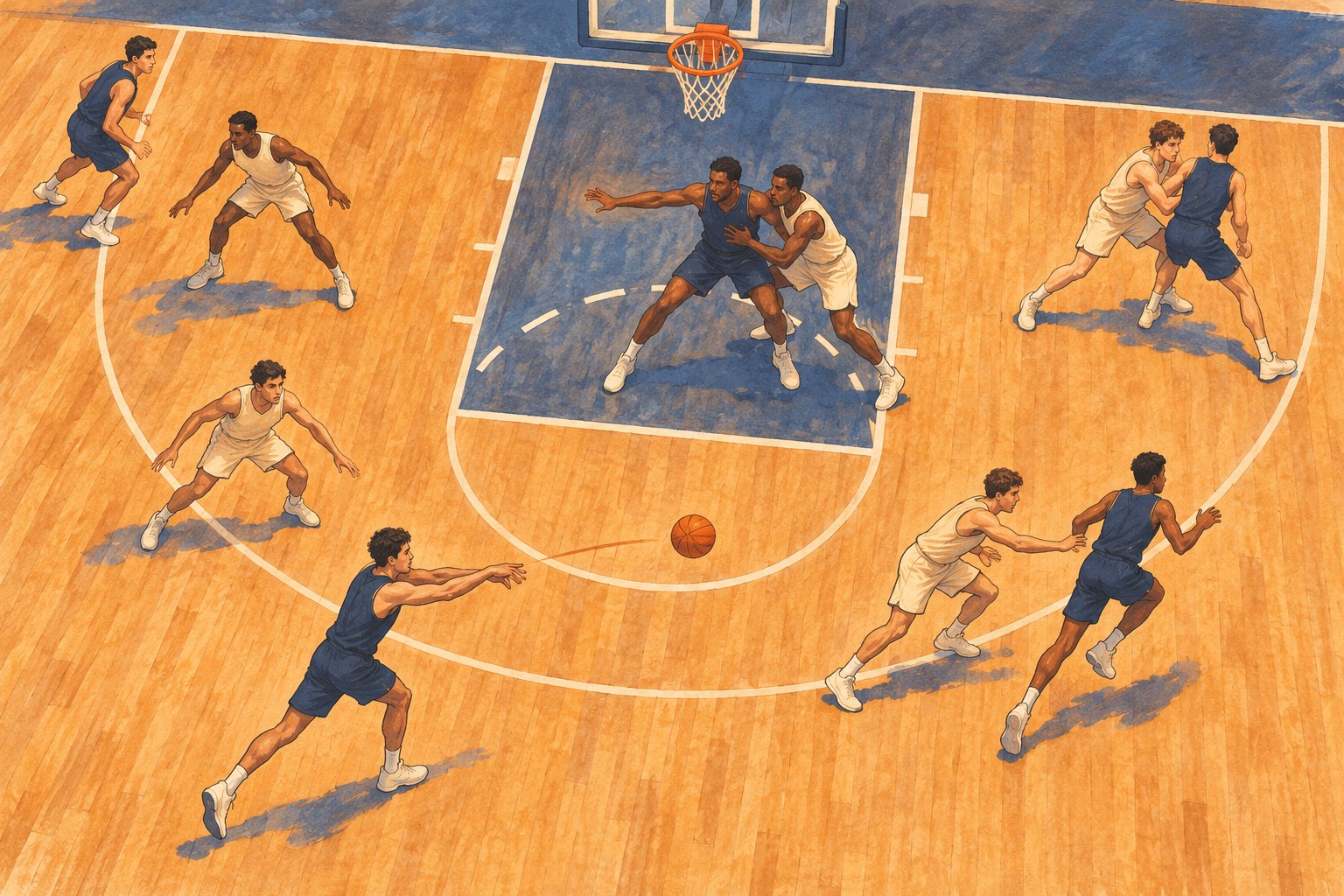
This exercise does not automatically establish that an off-ball player caused the outcome. It identifies a relationship worth examining. Repetition matters: one helpful movement is an observation, while a dependable pattern requires more evidence. Our guide to reading game footage beyond the highlights offers a related approach to separating visible outcomes from inferred responsibilities.
How to Read Enthusiastic Commentary Critically
Fan commentary can be valuable precisely because its emotional investment is visible. Enthusiasm tells readers what the writer finds rewarding. It becomes less useful when appreciation is treated as sufficient evidence for every larger conclusion.
Keep three questions separate while reading Five Alive: What does Macri report? What does he judge? What would you need to watch or compare to reach that judgment yourself? Agreement becomes more meaningful when you can explain which part of the argument persuaded you.
The same discipline applies to edited nonfiction. A selection can be accurate while remaining incomplete. Readers interested in that distinction can also explore our discussion of visibility and control in documentary storytelling. In both forms, access to memorable moments does not automatically provide the whole explanation.
The Deeper Question: Who Gets Credit?
The most productive way to approach Five Alive is as an invitation to reconsider recognition. Individual stories make team sports legible, but they can also narrow the field of view. A comeback, a star performance, and an overlooked contribution each direct attention differently.
My judgment is that the ensemble approach becomes valuable when those stories lead us back to relationships. Follow the celebrated player, then follow the teammate beside him. Watch the finish, then the decision that preceded it. The reward is a fuller account of achievement—one that allows a memorable individual performance to remain memorable while making room for the people who helped it happen.
Original content by this site's editorial team. Published: November 23, 2026 at 03:42:42 PST (Los Angeles time)