Jon Watts is reportedly headed to Star Wars, with the Spider-Man director attached to the first film in a new trilogy. The possibility of continuing the Skywalker saga immediately raises expectations about familiar characters and another numbered episode. But the more interesting question is what a continuation would ask its heroes to do with the history they inherit.
The directing news and the trilogy’s identity deserve separate treatment. [TheWrap’s reporting](https://www.thewrap.com/creative-content/movies/star-wars-jon-watts-to-direct-first-film-in-new-trilogy-simon-kinberg/) identifies Watts as the director while describing conflicting accounts of whether these films constitute Episodes X–XII or a standalone series. That makes an unqualified declaration that Episode X is officially settled premature. Neither a returning character nor a particular storyline should be assumed from the director attachment.
This is development commentary and retrospective film analysis, not a review of Watts’ unmade film. Major spoilers follow for Return of the Jedi, The Last Jedi, and The Rise of Skywalker.
What the Skywalker Name Actually Promises
A Skywalker continuation inherits something more demanding than recognizable spacecraft. These films repeatedly turn family history into a problem of personal responsibility. Their characters must decide whether belonging to a family means repeating its behavior, repairing its damage, or rejecting its expectations.
That distinction matters because continuity alone cannot supply drama. Recognizing a surname gives an audience information; watching someone struggle to deserve or escape it creates emotional investment. My strongest hope for Watts’ involvement is that the next film understands that difference.
The Spider-Man association makes the appointment immediately legible to blockbuster audiences, but it cannot tell us whether this particular story will work. A director’s previous franchise experience is a reason to pay attention. It is not evidence of the new film’s tone, character relationships, or quality.
Luke’s Defining Victory Is an Act of Restraint
Return of the Jedi offers a demanding standard for any successor. During the throne-room confrontation, Vader’s threat against Leia pushes Luke into a furious attack. Luke gains the advantage, then refuses to finish his father or accept the Emperor’s invitation to replace him. His declaration is simple: “I am a Jedi, like my father before me.” The sequence and dialogue are documented in the [official Luke Skywalker biography](https://www.starwars.com/databank/luke-skywalker).
The line is powerful because Luke chooses which version of his father to recognize. Vader stands before him as evidence of cruelty, yet Luke insists that this history does not exhaust the person underneath it. His identification with Anakin becomes an ethical commitment rather than an excuse.
From Luke’s perspective, the temptation is especially painful. He wants to protect his sister, and violence briefly seems like the most direct expression of that love. The scene makes his anger understandable while refusing to confuse understandable anger with a good decision.
For me, this is where the film’s adventure storytelling becomes most persuasive. Luke’s physical advantage creates the opportunity for his meaningful choice. If he simply lacked the strength to strike, restraint would mean much less. He must be capable of doing harm before refusing it can define him.
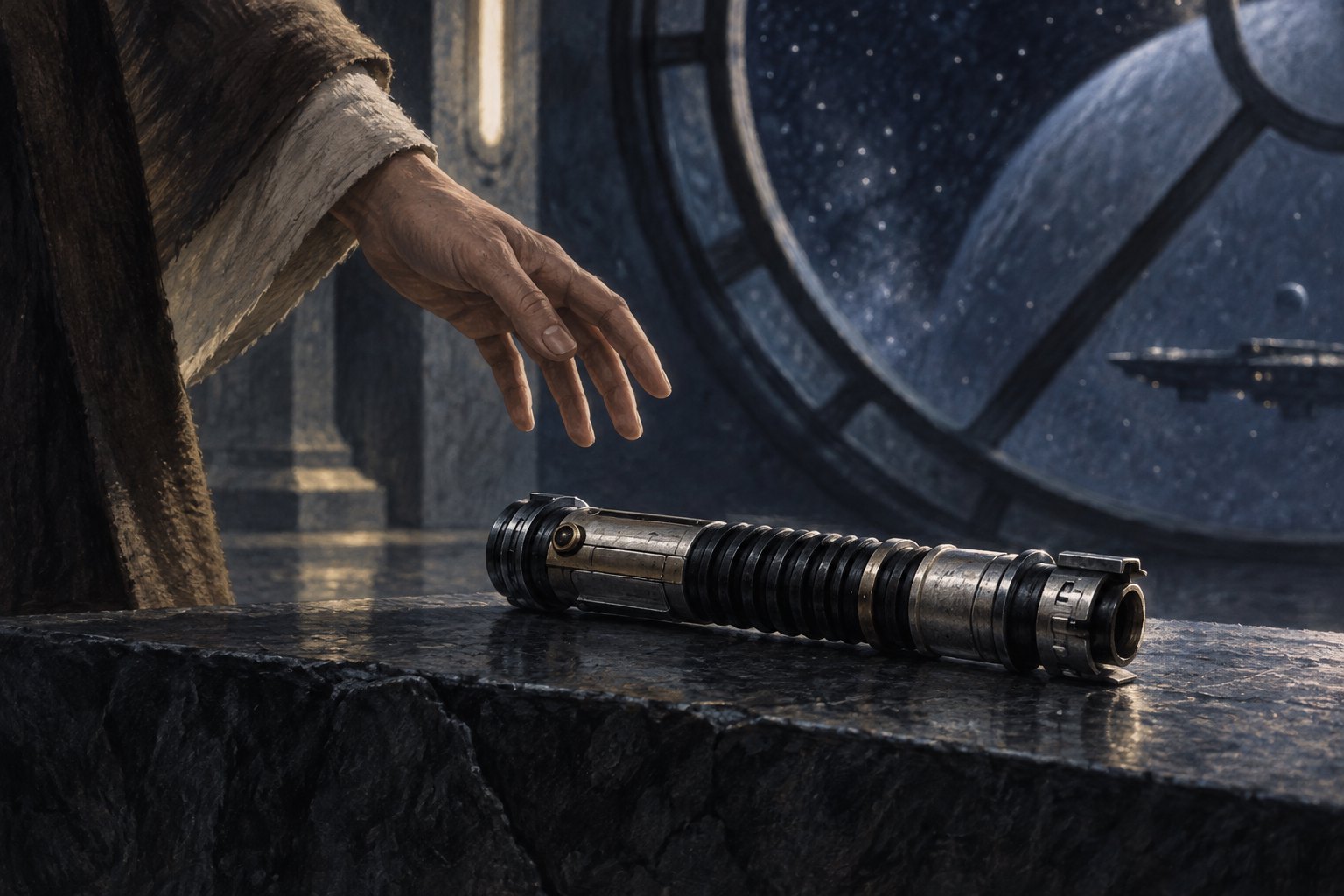
A continuation could learn from that structure without recreating the throne room. Give a protagonist a solution that works tactically but violates something essential about them. Then make refusing it costly. That would extend the saga’s moral imagination more effectively than another arrangement of familiar costumes.
The Last Jedi Makes Legacy Uncomfortable
The Last Jedi tests the distance between Luke the person and Luke the legend. Rey arrives seeking guidance; the man she finds is disillusioned. Yoda’s lesson, “We are what they grow beyond,” gives their relationship a larger meaning: a teacher’s importance cannot depend on remaining the final authority. [Lucasfilm’s overview of The Last Jedi](https://www.lucasfilm.com/productions/star-wars-the-last-jedi/) foregrounds both Luke’s despair and that teaching.
Viewed through Luke’s experience, the difficulty is accepting that failure has become part of what he must pass on. A heroic reputation can make that admission harder. When other people expect certainty, shame encourages withdrawal, and withdrawal begins to look like humility even when someone still needs help.
Rey’s perspective is equally important. Seeking a mentor does not mean surrendering the right to judge that mentor. Her disappointment exposes the practical weakness of treating legends as complete answers: the person asking for help still has to act when the legend cannot provide it.
This creates a useful challenge for Watts’ prospective film. Older achievements should shape a new protagonist’s world without settling every question inside it. The next generation needs room to discover where inherited wisdom works and where experience demands something different.
That tension also underlies our discussion of why Endgame’s character farewells retain their force: a franchise’s emotional history becomes valuable through the decisions characters make with it.
Rey Turns Inheritance Into a Choice
The Rise of Skywalker gives Rey a brutal conflict between ancestry and identity. She discovers her connection to Palpatine, faces him, and ultimately takes the Skywalker name after honoring Luke and Leia. Those established events are summarized in the [official Rey biography](https://www.starwars.com/databank/rey). They provide material for discussing a possible continuation, but they do not establish that Rey appears in Watts’ project.
My reading of the ending is that Rey claims the right to decide which relationships define her. Her ancestry remains a fact. Its moral authority over her does not. The name she chooses expresses gratitude and aspiration rather than biological belonging.
The ending also contains a tension worth taking seriously. A story about resisting inherited identity resolves itself through another famous family name. For some viewers, that offers satisfying emotional adoption. For me, it is moving but incomplete: the declaration expresses a destination more clearly than it shows the everyday work of living there.
If a future story returns to Rey, that work could provide meaningful drama. What obligations would she associate with the name? Could loyalty to her teachers coexist with disagreement? These are possibilities for criticism, not reported plot details. Their value is that they would let the ending produce consequences instead of merely becoming a reference.
What Would Make Watts’ Continuation Worthwhile?
I would judge a new Skywalker story by three connected tests. First, can its protagonist be described through a desire more specific than saving the galaxy? Second, does the inherited past create a difficult choice? Third, does the ending resolve that choice sufficiently to reward this film’s audience, even if another installment follows?
Those tests leave room for humor, spectacle, and strange creatures. They simply ask those pleasures to belong to a story with an emotional center. The same distinction informs our look at why familiar screen properties still need compelling character choices. Recognition can begin a relationship with the audience; it cannot sustain it indefinitely.
The Deeper Meaning of Continuing the Saga
The Skywalker story is most compelling when inheritance becomes something a person must interpret. Luke finds a moral possibility inside a damaged family relationship. Rey chooses an affiliation beyond her ancestry. Neither choice suggests that the past disappears. Both suggest that its meaning remains open to action.
That is the opportunity behind the Watts news. Continuing this saga could explore what people build after accepting responsibility for their history. The decisive question is whether the next hero can make a choice that feels personally necessary—and whether the film gives that choice enough weight to make the Skywalker name mean something new.
Original content by this site's editorial team. Published: September 27, 2026 at 10:08:27 PDT (Los Angeles time)