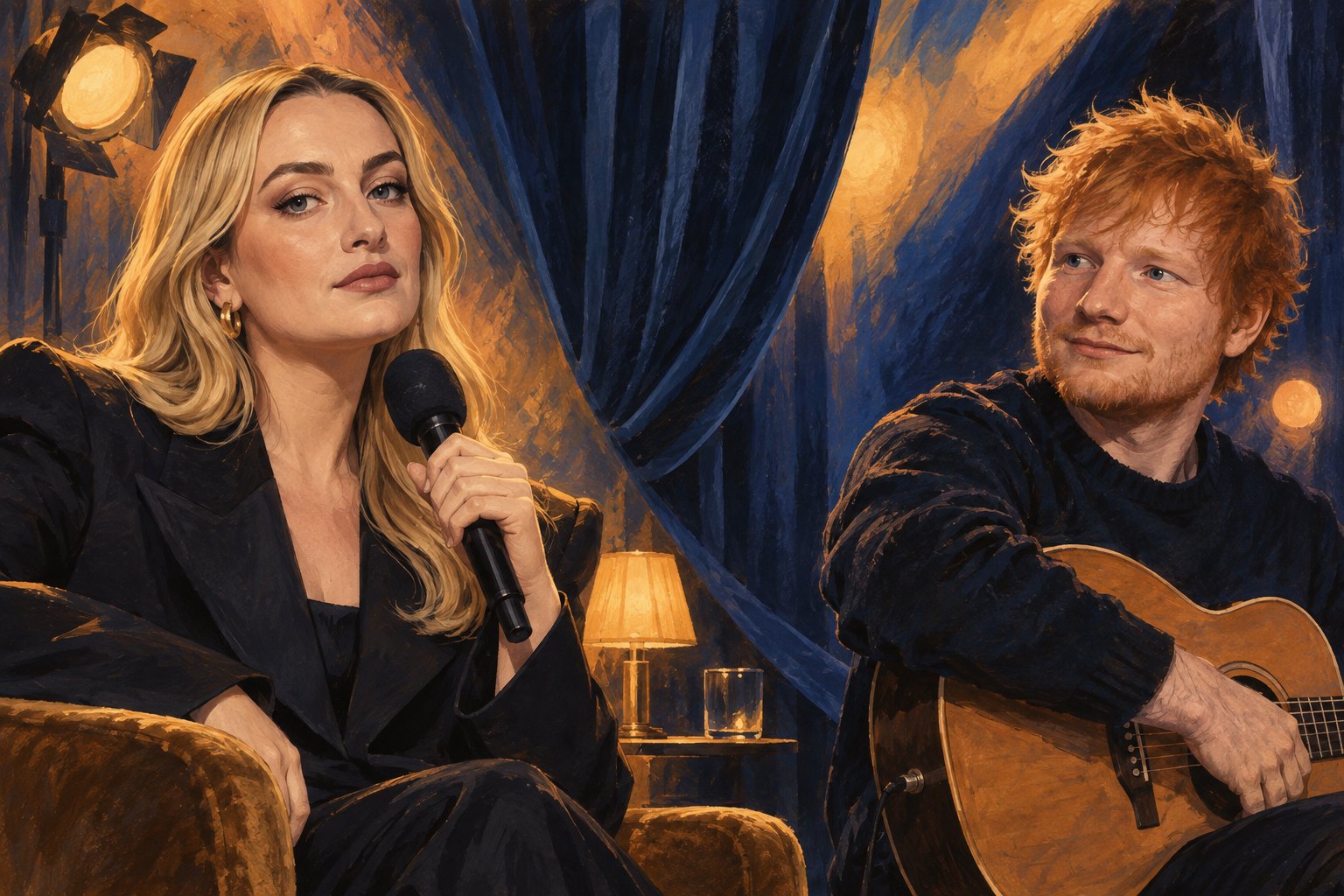
Amelia Dimoldenberg made Ed Sheeran the target of a roast on SNL UK, bringing the Chicken Shop Date host into a familiar but revealing television role: the celebrity who gets to puncture another celebrity’s image. TMZ reported the roast, while accompanying coverage highlighted the description “red-headed puppet.” That brief phrase carries the central tension. It begins with an instantly recognizable physical feature, then turns toward a much more pointed suggestion about independence.
The interesting critical question is what that transformation accomplishes. A joke can make a famous person look ridiculous without offering a persuasive interpretation of them. It can also compress a complicated public argument into an image so efficiently that viewers mistake the image for an explanation. Dimoldenberg’s reported jab invites both readings.
This is commentary on the reported roast and its language, rather than a review of the full episode. The distinction matters: a memorable insult provides something concrete to analyze, but it does not establish the quality of every sketch, the target’s reaction, or the truth of the suggestion inside the joke.
What the Reported Joke Actually Gives Us
The basic event is straightforward: Dimoldenberg roasted Sheeran on SNL UK. Coverage also placed the opening against a tour controversy. That context helps explain why the exchange has attracted attention, but the existence of controversy does not settle its merits. Nor does it give a critic permission to supply an unverified account of what Sheeran intended, who advised him, or how he felt about being mocked.
The phrase highlighted in coverage is useful precisely because it is compact. Its first element identifies; its second interprets. Red hair supplies the visual shorthand. The puppet comparison supplies the accusation embedded in the comedy: a person who appears to speak for himself might instead be performing someone else’s wishes.
That is a reading of the metaphor, not a factual finding about Sheeran. Keeping those categories separate makes the joke easier to discuss honestly. We can examine the character it constructs without accepting that character as a complete portrait of the real person.
The Character Built Into the Insult
Through a character-focused lens, the roast creates a miniature conflict between visibility and control. Sheeran is the recognizable figure at the center of the sentence, yet the metaphor imagines his agency elsewhere. He becomes simultaneously prominent and diminished: everyone can identify him, but the joke asks whether he controls what that recognizable figure says.
That contradiction is the strongest element of the reported wording. A generic insult merely lowers its target’s status. This one gives the audience a relationship to imagine, even without naming another participant. A puppet implies a puppeteer. The missing figure becomes part of the audience’s interpretive work.
It is also the phrase’s weakness. Leaving the controlling force unspecified makes the image flexible enough to accommodate almost any suspicion. Different viewers could hear it as a jab at publicity management, commercial pressure, or a failure of personal conviction. Those possibilities are interpretations, and the joke’s brevity cannot adjudicate between them.
My judgment is that the metaphor is efficient comic shorthand but incomplete criticism. It makes a claim feel concrete through a physical image. Whether that claim is fair requires evidence beyond the image itself.
Dimoldenberg’s Position Changes the Meaning
Dimoldenberg’s identification with Chicken Shop Date gives this story another layer. She enters the discussion as someone associated with celebrity encounters, then occupies the position of someone publicly judging a celebrity. Familiarity and distance become competing sources of authority: audiences may value an entertainer’s proximity to famous people while also expecting her to resist treating them too delicately.
That does not establish a personal falling-out or reveal a private opinion. A host delivering comedy is performing a public role. Treating every scripted insult as an unfiltered confession would flatten the distinction between the performer, the material, and the institution presenting it.
From the host’s perspective, the artistic challenge is making the line sound like a specific comic voice rather than a topical insult anyone could deliver. From the target’s perspective, the structural imbalance is obvious: the joke determines the version of him the audience is invited to consider. Neither perspective requires us to invent anyone’s thoughts.
Our discussion of Jalen Brunson’s SNL appearance and celebrity vulnerability approaches a related problem from the performer’s side. Here, the revealing issue is who gets to define the celebrity’s vulnerability in the first place.
Why the Full Performance Still Matters
A printed punch line preserves wording while stripping away many of the things that make screen comedy work. A pause can turn apparent friendliness into menace. A facial expression can establish that the speaker is playing a character. A transition can make an insult feel earned, abrupt, or deliberately excessive. These are criteria for evaluating the performance, not claims about how Dimoldenberg delivered this particular line.
The setup matters just as much. It establishes what the audience expects before the joke redirects that expectation. Without the complete sequence, a reader can evaluate the metaphor but cannot confidently measure the construction of the whole routine.
That is why declaring the entire appearance a triumph or a disaster on the strength of one reported remark would be premature. A line can be quotable and poorly integrated. It can also look blunt in print while functioning elegantly within a larger performance. The unit of criticism should match the evidence available.
A Sharp Roast Needs More Than a Recognizable Target
The fairest test of this kind of comedy is whether it reveals a particular contradiction. Recognizability gets the audience to the premise quickly; specificity determines whether the joke has somewhere interesting to go. If the insult would work equally well against almost any famous musician, its topical relevance may exceed its insight.
The puppet comparison at least proposes a subject: the gap between a public voice and independent judgment. For that subject to become substantial satire, the surrounding material would need to clarify the behavior being criticized. Otherwise, viewers are left filling the gaps with whatever they already believe about Sheeran.
Expectation can overwhelm the work itself. Our examination of how farewell expectations shape responses to Mike Leigh’s work considers a different example of that pressure. Here, an audience arriving for a celebrity takedown may reward severity before asking whether the observation is precise.
The Deeper Question Is Who Controls the Public Character
Dimoldenberg’s reported roast is most interesting as a contest over authorship of a public image. The joke temporarily replaces the musician’s self-presentation with a character created by comedy: recognizable, exposed, and supposedly directed by someone else. Its power lies in how quickly that replacement can happen.
Its limitation is the same speed. A vivid metaphor can outrun the evidence needed to support its implications. The strongest response is to hold both ideas together: appreciate the economy of the comic construction while refusing to confuse that construction with a verified account of a person. The roast gives audiences a pointed image of Sheeran. Whether it gives them a deeper understanding remains the more demanding question.
Original content by this site's editorial team. Published: September 27, 2026 at 10:43:55 PDT (Los Angeles time)