
Jason Voorhees is reportedly heading back to the big screen in a new Friday the 13th film. Pajiba reports that the franchise’s signature killer will return after years away. That makes the immediate attraction clear: another encounter with one of horror’s most recognizable figures. The more interesting question is whether the people facing him will feel as substantial as the threat.
A return announcement cannot establish how frightening, inventive, or satisfying the finished film will be. What it can do is send us back to the original Friday the 13th, where the relationship between Jason, his mother, and a surviving counselor offers a useful standard for another installment. The mask may sell the invitation, but someone else must make us dread what happens next.
Major spoilers follow for the 1980 film. This is a retrospective review and commentary on the reported return, not a review of the forthcoming movie.
Before Jason became the attraction, he was the wound
The essential fact about the original is also its most productive complication: Mrs. Voorhees is the killer. Jason’s reported drowning, and her conviction that negligent counselors were responsible, provide the motive. The film initially keeps the attacker’s identity hidden, letting the camp itself become an apparently hostile environment.
That structure makes a difference. Watching with the franchise’s later reputation in mind, we arrive expecting a familiar monster. The original instead reveals a mother who has made other people answer for her loss. Her pain is comprehensible; the leap from pain to collective punishment is monstrous.
For Pamela, reopening the camp means allowing ordinary life to resume in a place where her own life stopped. For the counselors, it means work, company, and a summer ahead. Those perspectives occupy the same location without sharing the same history. The horror grows from the fact that only one side knows a reckoning is underway.
My reading is that this mismatch gives the film more force than its reputation as a simple punishment machine suggests. The young people are not participating in Pamela’s private argument. She forces them into it. A future Jason movie could preserve that imbalance without repeating the original revelation: characters need their own reasons to be somewhere before the killer gives that place its terrible meaning.
Alice makes survival a problem of incomplete knowledge
Alice becomes the original film’s surviving center as the camp’s ordinary routines give way to discoveries of violence. She does not begin with the audience’s understanding of the genre. Missing friends, failed attempts to get help, and seemingly usable shelter acquire their significance piece by piece.
This is where the film works best for me. Suspense depends on a gap between recognizing that something is wrong and understanding what action might actually help. Alice must keep making decisions while the information behind those decisions remains unreliable.
From a comfortable seat, it is easy to treat a survivor’s hesitation as stupidity. From inside the situation, hesitation can be the cost of choosing between several bad possibilities. A room offers cover but might become a trap. Leaving it creates an escape route but exposes the body. The film turns simple geography into an argument that Alice must resolve under pressure.
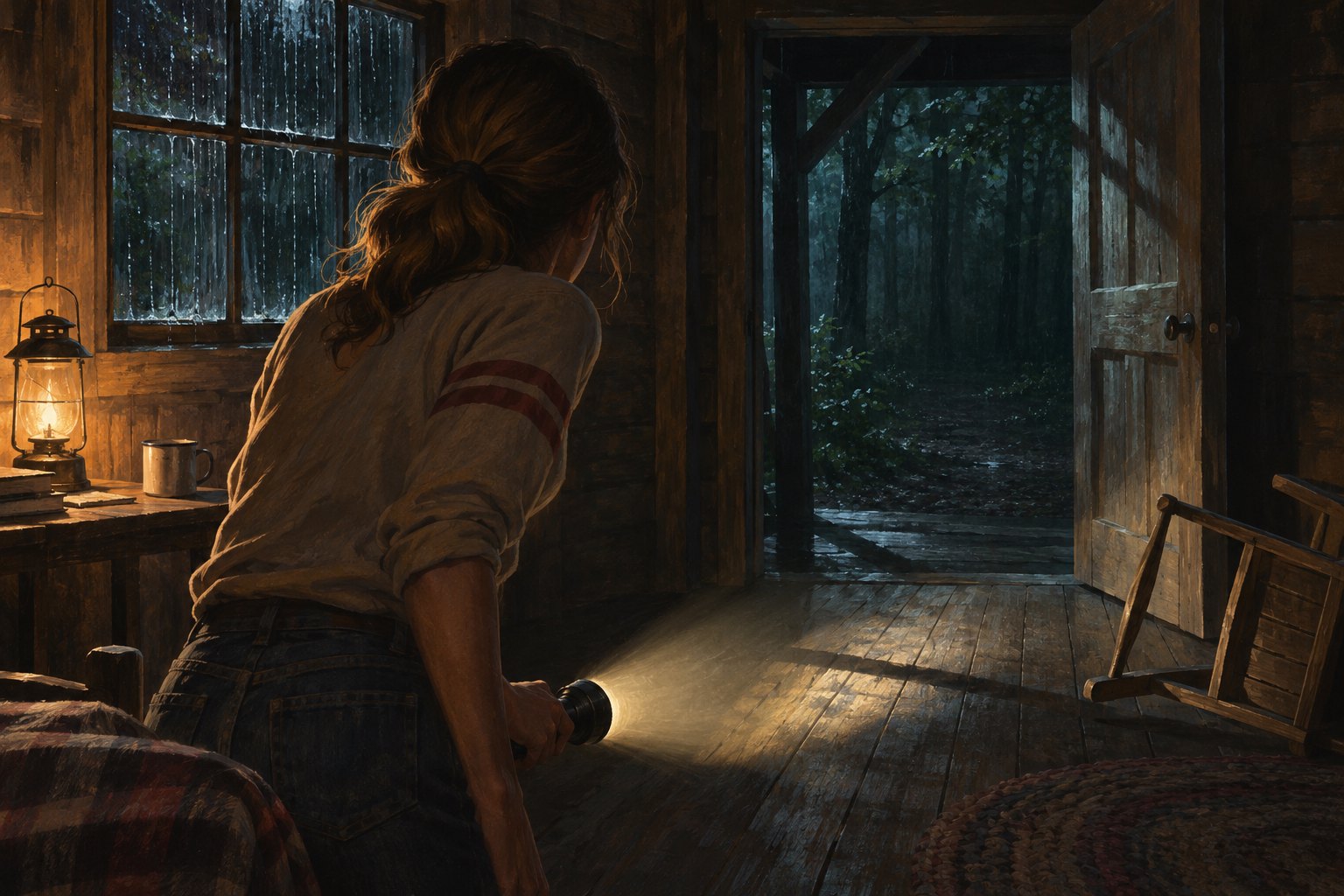
The original is less successful at giving every counselor an equally developed inner life. Some register more strongly as personalities or prospective victims than as people whose futures we can imagine. That limitation matters. An inventive death can deliver a momentary jolt; a lost relationship can keep hurting after the scene ends.
Our discussion of how character work makes screen stories believable applies even to a lean slasher. A gesture, a disagreement, or an unfinished conversation can establish something worth losing without stopping the movie for a biography.
Pamela’s comforting language becomes a threat
Mrs. Voorhees’s arrival briefly offers the possibility of adult reassurance. Her promise, “I’ll take care of you,” carries a familiar social meaning: someone capable has arrived, and the frightened younger person can surrender responsibility.
Once her role becomes clear, that language turns poisonous. Care and control have become inseparable in her thinking. She can speak with concern while pursuing someone who had no part in the original loss.
The line “Kill her, Mommy” makes the contradiction explicit. Speaking in a childlike voice, Pamela gives her violence the form of a request from Jason. In my interpretation, she is not simply remembering her son; she is making his imagined wishes authorize what she wants to do.
That distinction should remain uncomfortable. Explaining a killer’s emotional history does not require accepting the killer’s account of responsibility. Alice is not a stand-in who legitimately owes a debt. She is a person Pamela refuses to recognize as separate from the people she blames.
For another Friday the 13th, this offers a stronger dramatic foundation than adding explanatory speeches. The film can let us understand the history surrounding Jason while keeping the suffering of his victims in the foreground. Sympathy for a wounded child and terror of a killer can coexist without canceling each other.
The final shock takes safety away twice
Alice’s confrontation with Mrs. Voorhees ends at the lakeshore, where she decapitates her attacker. The subsequent canoe sequence appears to offer release before the startling image of young Jason emerging from the water. Alice then wakes in a hospital, where the boy’s presence is not corroborated.
The sequence works by changing the terms of relief. First, surviving the attacker seems sufficient. Then physical distance from the camp appears to promise safety. Finally, even the apparent security of waking elsewhere cannot settle what Alice experienced.
Her closing thought, “Then he’s still there,” is memorable because it refuses the emotional tidiness of rescue. The immediate danger may have ended, but her relationship to the world has changed.
I find that uncertainty more affecting than a straightforward promise of another attack. The ending makes survival an unstable condition. Alice has escaped, yet neither she nor the audience receives an explanation capable of containing the fear.
What Jason’s return should earn
A recognizable villain creates anticipation before a new movie has shown us anything. That is useful publicity, but it is not a critical verdict. As our commentary on why a forthcoming film’s role matters more than casting excitement argues, the eventual drama must justify the expectation.
For Jason’s return, I would look for three things: characters with competing needs, spaces whose layout makes danger legible, and consequences that survive the spectacle of a killing. None requires turning the series into a solemn lecture. Humor, speed, and outrageous shocks can still leave room for attachment.
The deeper promise of Friday the 13th lies in its conflict over who gets to move on. Pamela cannot tolerate the camp’s renewed life. Alice must fight for a future that another person’s grief threatens to erase. Jason occupies the disturbing space between the child who needed protection and the fear that outlasts the confrontation.
That is why bringing him back is only the beginning. The next film’s most meaningful achievement would be making us want someone else to get away—and making that escape feel like a life reclaimed.
Original content by this site's editorial team. Published: November 14, 2026 at 12:52:18 PST (Los Angeles time)