Hope builds its most interesting conflict around a police officer who needs to stop a monster but cannot entirely stop recognizing its suffering. Na Hong-jin’s science-fiction action film invites a character-focused reading: beneath the escalating pursuit lies a struggle between the instinct to survive and the obligation to understand. Its human defenders are frightened, improvisational, and sometimes dangerously certain of things they do not know.
The film pairs Hwang Jung-min’s police chief Bum-seok with Hoyeon’s officer Sung-ae, while Zo In-sung’s Sung-ki faces danger in the surrounding mountains. The official Cannes synopsis establishes their predicament: communications have failed, reinforcements are occupied with wildfires, and an elderly village population needs protection. [Cannes film profile](https://www.festival-cannes.com/en/f/hope/)
Spoilers follow for the creature revelations, character conflicts, and unresolved ending. This analysis draws on documented scenes and published accounts; the accompanying illustrations are symbolic artwork, not film stills.
Bum-seok: Authority Without Control
Bum-seok enters the crisis through something apparently manageable: an investigation into a mutilated cow. Hunters suggest a tiger might be responsible. His initial concern with their unregistered firearms belongs to a recognizable world of regulations and local irritation. The disaster that follows makes those familiar categories inadequate.
His bewildered question, “Where did all these guns come from?”, captures the comic mismatch between his position and his circumstances. As documented in Sight and Sound’s Cannes review, the village’s improvised resistance includes an astonishing quantity of weaponry. The police chief remains responsible for public safety while losing any meaningful monopoly on force. [Sight and Sound’s account](https://www.bfi.org.uk/sight-and-sound/reviews/hope-big-bold-south-korean-creature-feature)
That contradiction provides a useful way to understand his character. Authority usually promises that someone can assess a situation and issue sensible instructions. Bum-seok instead has to make decisions while the nature of the situation keeps changing. His fear does not automatically disqualify him from leadership. It reveals how little protection the role itself offers.
The distinction matters for action cinema. A character can be courageous because he understands the danger and acts anyway; he can also be reckless because he mistakes incomplete knowledge for certainty. Bum-seok’s uncertainty leaves room for both possibilities.
Sung-ae and Sung-ki: Two Ways to Meet the Emergency
Sung-ae shares the immediate responsibility of defending the village. Sung-ki and the local hunters, meanwhile, venture into terrain where the relationship between pursuer and prey reverses. Those parallel situations give the story two practical questions: how do you protect people who cannot escape, and what happens when tracking a threat brings you closer to something you cannot comprehend?
The Harvard Crimson’s account emphasizes Sung-ae’s determination and Sung-ki’s fearlessness, alongside the community’s personal connections. These are people defending neighbors, rather than an interchangeable crowd assembled for destruction. [The Harvard Crimson’s Cannes review](https://www.thecrimson.com/article/2026/6/1/hope-review/)
My reading is that the distinction between the two roles matters more than a simple ranking of bravery. Defense demands attention to other people’s limitations. Pursuit encourages forward movement. Both can save lives, but each carries a different temptation: to hesitate too long, or to continue because turning back would mean admitting uncertainty.
That emphasis on vulnerable people also connects with the question raised in our discussion of meaningful survival horror in Resident Evil: danger becomes dramatically useful when it puts a particular person’s judgment under pressure.
Comedy Makes Heroism Look Unreliable
Another revealing line asks, “When did your cousin become so good at riding a horse?” Sight and Sound records it as part of the film’s commentary on sudden heroic competence. The joke notices something action movies frequently ask audiences to accept without question: an ordinary person abruptly possesses exactly the skill a spectacular escape requires.
That observation creates a productive tension. We can enjoy a character’s improbable resourcefulness while recognizing the absurdity of the situation. The joke does not have to cancel the suspense; it can expose how eagerly we want someone to become capable enough to survive.
There is a related pleasure in our Life of Brian analysis of misunderstanding and misplaced certainty. The genres differ, but both invite attention to the distance between what people believe they are doing and what their behavior actually accomplishes.
The Creature’s Tears Change the Question
The decisive emotional complication is the creature’s visible distress. The Santa Barbara Independent describes its tearful eyes during pursuit and the later expansion of the alien characters’ story. Those details challenge an uncomplicated division between the people who deserve protection and the bodies that exist to be destroyed. [The Santa Barbara Independent’s review](https://www.independent.com/2026/09/17/film-review-monstrous-action-figure-study/)
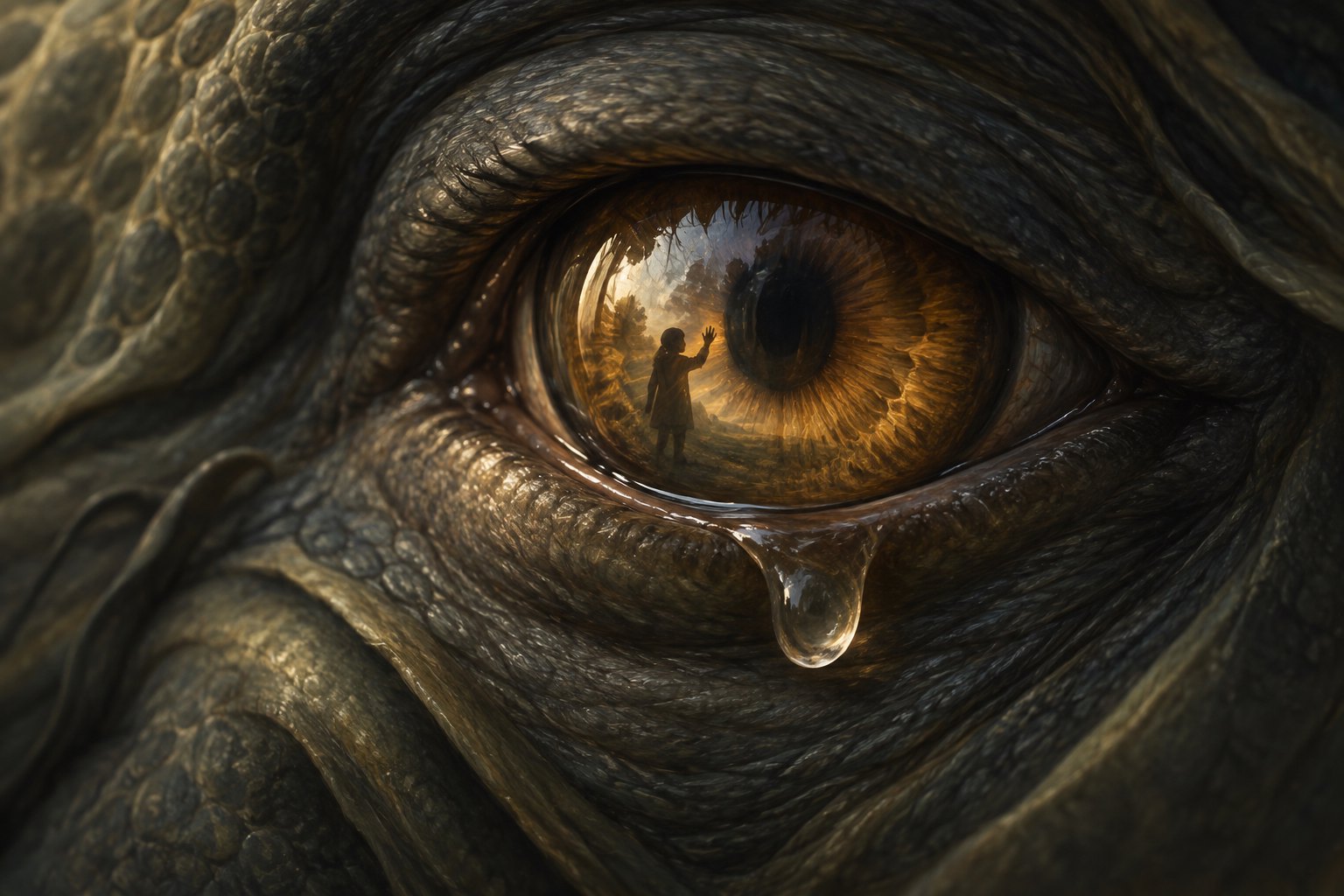
The Harvard Crimson also identifies Bum-seok’s difficulty firing after seeing the creature cry. Read alongside Yang-bae’s disregard for other lives, the hesitation establishes a moral difference between characters who are nominally on the same side.
Compassion here need not mean denying the threat. Someone can be dangerous and still experience pain. The harder question is whether recognizing that pain should change a response when other lives remain at risk. That is a more demanding conflict than discovering that an apparent monster was harmless all along.
When Escalation Becomes Exhaustion
The Independent describes extended agitation, a temporary relaxation into humor and character material, and a later climactic vehicle pursuit. Its reservations about the accumulating action suggest the film’s central formal risk: sustained intensity can make distinct encounters begin to feel equivalent.
For this reading, the measure of an action sequence is what changes inside it. Does someone learn something? Does a rescue expose a relationship? Does another attack confirm a fear or undermine an assumption? Movement earns its length when it alters the characters’ understanding. Otherwise, greater scale may offer diminishing emotional returns.
The Ending Leaves Understanding Unfinished
The ending resists a settled victory. Watch Darkly’s detailed account distinguishes what the characters conclude from what the film establishes, particularly around the dead alien child and the attacking creature’s relationship to that loss. It also records the closing alien instruction, “Change fate.” [Ending and credits-scene breakdown](https://www.watchdarkly.com/articles/hope-2026-ending-explained)
That distinction is essential: Bum-seok’s explanation should not become unquestioned truth simply because he is the human protagonist. My interpretation is that the film’s deeper challenge concerns the speed of judgment. Its characters must act immediately, while understanding arrives slowly and incompletely. The title can therefore suggest something smaller and more difficult than victory: the possibility that a response might still change after fear has already produced violence.
The Credits Coda
The same ending account describes Sung-ki returning after the first block of credits, injured but alive following his apparent death. This is a narrative coda rather than a hidden reference. It offers the audience knowledge the other characters lack, adding a small survival to a crisis that remains unresolved. Hope survives as a possibility, not a guarantee.
Original content by this site's editorial team. Published: September 17, 2026 at 22:09:32 PDT (Los Angeles time)