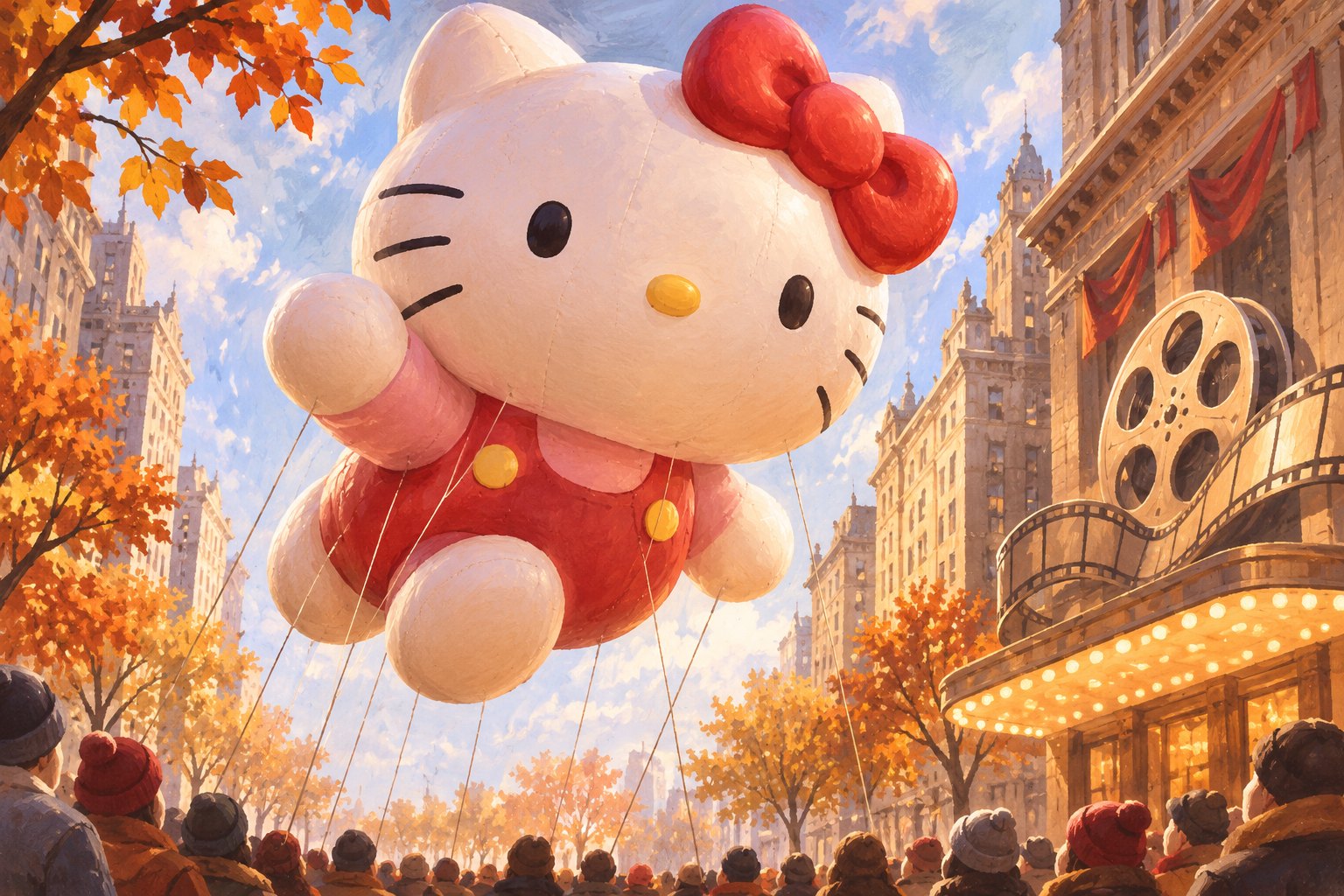
Hello Kitty’s Thanksgiving parade spotlight brings a larger screen ambition into view. Variety reports that Sanrio executives are discussing an animated movie with Warner Bros., video game plans, and a strategy for connecting with Gen Alpha. For moviegoers, the central question is what kind of storytelling can turn such immediate recognition into sustained emotional interest.
A parade appearance can make a familiar character feel larger than life. A feature film has to make that character feel specific: someone whose decisions we understand and whose disappointments we care about. That is the most interesting creative challenge behind Hello Kitty’s next move.
This is a spoiler-free analysis of the announced direction, not a review of a completed film. Story possibilities discussed below are critical considerations, not confirmed plot details.
What the Hello Kitty movie news establishes
The reporting connects three ambitions: an animated Warner Bros. movie, video games, and an effort to reach a younger generation. The Thanksgiving parade provides the public-facing occasion for that conversation. Together, these elements suggest that Sanrio wants audiences to encounter Hello Kitty across different forms of entertainment.
The word “magical” appears in the coverage of the executives’ movie tease. It is an evocative promise, but it does not establish a fantasy premise, a particular visual style, or a story about supernatural powers. It should be understood as a description of ambition until the film itself supplies something more concrete.
There is no basis here for evaluating performances, quoting movie dialogue, explaining an ending, or identifying Easter eggs. Those judgments require actual scenes. What can be assessed now is the adaptation problem: how a character with an immediately recognizable presence becomes the emotional center of a feature.
A parade rewards recognition; a movie needs progression
Parades and movies ask different things of their audiences. A parade character can deliver pleasure in a brief encounter. Recognition happens almost instantly, and the moment can be complete without a story attached. Cinema unfolds over time. An opening image may attract attention, but the next scene needs to change our relationship with it.
For Hello Kitty, that means a successful film will need to establish a desire, place something meaningful in its way, and allow the response to reveal character. None of this requires a dark reinvention or an enormous threat. A small disappointment can carry considerable weight if the audience understands why it matters.
My preference would be for a film confident enough to let seemingly modest stakes breathe. Family animation can make belonging, embarrassment, or a broken promise feel consequential through observation and timing. Spectacle becomes more involving when it expresses an emotional problem we already understand.
The distinction between a recognizable property and an accomplished animated film also runs through our discussion of how familiar animated franchises should be judged beyond their names. Recognition helps viewers arrive. Character development gives them a reason to stay.
The character question: what will Hello Kitty choose?
The most useful question for an adaptation is often what its protagonist does when two worthwhile things cannot both happen. A choice creates a point of view. It tells us what someone values, what they misunderstand, and what they may need to learn.
A gentle central character still needs agency. If supporting characters make every decision while the protagonist simply inspires affection, the story can feel strangely empty at its center. Hello Kitty should matter to the outcome through action, whether that action is speaking up, listening carefully, accepting help, or changing course. These are possible dramatic tools, not descriptions of the announced screenplay.
Kindness, in particular, becomes interesting when it requires judgment. Helping someone can involve respecting a boundary. Bringing people together can mean acknowledging a disagreement instead of smoothing it over. Such tensions could give an inviting screen presence emotional complexity without requiring the film to abandon its warmth.
Supporting characters would also need room to want things independently. An ensemble becomes memorable when affection coexists with friction: different priorities, mismatched expectations, competing ideas about what would make everyone happy. A collection of appealing faces is a starting point; relationships develop through the ways those faces respond to one another.
Video games and movies create different kinds of attachment
Sanrio’s discussion of games alongside the movie makes the distinction between participation and observation especially relevant. In a game, attachment can develop through actions the player repeats or chooses. In a film, the audience follows decisions made by the characters and shaped by the filmmakers.
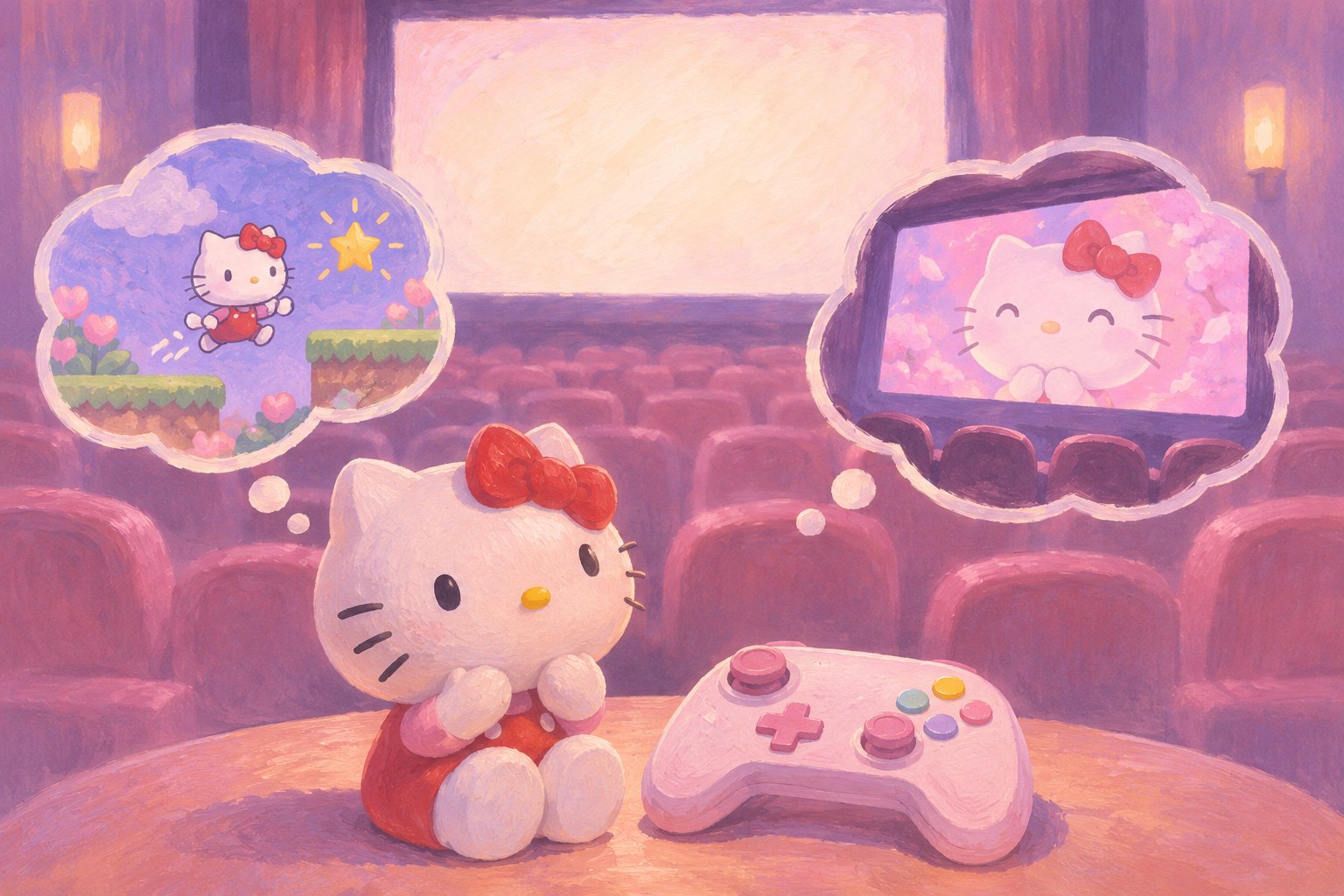
That difference matters even when both experiences share a welcoming atmosphere. An activity can remain satisfying in a game because the player controls its pace. A movie sequence needs its own dramatic rhythm: anticipation, variation, surprise, or an emotional change. Simply reproducing familiar activities would not automatically create compelling scenes.
The strongest relationship between these formats would let each offer a complete experience. A viewer should not need familiarity with a game to understand a friendship or recognize why a decision hurts. References can reward existing fans, but essential emotional information belongs inside the film.
A related question appears in our coverage of how different screen formats can reveal different sides of a familiar subject. Changing the format creates an opportunity to offer a new perspective. Repeating the same attraction in another container is a more limited ambition.
Reaching Gen Alpha without writing to a demographic label
The Gen Alpha strategy gives this expansion a clear business context. It does not, by itself, tell us what the film’s young viewers will find funny, moving, or memorable. A demographic category is too broad to function as a personality.
Creatively, I would rather see precise emotional observation than dialogue built around presumed youth trends. Wanting to join a group, fearing that a friend has moved on, or struggling to admit a mistake can become distinctive through characterization. The situation may be familiar; the response should feel particular to the person experiencing it.
Nor should accessibility mean explaining every feeling aloud. Animation can communicate through posture, distance, movement, color, and the length of a pause. Giving young viewers space to notice these details can make them active interpreters of the story, even while they remain spectators.
What would make the promise of magic meaningful?
For me, the deeper opportunity is to explore the distance between being recognized and being understood. Hello Kitty’s public familiarity creates a useful starting condition: many viewers will arrive with an emotional association already in place. The film can then make that attachment more specific through experience.
A meaningful payoff would leave audiences remembering a decision, a relationship, or a moment of vulnerability alongside the character’s appearance. That is how an adaptation earns an emotional identity of its own.
The parade, movie, and game ambitions make Hello Kitty’s reach the immediate news. The artistic test will happen at a smaller scale: within a scene, between characters, when an appealing presence has to make a choice. If the film makes that choice matter, its promise of magic will have something solid beneath it.
Original content by this site's editorial team. Published: November 26, 2026 at 18:25:18 PST (Los Angeles time)