Hans Christian Andersen is the subject of an animated biopic in development from Illustrious Media Group and a Black List writing duo, according to Deadline. The combination offers an appealing possibility: a film that uses animation to explore the person doing the imagining. Its most consequential creative decision will be how much attention it gives that person when the magic begins.
The development news establishes a project, not a finished movie to evaluate. This is a spoiler-free look at its dramatic potential, rather than a review of performances, scenes, or dialogue. The announcement alone cannot tell us how the film depicts Andersen, which events it dramatizes, or whether its visual approach serves its central character.
My interest lies in a particular tension. A storyteller’s reputation can make a biopic immediately recognizable, but recognition does not supply a dramatic life. The film will need to make Andersen’s immediate desires matter even to viewers who arrive knowing little about him.
What the Development News Actually Establishes
The firm starting points are limited: the subject is Hans Christian Andersen, the proposed form is an animated biopic, and Illustrious Media Group and a Black List duo are associated with its development. Those facts provide a useful foundation for discussing the concept. They do not establish the quality of a screenplay or the emotional effect of a completed film.
Readers looking for a release date, voice cast, animation style, or detailed plot should distinguish those separate questions from the existence of the project. None can be answered from the announcement summarized here. Likewise, the Black List association is a reason to notice the writing team, not a substitute for judging what eventually appears onscreen.
That distinction matters because a promising announcement can invite premature praise. As with our discussion of the character opportunities behind Freya Allan’s System casting, the useful critical exercise is identifying what the premise needs to deliver. Enthusiasm becomes more meaningful when it has specific expectations attached.
Andersen Must Want Something Beyond Becoming Famous
A biographical protagonist can easily become trapped inside the audience’s knowledge of the future. Every disappointment starts looking like preparation for greatness; every conversation becomes an opportunity to foreshadow an achievement. The result may honor a reputation while leaving the person strangely inaccessible.
For this Andersen film, a stronger approach would be to organize scenes around immediate wants. What does he need from the person across the room? What would make him feel heard? What is he unwilling to admit? These are questions for the filmmakers, not claims about the screenplay. Their value is that they turn an admired name into someone whose next choice could surprise us.
From a character’s perspective, an eventual legacy offers little comfort during an unresolved encounter. A request can be refused. An attempt at connection can misfire. A success can fail to provide the satisfaction expected of it. If the film finds room for that uncertainty, Andersen’s imagination could emerge as part of an active emotional life rather than an attribute the audience is asked to applaud.
The supporting characters would need comparable independence. Friends, rivals, collaborators, or family members, if included, should have desires that exist beyond encouraging or obstructing the protagonist. A convincing biopic allows other people to misunderstand its central figure without automatically making them foolish or cruel.
Animation Can Make Perspective Visible
Animation offers this project more than the ability to place fantastic objects beside a historical figure. It can change how an ordinary experience feels. Scale, movement, texture, and the relationship between a body and its surroundings can communicate a character’s state of mind before anyone explains it.
Consider the possibilities in purely hypothetical terms. A room could seem to widen as a conversation becomes uncomfortable. A rigid composition could loosen when an idea arrives. An object could acquire an exaggerated presence because the protagonist cannot stop thinking about it. Such choices would be valuable if they clarify Andersen’s perspective and influence how we understand his behavior.
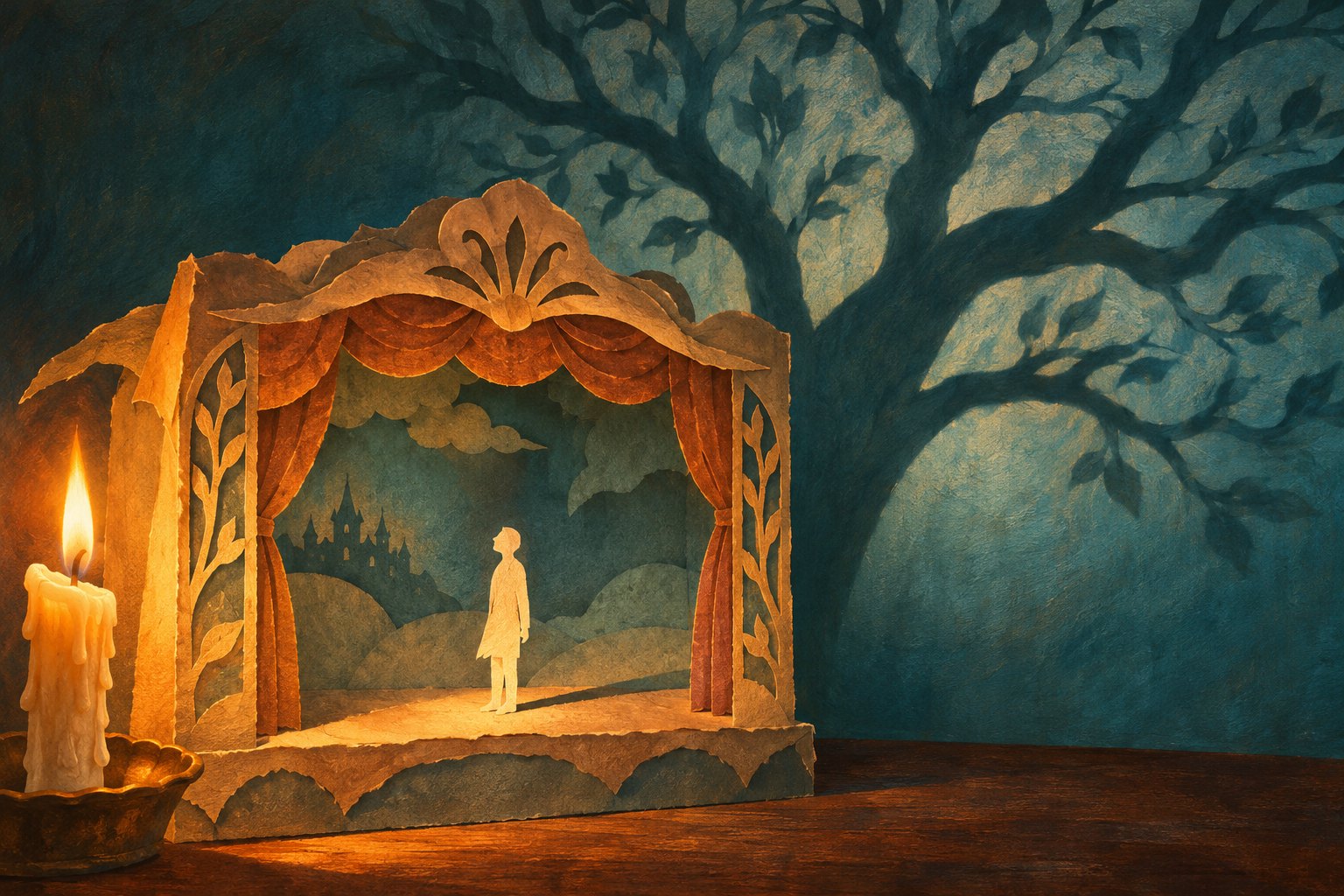
The accompanying illustration suggests that expressive possibility; it does not depict a scene from the production. A small figure and a disproportionate shadow can imply vulnerability, invention, or self-importance without fixing a single interpretation. That ambiguity is something an animated biography could use well.
Visual invention also needs rhythm. If every feeling produces an elaborate transformation, the audience may lose its sense of emphasis. A held expression, an unfinished gesture, or an unexpectedly quiet frame could give the more expansive passages their emotional weight. The medium’s flexibility includes the freedom to be still.
The Risk of Turning Creativity Into a Simple Explanation
One temptation in a writer’s biopic is to attach each creative idea to a conveniently identifiable incident. A person says something; the future author looks thoughtful; a familiar work suddenly seems explained. This can produce a pleasurable moment of recognition, but repeated too often it reduces imagination to transcription.
I would prefer an Andersen film that allows experience to change shape. Art can combine observation, invention, revision, and contradictory feelings. A dramatization does not have to diagram that entire process, but it should leave room for the difference between encountering something and making a story from it.
There is a related issue of historical clarity. Fantasy sequences could communicate subjective experience beautifully, yet they cannot serve as evidence that an event occurred. A strong film would establish an intelligible relationship between its biographical world and its imaginative passages. Viewers should be able to engage with the invention without mistaking every expressive detail for a documented memory.
Wonder Needs Emotional Consequences
The most promising version of this concept would give wonder a dramatic job. An imaginative passage might change what Andersen understands, expose something he avoids, or complicate a relationship. When he returns to an ordinary interaction, something should feel different because of what the audience has experienced with him.
Our character-focused reading of The Princess Bride considers how affection and storytelling work together. That relationship offers a useful question here, too: who is a story reaching, and what happens between people when it reaches them? A writer’s imagination becomes dramatically interesting when it has consequences outside his own head.
Humor could be equally revealing. There is room for comedy in the distance between how a protagonist sees himself and how others experience him. Allowing Andersen to be awkward, mistaken, or funny would not inherently diminish the film’s respect for its subject. Depending on the execution, it could make that respect feel earned.
The Most Interesting Promise Is a Change in How We See
For now, this animated biopic deserves curiosity rather than a verdict. Its premise creates opportunities for expressive filmmaking, but the announcement gives no basis for praising specific dialogue, identifying memorable scenes, or cataloging Easter eggs.
The deeper opportunity is to explore storytelling as a relationship between attention and invention. A compelling film could ask what its protagonist notices, what he overlooks, and how those habits affect the people around him. That would make imagination an aspect of character with pleasures, limits, and responsibilities.
If the eventual movie makes viewers care about Andersen’s choices before asking them to admire his legacy, its fantasy will have somewhere meaningful to begin. The spectacle may draw us toward the screen. Understanding the person looking back would give us a reason to stay.
Original content by this site's editorial team. Published: November 16, 2026 at 06:38:07 PST (Los Angeles time)