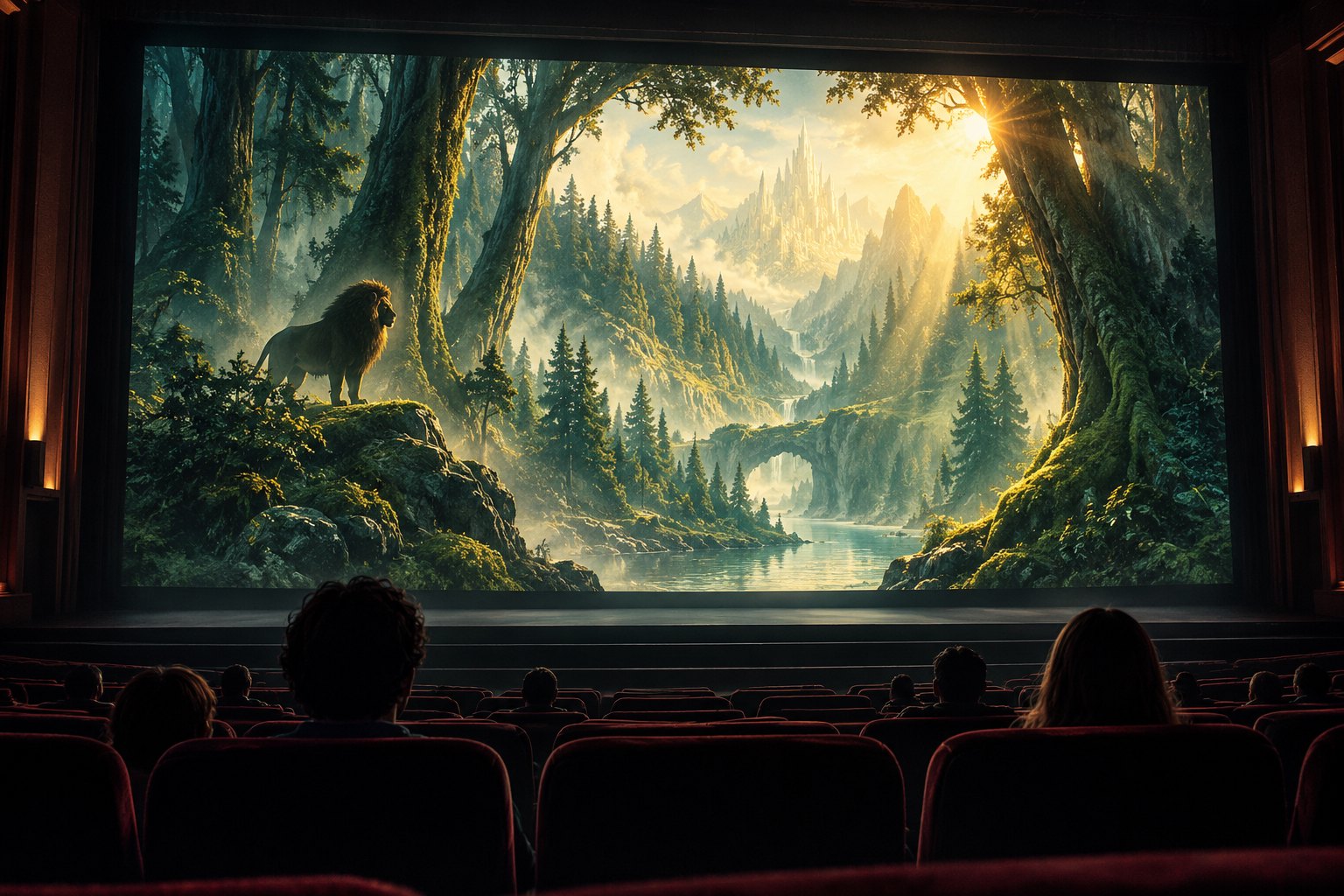
Greta Gerwig has debuted a Narnia trailer, and the most interesting idea accompanying it concerns the relationship between spectacle and intimacy. The Hollywood Reporter’s coverage pairs the unveiling with her discussion of telling a personal story on “the biggest screen you can imagine.” That ambition gives audiences a useful question to carry into the film: will its enormous world bring us closer to the people experiencing it?
The distinction matters. A fantasy can impress us with its dimensions before giving us a reason to care about anything inside them. Gerwig’s emphasis on intimacy suggests a more demanding goal, one in which visual grandeur acquires meaning through individual feeling. My view is that this is the strongest possible starting point for a Narnia adaptation, provided the finished film makes that relationship tangible.
This is spoiler-free commentary on the trailer announcement and Gerwig’s stated ambition, not a review of the completed film. It does not assign unseen scenes, dialogue, character arcs, or an ending to her adaptation.
What the Trailer Debut Actually Establishes
The announcement establishes a trailer unveiling and a creative intention. Those are meaningful developments, but they answer different questions. The unveiling introduces the film to an audience; the discussion explains something about the experience Gerwig hopes to create. Neither, by itself, establishes how successfully the full story sustains its emotional perspective.
A trailer compresses. A feature develops. An expression that feels moving in a promotional montage might acquire greater depth through the surrounding scenes, or it might turn out to carry more emotional weight in isolation. The essential evidence lies in the connections: what precedes a decision, what follows it, and whether the person making it changes in a believable way.
That distinction also informs our discussion of what early reactions can reveal about a movie’s performances. Anticipation becomes more useful when it identifies specific dramatic questions instead of treating enthusiasm as a verdict. For Gerwig’s Narnia, the central question is already unusually clear: how does a film preserve personal stakes while expanding its physical scale?
Character Perspective Gives a Fantasy Its Size
Scale is relational. An unfamiliar landscape feels immense because someone must find a way through it. A powerful presence feels intimidating because someone has to decide whether to approach. Without a recognizable perspective, even an elaborate setting can become visual information that passes before our eyes without leaving much behind.
For a character-centered fantasy, the crucial issue is therefore less how much the camera reveals than whose experience organizes the revelation. Does the audience learn something when a character learns it? Are we allowed to share uncertainty? Does an imposing space become reassuring, threatening, or tempting as that person’s understanding changes?
These are criteria for evaluating the adaptation, rather than descriptions of particular scenes. They explain why Gerwig’s emphasis on intimacy is consequential. A film can make viewers feel small in an exciting way, but it can also make its characters seem incidental. The difference often rests on whether a spectacular image develops an emotional situation already in motion.
I would look especially closely at the moments immediately after a revelation. Surprise is comparatively easy to communicate. What someone does with that surprise is where characterization begins. A glance toward a companion, a refusal to move, or a question asked too quickly can establish a distinct personality more effectively than a speech explaining it.
A Large Screen Can Make Small Gestures Matter
There is no inherent contradiction between an intimate story and an enormous image. A large screen can give a hesitant expression extraordinary prominence. It can make the distance between two people feel uncomfortable, or allow a tiny movement within a wide composition to draw the eye. The artistic challenge is directing attention within that space.
Consider the difference between seeing an impressive environment and watching someone hesitate at its edge. In the first case, the setting supplies the attraction. In the second, it becomes part of a decision. The audience begins wondering what the person fears, what they want, and whether anyone will follow them. Physical space becomes dramatic pressure.

Gerwig’s ambition will be most persuasive if the film gives such gestures time to register. Intimacy requires duration as well as proximity. A close-up cannot do all the work if the editing moves away before a feeling becomes legible. Equally, a distant figure can hold our attention when the film has taught us what that person stands to lose.
Sound Must Leave Room for a Point of View
The same principle applies to sound. An expansive soundtrack can create excitement, but constant emphasis may flatten the distinctions between discovery, danger, and relief. If every moment announces its importance at the same intensity, an audience has fewer opportunities to discover an emotion for itself.
A character’s perspective can shape what we hear as much as what we see. A nearby breath, a voice across an empty space, or a pause before an answer can make a large setting feel intensely personal. These are possibilities for evaluating the film’s storytelling, not claims about its actual sound design.
Our commentary on how film music shapes our understanding of character explores this relationship further. The useful question is whether sound gives us access to a person’s experience. For Narnia, that would mean allowing wonder to have different emotional textures rather than treating it as one continuous crescendo.
The Emotional Test Is What Survives the Spectacle
When the finished film can be assessed, three questions will matter most to this reading. Can we identify what its central characters want beyond reaching the next destination? Do extraordinary experiences alter their relationships? And do consequential choices emerge from the personalities the film has established?
Those questions also explain why memorable dialogue cannot responsibly be selected in advance. A line becomes memorable through its place in a relationship: who says it, what it costs to say, and how its meaning changes afterward. Borrowing familiar words from another version would tell us little about the emotional achievements of this one.
My deeper reading of Gerwig’s stated ambition is that intimacy could provide the organizing principle for the entire spectacle. An imagined world becomes meaningful when its size changes someone’s sense of responsibility, dependence, or possibility. The wonder then belongs to a developing human experience rather than remaining an attractive backdrop.
That is the promise worth following after this trailer debut. The eventual measure of Gerwig’s Narnia will be whether viewers remember the people inside its grand images with equal clarity. A vast screen can hold an intimate story. The lasting achievement would be making every expansion of that world bring its emotional stakes into sharper focus.
Original content by this site's editorial team. Published: October 14, 2026 at 03:35:43 PDT (Los Angeles time)