Greg Cosell’s Film Study Week 9 is a Cleveland Browns football-analysis item, rather than a feature film with a screenplay, fictional characters, or a dramatic ending. For anyone arriving through the phrase “film study,” that distinction matters immediately. The useful question is how watching game footage can reveal the decisions beneath a result—and how viewers can evaluate an explanation instead of simply accepting it.
This is an editorial viewing companion, not a recap or a review of the episode’s individual arguments. The title and publisher establish the subject; specific plays, player assessments, and quotations are not established here. What follows is a framework for approaching the Week 9 study with curiosity and a critical eye.
Start With What the Footage Can Actually Show
The appeal of football film study is the possibility of replacing a broad reaction with a precise observation. A failed play invites an immediate judgment. Watching it again creates space to ask what happened before the failure became obvious: where players lined up, which movements changed the available space, and when a decision had to be made.
That is the standard I would bring to Cosell’s Week 9 installment. A useful explanation should help a viewer locate its evidence. If the claim concerns timing, the relevant moment should be identifiable. If it concerns positioning, the relationship between players should be visible. Technical vocabulary becomes valuable when it directs attention toward something the audience can examine.
There is also a necessary limit. A camera records movement, but movement alone does not disclose every assignment, instruction, or thought. An analyst may infer an intended responsibility from the arrangement of a play. Viewers should still distinguish that inference from something directly observable. The strongest interpretation makes its reasoning legible.
Read the Play From the Player’s Position
Character-centered movie criticism asks what a person knows when a choice becomes necessary. A related question helps with game footage: what information was available to the player at the moment of action?
Consider a hypothetical passing play. A receiver appears open late in the replay, after the quarterback has already released the ball elsewhere. That later opening does not, by itself, establish that the earlier decision was poor. The useful comparison concerns the receiver’s position, the pressure, and the available throwing lane at the time the quarterback could act.
This example is not a description of a play in Cosell’s Week 9 segment. It illustrates a viewing habit: stop the sequence at the decision, then examine the options. Otherwise, the spectator’s knowledge of the ending can quietly become an unfair expectation that the athlete should have known it too.
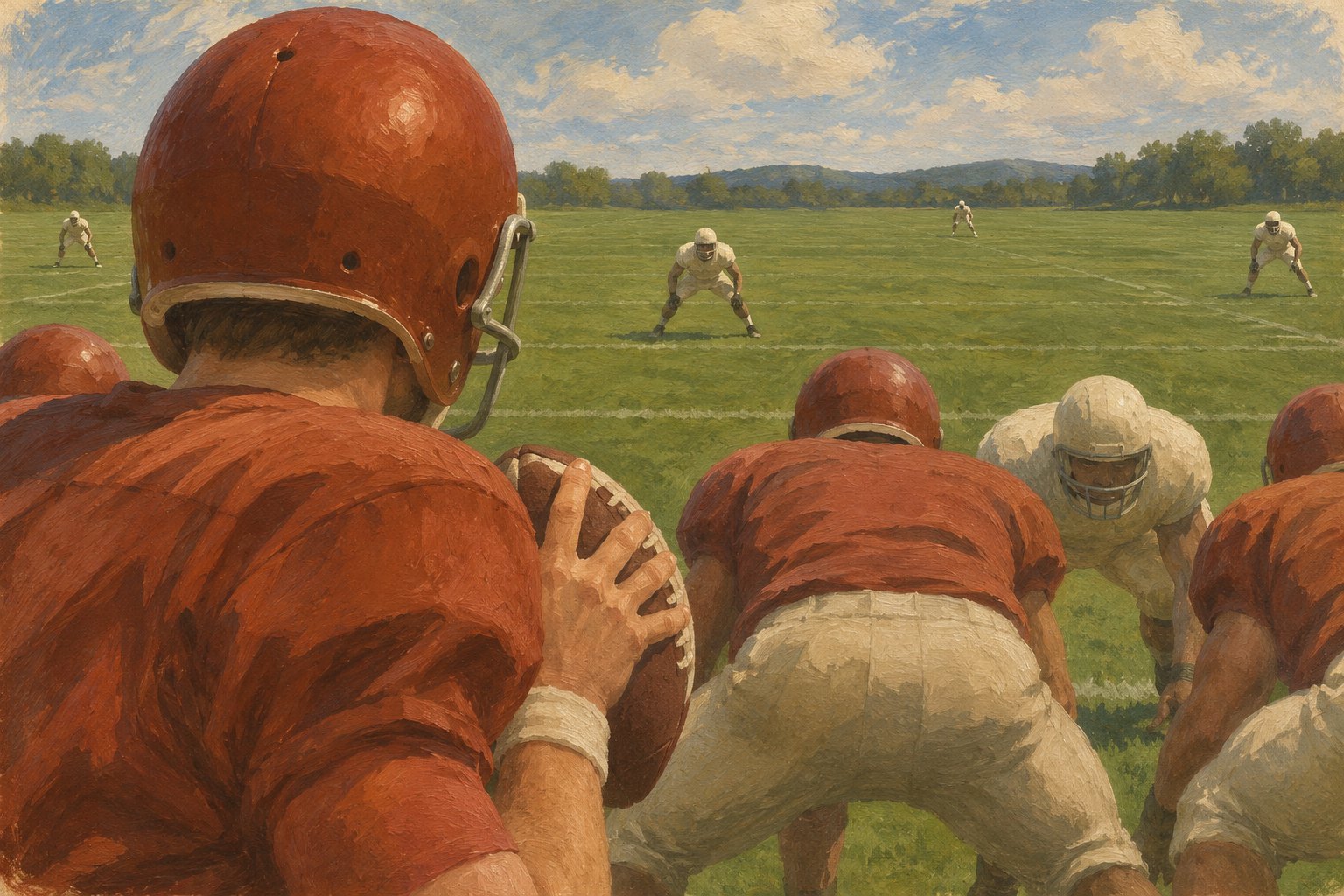
The image above is a conceptual illustration, not a reconstruction of game footage. Its obstructed viewpoint captures the question worth carrying into a replay: how much of the field is meaningfully available to the person making the choice? A high camera angle can make relationships clear to viewers while concealing how difficult they are to recognize from within the action.
Perspective also shapes the viewing questions in our discussion of Jet Lag: The Game and the importance of incomplete information. Knowing more than a participant can make an audience feel perceptive. Understanding the participant’s limits demands a more patient kind of attention.
Follow Someone Who Never Touches the Ball
For a second viewing, choose a player away from the ball. Follow that person from the beginning of the sequence until the relevant action ends. This simple exercise changes the apparent center of the play.
A route may matter because of the defender it draws. A block may create an opportunity that the ball carrier makes visible a moment later. A defender’s positioning may discourage an option that never becomes a pass. These are general possibilities to investigate, not conclusions about the Week 9 footage.
The important discipline is to resist converting possibility into certainty. If a receiver moves a defender away from a space, that relationship is visible. Whether creating that space was the receiver’s primary assignment may require additional context. Good viewing preserves the distinction.
For film enthusiasts, this resembles watching a scene’s background performers or noticing who holds another character’s attention. The central action becomes easier to understand when the surrounding relationships come into focus. Football players, however, are real competitors, and a moment on tape should not be treated as evidence of a scripted personality.
Use Slow Motion Without Losing the Clock
Replay gives viewers time that the players never had. That makes it useful for identifying a sequence and potentially misleading for judging its difficulty.
A pause can expose the instant when space opens. Slow motion can clarify which movement comes first. Neither reproduces the pressure of recognizing that opening and responding before it disappears. An assessment built entirely around a frozen image risks overlooking the very quality it claims to explain: timing.
My preferred approach is to move between ordinary speed and a closer inspection. First, watch the action continuously. Next, isolate the detail under discussion. Finally, return to ordinary speed and ask whether the explanation still fits the pace of the event. A persuasive breakdown should survive that return.
A Practical Checklist for the Week 9 Study
When approaching Greg Cosell’s Film Study Week 9, use these questions to organize your attention. They do not presume which footage the installment contains or what Cosell concludes.
- What is the claim? Identify whether the explanation concerns a decision, technique, spacing, or the final outcome.
- Where is the evidence? Look for the specific movement or moment that supports the claim.
- What does the camera omit? Notice whether an important player or part of the field falls outside the frame.
- What is inferred? Separate visible behavior from assumptions about assignments or intentions.
- Does the conclusion fit the sample? One sequence may explain one result without establishing a player’s usual performance.
That final distinction is especially useful. A vivid example can feel representative simply because it is memorable. Repetition across comparable situations would support a broader judgment more strongly than one striking success or mistake.
The Deeper Value: Learning to Revise a First Impression
My view is that film study earns its value when it changes how someone watches the next sequence. An explanation that merely supplies a confident verdict leaves the audience dependent on the speaker. An explanation that makes evidence understandable gives the audience a skill.
That distinction also informs our commentary on separating predictions from critical judgment in Movies Fantasy League. An outcome and the quality of the choices behind it are related questions, but they require separate examination.
For Cosell’s Week 9 study, the most productive starting point is therefore neither praise nor blame. It is a willingness to revisit the moment before the result became inevitable. Follow the movement, restore the player’s limited perspective, and ask what the evidence supports. The reward is a more specific understanding of the action—and the ability to explain why your first impression changed.
Original content by this site's editorial team. Published: November 5, 2026 at 15:26:27 PST (Los Angeles time)