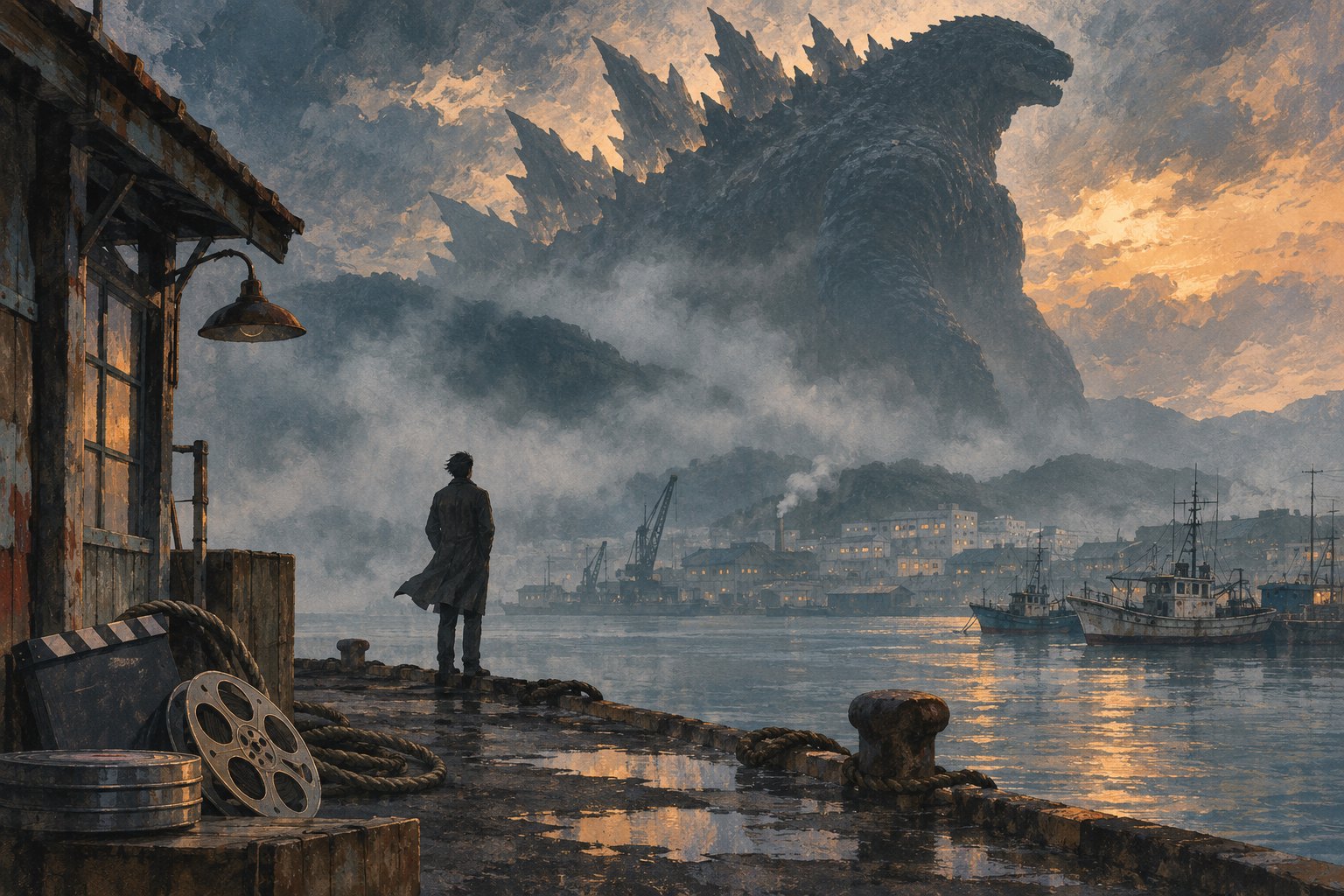
Godzilla Minus Zero puts Takashi Yamazaki in a demanding creative position: continuing a monster story whose strongest achievement was making individual lives matter. The Hollywood Reporter’s interview coverage centers on sequel pressure, Hollywood offers, and a possible third film. Those subjects raise meaningful questions about his future, but a possible continuation should not be mistaken for an announced production, and discussion of offers does not establish an accepted job.
The artistic question is more revealing than the career speculation. What, exactly, should Yamazaki carry forward? Looking closely at Godzilla Minus One, my answer is its insistence that surviving catastrophe creates a future worth inhabiting. That conviction gives its destruction emotional weight and establishes a difficult standard for anything that follows.
Major spoilers for Godzilla Minus One follow. This is a retrospective review and analysis of the sequel’s creative stakes, not a review of Godzilla Minus Zero or a description of its unverified plot.
Koichi’s struggle makes sequel pressure personal
In Minus One, Koichi Shikishima survives a wartime encounter with Godzilla after freezing when ordered to fire on the creature. Back in devastated Tokyo, he builds an improvised household with Noriko and the orphaned Akiko. Yet physical survival does not give him permission, in his own mind, to enjoy that household.
This is the film’s most effective dramatic construction. Koichi experiences happiness almost as an accusation. Each opportunity for attachment exposes the distance between the life available to him and the punishment he believes he deserves. Godzilla’s return therefore threatens more than his safety: it gives his self-condemnation another apparent justification.
Yamazaki makes this conflict accessible through direct, sometimes emphatic melodrama. The approach can feel insistent, but its clarity serves the monster sequences. We understand why a particular person might interpret danger as an obligation to die.
That is a substantial inheritance for Minus Zero. Any continuation of this emotional territory needs to distinguish renewed danger from erased development. A character can suffer again without becoming exactly the person he was before. For me, the meaningful test is whether earlier choices continue to shape later ones.
Noriko gives survival a practical meaning
Noriko’s importance extends beyond offering Koichi reassurance. Her care for Akiko makes survival concrete: someone must feed a child, maintain a household, and imagine another ordinary day. Against Koichi’s inward reckoning with the dead, she represents responsibility to people who are still here.
Her declaration, “Everyone who survived the war is meant to live,” expresses the film’s moral argument with unusual economy. It does not ask Koichi to prove that he deserved to escape. It begins with the fact that he did.
There is also a limitation worth acknowledging. Noriko’s apparent death during the Ginza attack becomes a powerful engine for Koichi’s anguish. The film gives her courage and initiative, but it also uses her suffering to accelerate his development. My admiration for the family story comes with a wish for more room inside her perspective.
That offers a productive standard for future storytelling: deepen the lives around the central protagonist. A familiar character can become newly compelling when the narrative takes her desires as seriously as the effect she has on someone else.

The climax changes what bravery looks like
The final operation against Godzilla brings Koichi’s private crisis into a collective effort. The decisive emotional turn is his escape from the explosive aircraft through its ejection seat. The action allows him to contribute without completing the death sentence he has carried within himself.
That distinction gives the climax its force. An escape mechanism becomes an expression of care. Someone has considered the pilot’s return part of the plan, and Koichi must accept that his return matters.
My reading is that the film’s deepest victory occurs in this acceptance. Destroying the immediate threat and accepting a future become connected achievements. The action would mean something substantially different if it rewarded Koichi’s belief that only his death could settle the past.
This is why the sequel pressure cannot be measured entirely in the size of an effects sequence. The earlier film made a mechanical detail carry a moral decision. A larger spectacle needs similarly precise relationships between action and character.
That relationship also underlies our discussion of how Good Will Hunting turns accepting love into a difficult choice. In both readings, the possibility of a better life becomes dramatic because the protagonist struggles to accept it.
Hollywood offers raise questions about creative conditions
The Hollywood offers discussed in the interview invite an understandable curiosity about Yamazaki’s next move. Without verified details of individual proposals or commitments, however, naming prospective projects or assigning motives would turn speculation into biography.
As a critical question, the useful issue is what working conditions would support his strengths. Minus One gives domestic scenes enough importance that the audience has something specific to fear losing. Its appeal depends on the interaction between intimate drama and large-scale destruction.
A different production environment could offer new collaborators, resources, and possibilities. Whether those possibilities produce a stronger movie would depend on the screenplay, the creative relationships, and the decisions preserved through production. Geography alone cannot answer that.
Our analysis of the creative challenge of expanding a short film into a feature considers a related problem: additional opportunity becomes valuable when it creates room for meaningful development. Expansion still needs a dramatic purpose.
A possible third film needs another human question
The possibility of a third film is interesting precisely because continuation is not automatically justification. A recurring monster supplies danger readily. Finding a fresh relationship to that danger is harder.
One promising question, as an editorial possibility rather than a prediction, concerns the obligations that follow survival. What does a person owe a family after learning to accept its love? How does a community preserve solidarity once the immediate emergency passes? These questions could generate conflict without declaring earlier growth meaningless.
They also suggest a fair way to assess any continuation: look for changed choices. Greater peril can reveal development when a character responds with a new understanding of responsibility. Repeating the same emotional crisis requires more justification than repeating a recognizable creature.
The ending leaves a standard, not just an opening
When Noriko asks Koichi, “Is your war finally over?”, the question brings the film back to his internal struggle. Defeating Godzilla cannot by itself determine whether he can live without treating survival as a debt.
For me, that is the deeper achievement of Minus One: it makes the right to an ordinary future feel worthy of a spectacular climax. Its emotional resolution does not depend on suggesting that the world has become safe. It depends on Koichi becoming capable of wanting a place in it.
That is the standard behind the pressure surrounding Yamazaki and Godzilla Minus Zero. Hollywood opportunities and the prospect of another film matter as career developments. Artistically, the harder task is sustaining attention to the people beneath the spectacle—and finding something new for them to live for.
Original content by this site's editorial team. Published: November 5, 2026 at 16:02:20 PST (Los Angeles time)