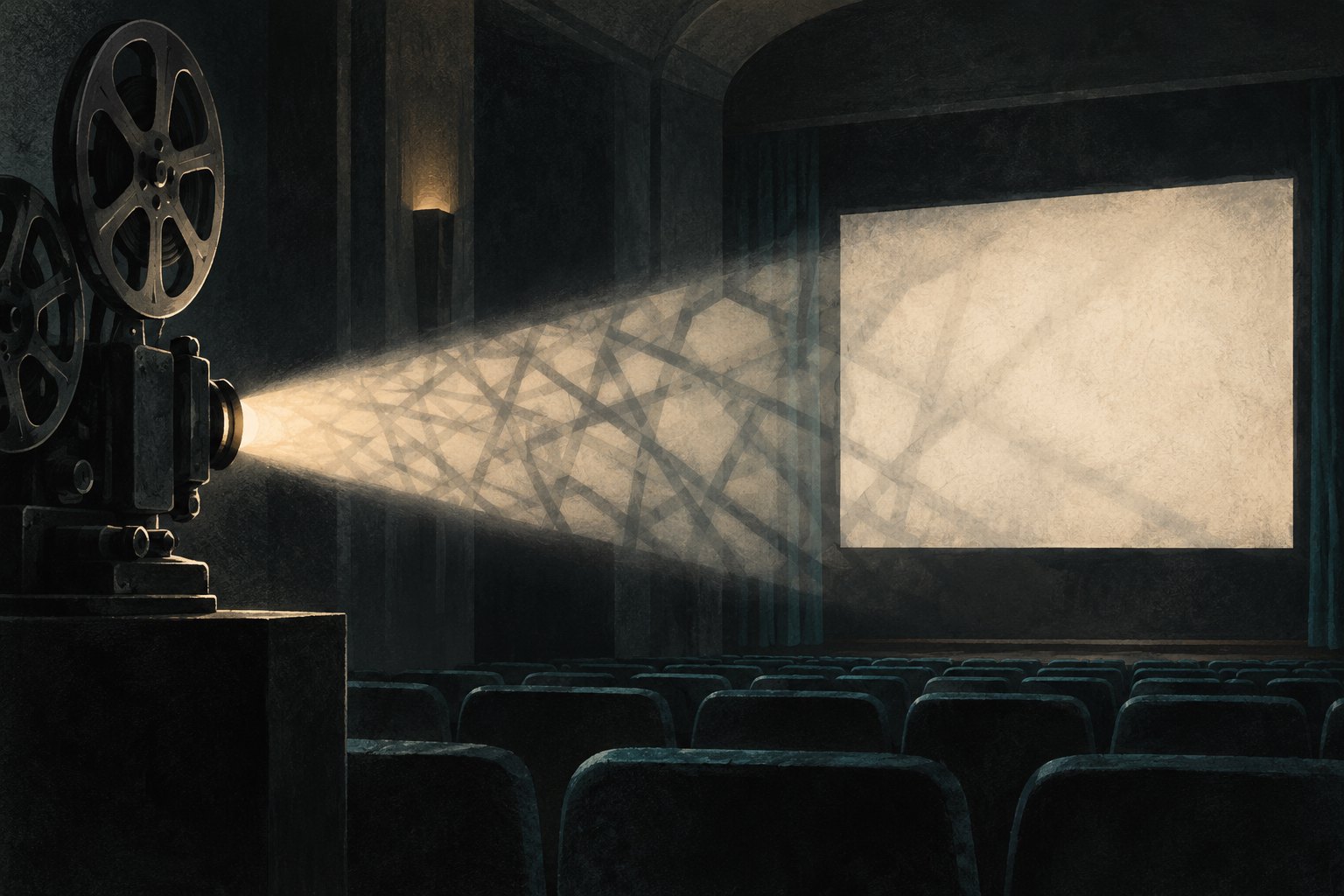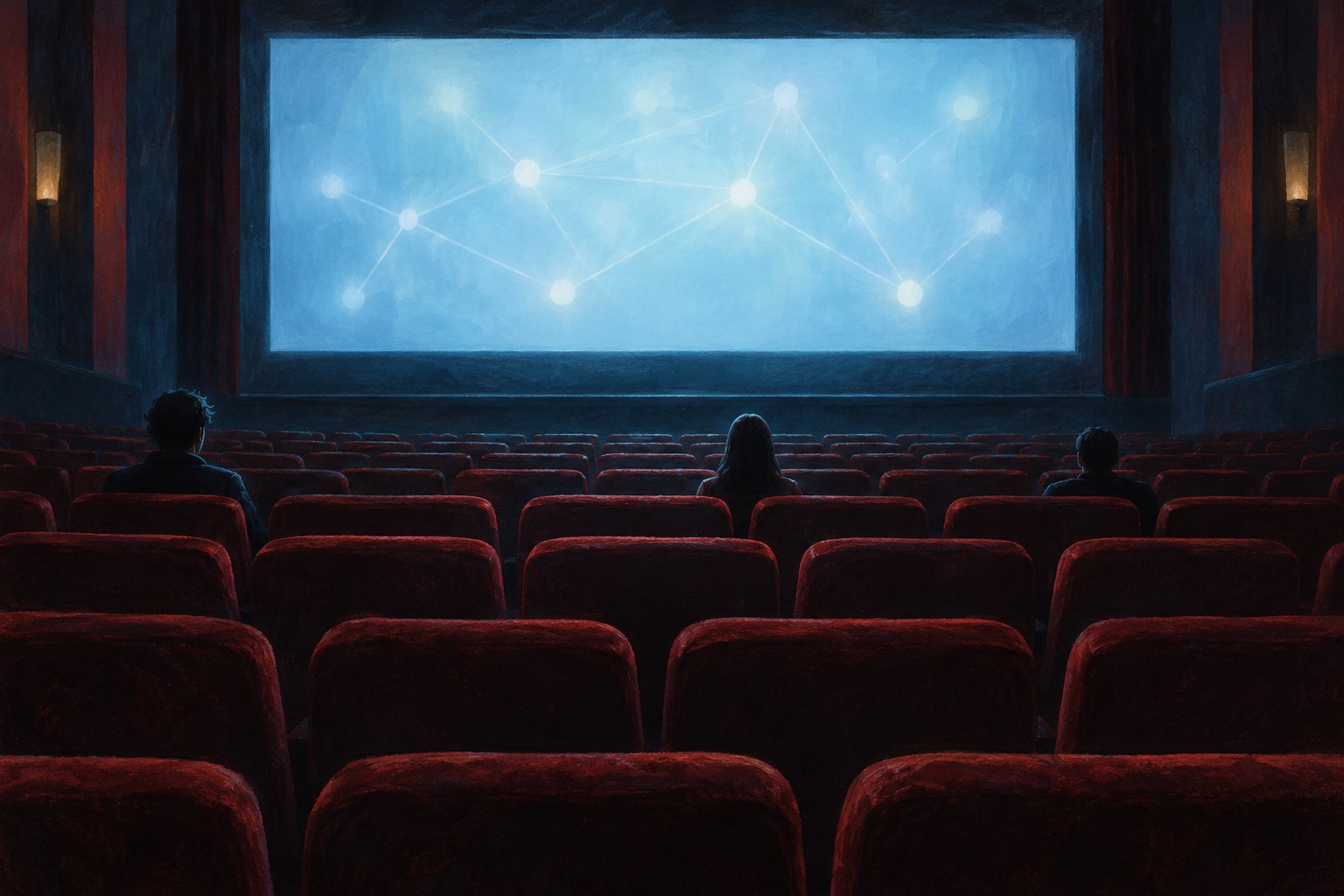
Ghost in the Machine locates technological horror in an uncomfortable possibility: a system can become powerful while the people affected by it have little say in its purpose. Valerie Veatch’s documentary examines artificial intelligence through its human origins and political assumptions. The frightening question is who gets to define progress—and whose experience disappears inside that definition.
Scope and spoilers: This critical analysis draws on documented film content and filmmaker interviews. It discusses the documentary’s arguments and visual devices; it is not a firsthand assessment of its pacing, performances, or overall viewing experience.
A documentary organized around power
Sundance’s official program identifies Veatch as the director, writer, and producer of this investigative essay documentary. Its subjects include the cultural and political forces behind the AI boom, with historians, philosophers, sociologists, and other interviewees examining technology and human agency. That establishes a useful expectation: this is an argumentative film organized around ideas. [Sundance’s film description](https://festivalplayer.sundance.org/sundance-film-festival-2026/play/693dbfdf302284ba4f106979).
For viewers, the most productive approach is to follow how an argument changes as different people speak. An expert might explain a technical category; a worker might reveal what maintaining that category demands. Those perspectives carry different kinds of knowledge. A documentary earns its authority when it helps us understand their relationship without treating an impressive credential as a substitute for evidence.
That also changes what character-centered criticism means here. These are real participants with distinct stakes, responsibilities, and limits of knowledge. Reading them as heroes and villains would flatten the very human complexity that makes nonfiction worth watching.
History supplies the haunting
In Sundance’s account of the film, Ezekiel Dixon-Román explains that some statistical models “emerged specifically out of eugenics.” Archival footage also shows semiconductor pioneer William Shockley advocating incentivized sterilization. These examples place the documentary’s technological argument alongside explicit historical projects of human classification. [Sundance’s premiere report](https://www.sundance.org/blogs/2026-sundance-film-festival-ghost-in-the-machine/).
The critical significance lies in the act of classification. Who decides what intelligence means? Which abilities count? What happens when a measurement acquires the authority to determine somebody’s opportunities? Those questions give an apparently abstract history an immediate human dimension.
There is also an essential distinction to preserve. A method’s disturbing origins do not, by themselves, establish that every later application produces the same harm. A persuasive historical argument must demonstrate the mechanisms that survive: assumptions embedded in categories, choices about whose information matters, or institutions that distribute benefits unequally.
My reading is that this is where the documentary’s premise becomes most demanding. Historical revelation can shock an audience, but the harder intellectual work begins afterward. Viewers should ask how each historical example explains a present practice, and where an analogy needs additional evidence. That scrutiny strengthens serious criticism of technology.
Veatch’s perspective: an artist questioning the tool
In an interview with the International Documentary Association, Veatch describes encountering racial stereotypes and sexualized depictions while experimenting with a generative video tool. She connects that experience to the investigation that became the film. She also discusses assembling interviews and archival material with limited resources. These are her accounts of the project’s origins and production. [Veatch’s filmmaker interview](https://documentary.org/column/synthesis-valerie-veatch-connects-ai-and-eugenics-ghost-machine).
From an artist’s perspective, the issue is authorship. Making an image involves more than obtaining something visually impressive. It involves deciding what a person looks like, what their presence means, and what responsibility the maker accepts for showing them that way.
A tool that frustrates those intentions raises a practical creative problem before it raises a philosophical one. The distance between what an artist requests and what an image implies can become the work’s most consequential feature. That is a useful lens for understanding Veatch’s skepticism without assuming that her experience alone settles every question about the technology.
The human work behind apparent automation
Veatch’s interview also emphasizes Kenyan data workers and the labor involved in preparing and moderating material for AI systems. Her account directs attention toward people whose work can become invisible when the finished product is described as automatic.

The worker’s perspective changes the meaning of convenience. A frictionless experience at one end of a system can depend on difficult decisions and repetitive tasks elsewhere. For a documentary, making that relationship legible requires more than placing an anonymous worker beside an impressive machine. It requires preserving the person’s knowledge, choices, and ability to describe their own conditions.
There is a related question of spectatorship in our commentary on privacy and the camera: access to an image does not eliminate responsibility toward the person behind it. Here, that responsibility extends to the people whose work makes an image possible.
When the picture itself becomes suspect
The documentary identifies synthetic and nonsynthetic imagery with on-screen labels, including “Not AI.” Veatch explains in her filmmaker interview that people close to her could not always distinguish the two. She describes using generated imagery for satirical effect.
As a formal idea, labeling gives the viewer useful information before asking for belief. It also makes an ordinary act—accepting a moving image as evidence—feel newly deliberate. The documentary screen becomes a place where different kinds of pictures require different kinds of trust.
Labels have limits, however. An authentic recording can still be selectively edited or misleadingly framed. Identifying how an image was made answers one question about its reliability; context answers others. The strongest reading of this device is therefore an invitation to sustained attention.
That connects with the distinction between momentary shock and sustained unease explored in our analysis of how horror builds dread. Uncertainty becomes meaningful when it changes how we understand a person’s situation. Mere visual strangeness cannot carry the whole argument.
The deeper fear is surrendering the future
Sundance’s report quotes participant Tiera Tanksley challenging the myth that “our future has already been determined, and we are helpless in it.” That documented line gives the film’s argument an important counterweight to despair. [Sundance’s account of Tanksley’s statement](https://www.sundance.org/blogs/2026-sundance-film-festival-ghost-in-the-machine/).
Fatalism can make spectators feel sophisticated while leaving them passive. If every outcome is inevitable, questioning a product, an institution, or a working arrangement seems pointless. Tanksley’s challenge restores the possibility that decisions remain open to dispute.
For me, this is the most compelling interpretation of Ghost in the Machine: its horror premise concerns the loss of meaningful participation in the world being built around us. Its answer begins with recognizing decisions as decisions. The machine’s apparent inevitability becomes less convincing once the people, incentives, and assumptions behind it come into view.
Original content by this site's editorial team. Published: October 12, 2026 at 01:28:04 PDT (Los Angeles time)