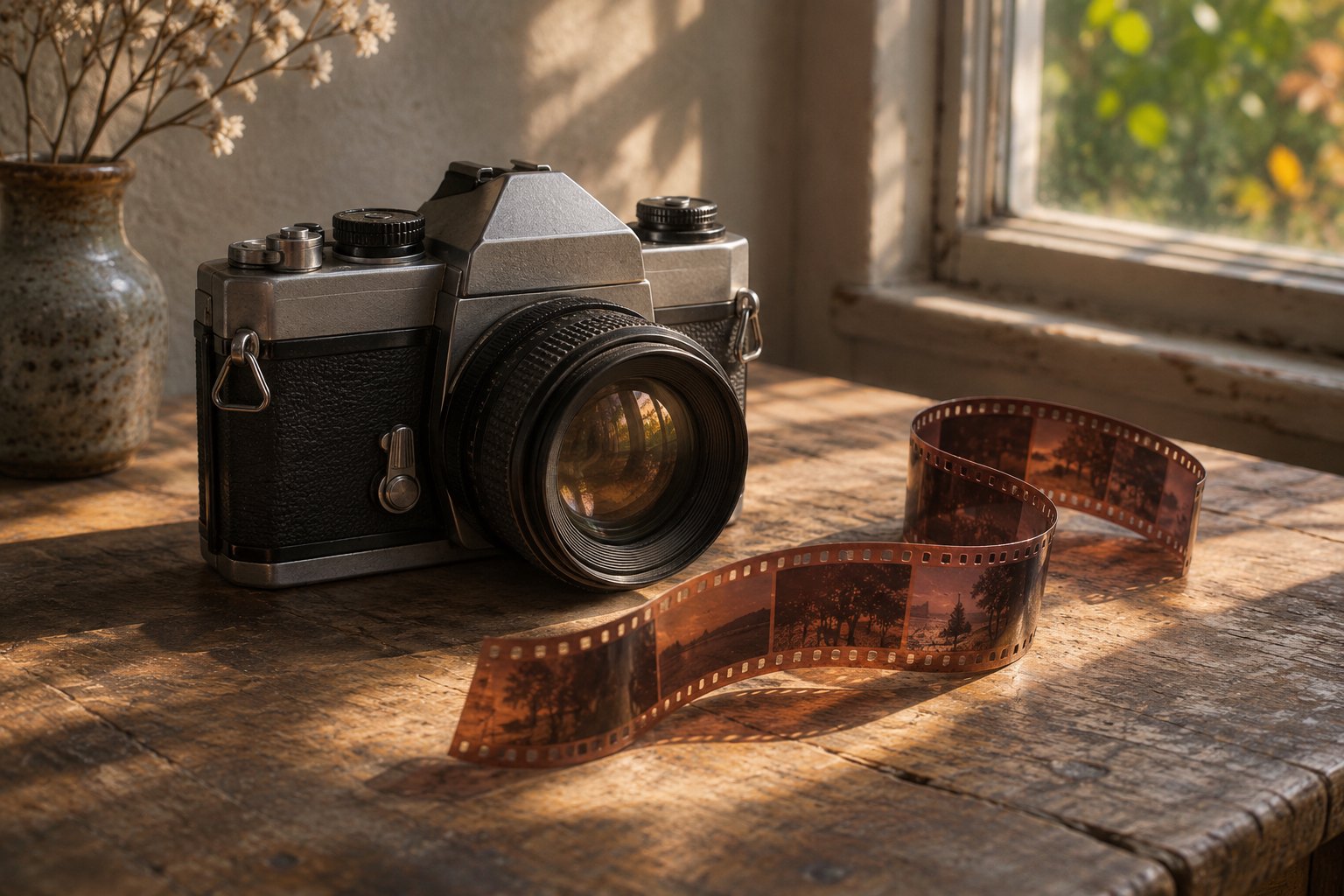
Film photography can look fashionably obsolete: a camera with no preview screen, a finite roll, and pictures that require processing before they can be examined. Its strongest appeal, though, is the relationship it can create between looking and taking a picture. When every exposure involves a small commitment, the question becomes specific: what about this moment deserves a frame?
That question matters to movie lovers, too. Still photography and cinema have different possibilities, but both direct attention through selection. A face, an empty chair, or a doorway becomes meaningful partly because someone decided where the image should begin and end. My view is that film photography earns its place when it makes those decisions more conscious. A vintage appearance alone offers much less.
What Does “Obsolete” Actually Mean?
Calling a medium obsolete usually assumes a particular job. If the task is to make a picture, check it immediately, and send it somewhere, photographic film introduces extra steps. Those steps are real limitations. They can also become part of why someone chooses the process.
Consider the gap between taking a photograph and seeing it. Without immediate playback, a photographer has to move forward without knowing exactly what the finished image will look like. That uncertainty can encourage close attention to light and timing. It can also produce avoidable mistakes. Waiting does not automatically improve a photograph, and inconvenience is no certificate of artistic seriousness.
The more interesting possibility is behavioral. A limited roll can encourage someone to watch a gesture develop instead of repeatedly pressing the shutter. Another person may become so anxious about wasting film that they stop experimenting. The medium creates a condition; the photographer determines whether that condition becomes productive.
The Vintage Look Can Become a Shortcut
Grain, softened detail, and shifts in color can make an image feel intimate or distant. We may associate those qualities with family albums, remembered summers, or photographs encountered long after their subjects have changed. Those associations give a picture an emotional head start.
They can also obscure how little the picture is doing. An ordinary composition may acquire an appealing atmosphere without gaining a point of view. A photograph can suggest memory while telling us almost nothing about the person or place being remembered.
A useful test is to imagine the same image with its nostalgic finish removed. Would the relationship between its subjects still hold your attention? Would the framing still create tension? Would a gesture still feel revealing? If the answer is yes, texture may be deepening an already expressive image. If the answer is no, texture may be carrying the entire argument.
This distinction also belongs in film criticism. Beautiful cinematography deserves more than a compliment about how expensive or atmospheric it looks. We should be able to explain what an image helps us understand. Our discussion of atmosphere and character development in country storytelling raises a related question: when does a recognizable style begin to express a particular life?
Framing Gives a Person a Point of View
Imagine a simple photographic exercise: someone sits alone at a cafe table. From close range, the photograph might emphasize a hand wrapped around a cup. From across the room, the same person might become a small figure surrounded by empty chairs. Through the window, reflections might partly conceal their face.
These are hypothetical compositions, not descriptions of a movie scene. They demonstrate how framing can change our interpretation without changing the person’s action. The close view invites attention to a physical detail. The wide view gives the surrounding space more influence. The window introduces a barrier between subject and observer.
None proves that the person is lonely, anxious, or waiting for someone. Those are interpretations. A responsible viewer distinguishes what the image shows from the story they bring to it.
For character-centered film analysis, this is an essential habit. Before calling a shot emotionally revealing, ask whose experience it makes available. Are we near enough to study a reaction? Are we positioned outside a conversation? Does the composition let us see something the character cannot? Those choices provide firmer grounds for interpretation than the general impression that an image looks cinematic.
The Photograph Continues After the Shutter
The romance of film photography often gathers around the moment of exposure: the camera raised, the shutter released, the instant preserved. Yet selecting and presenting pictures also shapes their meaning. Which frame survives the edit? What is placed beside it? What does the viewer encounter first?
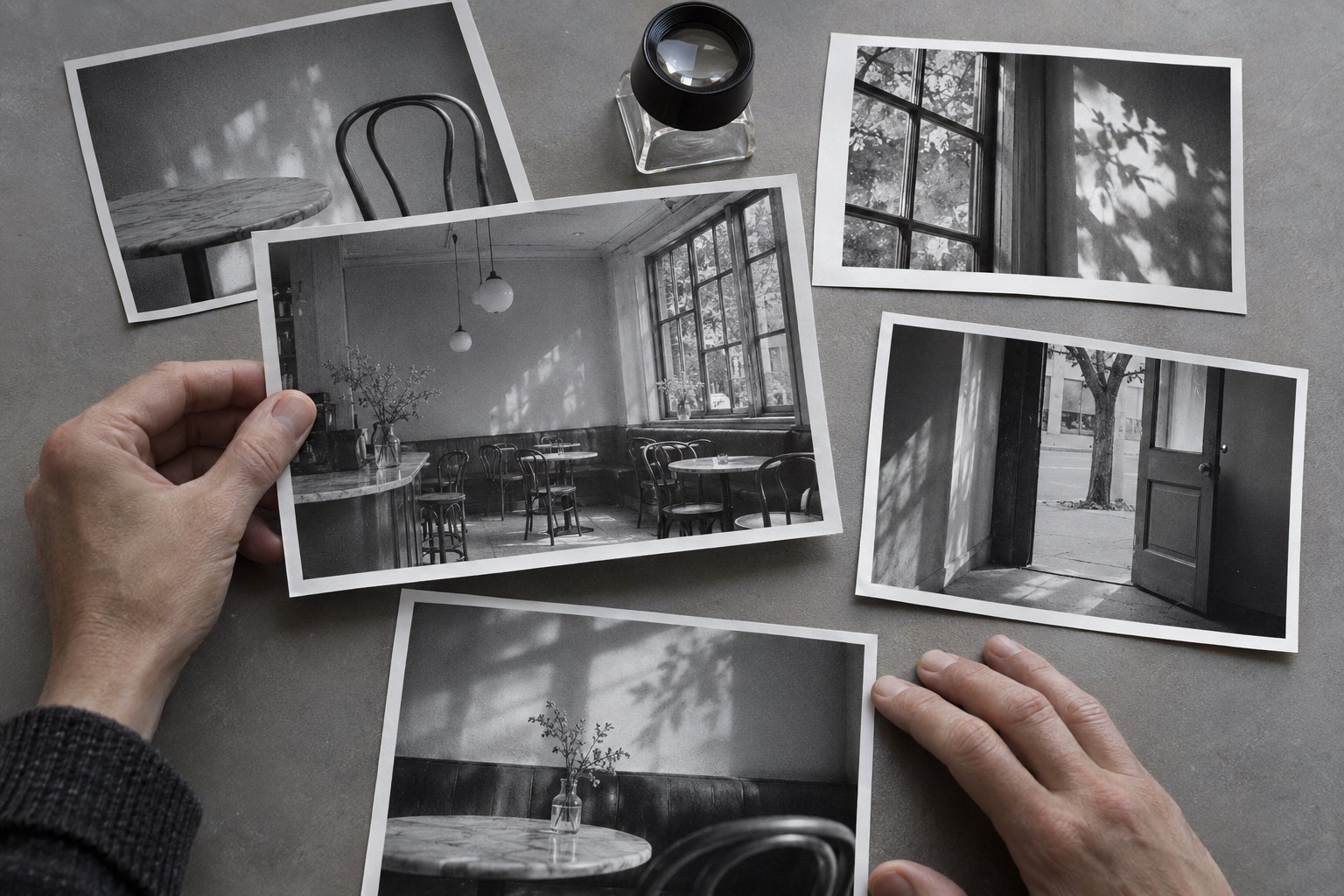
An empty chair can read differently beside a portrait than it does beside a photograph of a closed doorway. The objects remain ordinary, but their arrangement invites connections. The viewer begins to supply absence, anticipation, or departure.
This is one productive bridge between still photography and movies. Cinema can develop those relationships through duration, movement, editing, performance, and sound. A photograph asks us to dwell within a selected instant; a movie can revise our understanding of that instant with whatever follows.
That is also why a compelling still cannot settle a judgment about an entire film. A beautifully composed face may belong to a scene whose emotional force depends on a pause, a voice, or a response outside the frame. Our analysis of screen presence and emotional authority in Casablanca considers that wider relationship between an actor’s image and a character’s choices.
A Practical Way to Look Past the Surface
You do not need to purchase a film camera to explore the habits associated with deliberate photography. Try a small exercise with whatever camera you already use:
- Choose a limited subject. Photograph one room, one walk, or one person rather than collecting unrelated attractive images.
- Set a modest frame limit. Give each exposure a purpose, while allowing yourself enough freedom to make mistakes.
- Change the relationship, not just the angle. Notice what happens when you move closer, include more surroundings, or introduce an obstruction.
- Delay your selection. Return later and assess what the pictures communicate without relying entirely on your memory of taking them.
- Build a short sequence. Select three images and explain why their order matters.
For your next movie, carry over just one question: what does this framing let me know about the character? Follow it through a scene. Notice whether distance changes, whether another person enters the composition, or whether the film withholds a reaction you want to see. The exercise turns admiration into observation.
Film’s Value Depends on What We Notice
The least persuasive defense of film photography treats difficulty as virtue and nostalgia as proof of depth. The strongest defense is more personal and more demanding: this process helps someone make pictures they care about, with choices they can explain.
There is room for pleasure in the object itself—the camera, the negative, the print—without insisting that everyone must share it. There is also room to admit that a beautiful process can produce an uninteresting image.
My judgment is that film photography remains artistically worthwhile when its constraints sharpen attention to the world beyond the camera. Its deeper promise lies in learning to recognize a gesture, a distance, or a relationship worth preserving. The vintage look may invite us to stop. What the photograph notices determines whether we stay.
Original content by this site's editorial team. Published: November 20, 2026 at 14:45:35 PST (Los Angeles time)