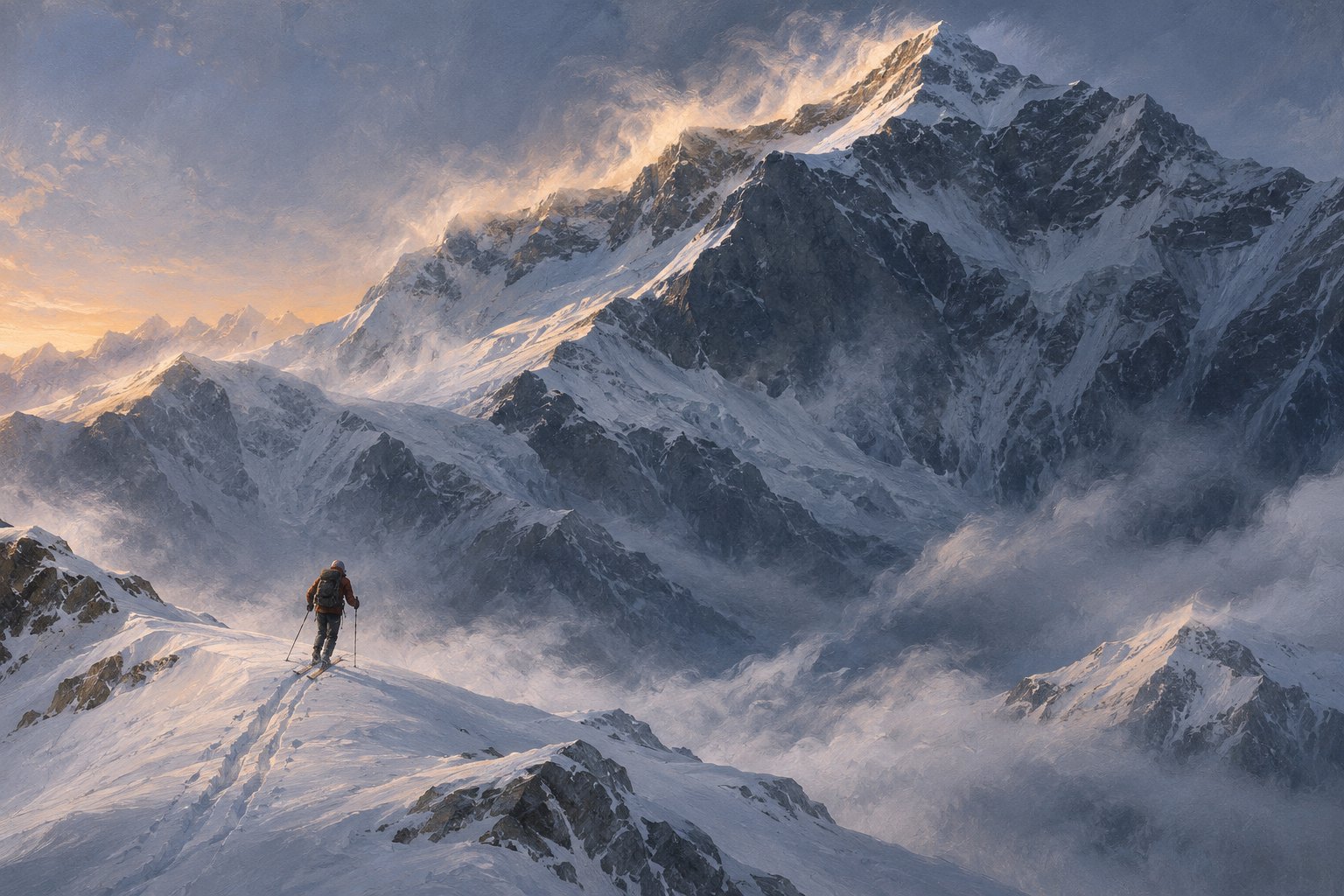
Everest: The Other Side places an extraordinary skiing objective inside a story whose emotional questions cannot be settled by reaching the bottom. Jim Morrison and Hilaree Nelson’s shared ambition—to climb and ski Everest’s direct north face—gives the documentary its forward momentum. Their relationship gives that ambition meaning. The most useful way to approach the film is to keep both in view: what the descent demands physically, and what completing it can possibly mean after loss.
POWDER’s skier-focused coverage provides a useful starting point for that conversation. A skier can appreciate an achievement without expecting every turn to resemble a dream vacation. A film audience can recognize determination while remaining uncertain about its costs. Those responses belong together.
Spoilers follow for the documentary’s central loss and expedition outcome. This critical analysis draws on published accounts, official film descriptions, and documented dialogue; it is not a firsthand screening review.
The objective matters because it belongs to two people
Directed by Elizabeth Chai Vasarhelyi and Jimmy Chin, the documentary centers on Morrison and Nelson as partners in life and ski mountaineering. The official synopsis identifies their objective as Everest’s direct north face, making the particular route essential to the story. Simply describing the project as climbing Everest loses the distinction between reaching a famous summit and pursuing a specific descent. [The filmmakers’ synopsis and statements](https://www.labiennale.org/en/cinema/2026/venice-open-out-competition/everest-other-side) establish that shared ambition.
From a character perspective, a shared objective does two jobs. It gives the couple something concrete to organize their lives around, and it expresses a kind of mutual recognition. Each understands why the other would want something that might seem incomprehensible from outside their sport.
That recognition deserves attention before any discussion of danger. Reducing their relationship to an appetite for risk makes both people smaller. Their partnership also involves expertise, preparation, and the satisfaction of being understood by someone with comparable commitments.
The useful question is how an ambition changes when it moves from one person’s imagination into a relationship. Does the objective become more meaningful because it is shared? Does it become harder to relinquish? These are interpretations to consider, not claims that either person’s private motives can be fully explained.
Hilaree Nelson must remain more than the reason Jim continues
The story is transformed by Nelson’s death. The British Board of Film Classification confirms that the documentary includes a fatal avalanche, bereavement, and the discovery of a deceased partner during a rescue operation. Its description also notes that the visual treatment of the recovery is discreet. That is useful context for viewers who might otherwise expect a straightforward sports documentary. [The BBFC’s content advice](https://www.bbfc.co.uk/release/everest-the-other-side-q29sbgvjdglvbjpwwc0xmtixmdaz) describes the potentially upsetting material.
For criticism, the crucial challenge is to preserve Nelson’s independence within a story that continues through Morrison. She should not become meaningful only through what her death makes him attempt. Her own ambition precedes that loss; the mountain was also her objective.
Vasarhelyi’s published director’s statement explicitly emphasizes Nelson’s importance to the project. That intention suggests a productive standard for viewers: remember the person making choices before interpreting the person being remembered.
The difference matters because memorial narratives can quietly simplify their subjects. Someone complicated, capable, and self-directed becomes an explanation for another person’s perseverance. A more attentive reading allows Nelson’s athletic identity and her relationship with Morrison to coexist without making either one subordinate.
A skier’s perspective changes what counts as spectacle
Morrison’s phrase “the raddest ski line in the world,” quoted from the documentary in the Associated Press review, communicates the attraction in the language of someone who skis. Vasarhelyi’s reported line, “This movie, the worst happened,” brings an entirely different register into the same project. Together, those brief statements establish the distance between imagining an extraordinary descent and living with irreversible consequences. [The Associated Press review](https://apnews.com/article/f092103e45631b4d501f062b6e1505cc) records both lines.
For a general audience, the mountain’s scale may be the immediate attraction. A skiing perspective adds another question: what kind of movement does this terrain actually permit? Speed, fluidity, and big clouds of snow are only some of the things a ski film can make compelling. Deliberation can carry its own tension.
This is why the quality of a ski outing and the significance of a ski achievement should be judged separately. Enjoyable conditions do not automatically produce an important expedition. Difficult conditions do not automatically produce an illuminating film. The documentary still has to make decisions intelligible.
Watch for the relationship between the skier and the surrounding terrain. An expansive image can communicate exposure; a closer view can reveal effort. Neither perspective is sufficient alone. Ideally, viewers understand both the scale of the problem and the human work of negotiating it, without needing a technical vocabulary.
The camera belongs to the expedition
The Mill Valley Film Festival’s account identifies the documentary’s coverage of Morrison’s 2025 ascent and notes that Chin climbs alongside him. That proximity matters: the filmmaker is participating in the environment he records. [The festival’s film description](https://app.mvff.com/film/everest-the-other-side) establishes this aspect of the production.
Such access can deepen a documentary’s understanding of physical effort and trust. It also creates an interpretive question. When someone is simultaneously a friend, expedition participant, and filmmaker, closeness becomes part of the perspective through which the audience encounters events.
That does not invalidate the images. It makes their viewpoint worth considering. A camera can provide evidence of what happened while leaving the meaning of that event unsettled. Admiration for the work required to obtain footage should not determine every judgment about the choices being filmed.
Our discussion of documentary testimony and responsibility in NAZA considers a related issue in a very different setting: access to someone’s experience does not require accepting that person’s interpretation as the only possible one.
Completing the route cannot settle the emotional story
The documented expedition outcome provides an answer to the practical question driving the narrative. Morrison reaches the objective. But an athletic result cannot establish whether grief has been resolved, whether a relationship has been adequately honored, or whether every risk was justified.
My reading is that the film’s premise becomes most compelling when those questions remain separate. Completing a shared dream can be an act of remembrance. It cannot recreate the partnership that gave the dream its original shape.
This distinction also protects viewers from an overly prescriptive message about bereavement. A remarkable individual response to loss does not become a model everyone else should follow. Continuing, retreating, changing direction, and abandoning an old goal can all carry meanings that an expedition’s success or failure cannot measure.
As in our analysis of love and usefulness in Klara and the Sun, the deeper question concerns what an action can express about attachment—and what it cannot repair.
Everest: The Other Side invites an interpretation of its title beyond geography. There is the mountain face, the imagined future beyond an achievement, and the altered life that follows loss. The most searching response holds those meanings together. A descent can end. The relationship between love, memory, and the need to keep moving remains open.
Original content by this site's editorial team. Published: November 3, 2026 at 06:10:05 PST (Los Angeles time)