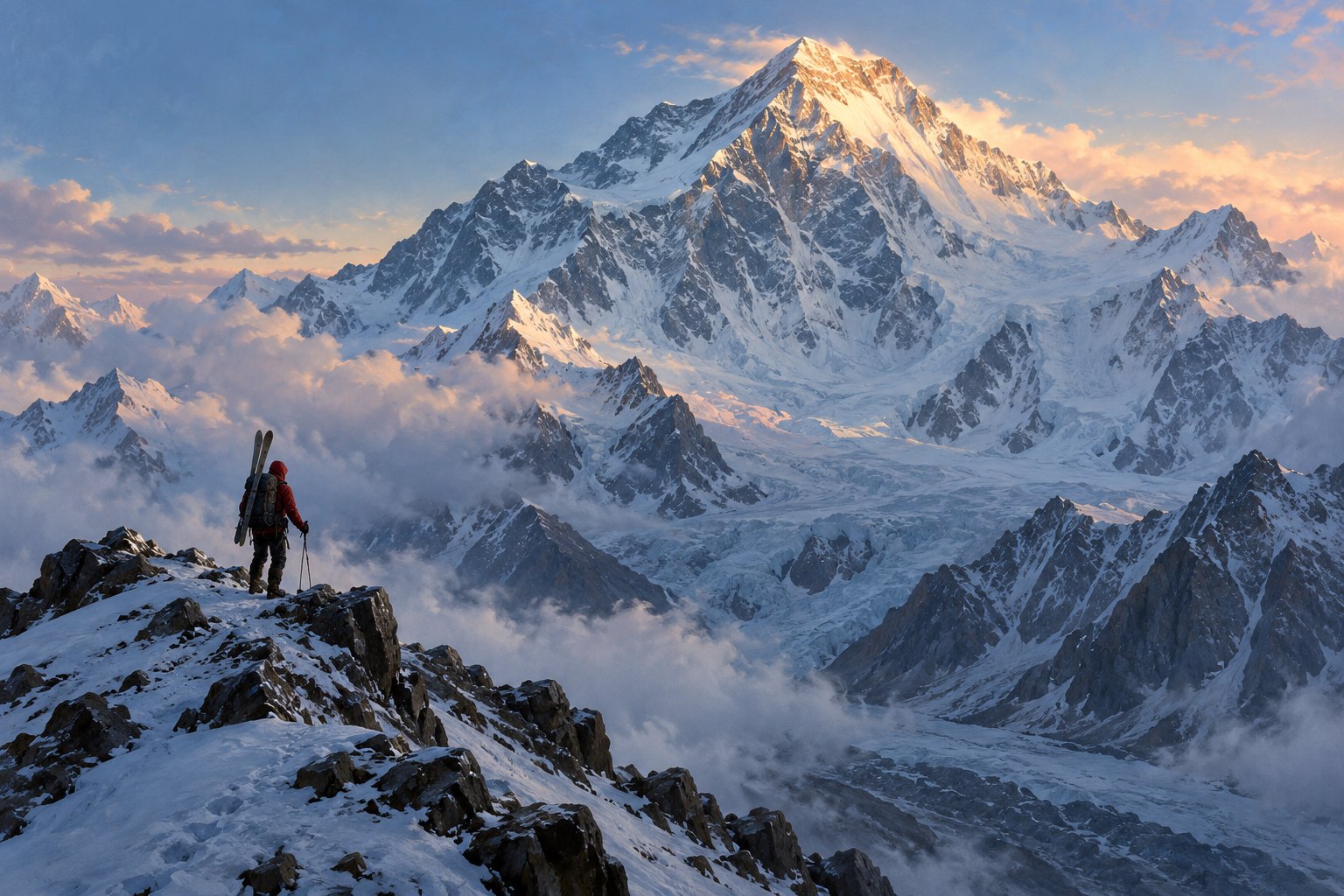
Everest: The Other Side makes the question of adventurers risking their lives when they have children painfully concrete. A dangerous expedition belongs to the people undertaking it, but its consequences also belong to people who never chose the mountain. My reading of the documentary’s central dilemma is that parenthood does not extinguish the right to pursue an extraordinary life. It does make personal conviction an insufficient justification for every risk.
Directed by Elizabeth Chai Vasarhelyi and Jimmy Chin, the documentary follows ski mountaineers Hilaree Nelson and Jim Morrison’s ambition to climb and ski Everest’s direct north face. The BFI’s festival description identifies concern among friends and family as part of that story. That concern deserves to remain central when we interpret the achievement.
Spoilers: This analysis discusses the documentary’s publicly documented events, including Nelson’s death and Morrison’s subsequent pursuit of their goal. It examines the story’s ethical implications rather than offering a firsthand assessment of every scene or technical element.
A shared dream becomes a survivor’s decision
Nelson and Morrison’s project begins with a powerful emotional advantage: they share both a relationship and an ambition. Climbing and skiing are ways of being together. That makes the expedition more intimate than a record attempt undertaken for recognition alone. For these two people, the mountain is connected to the life they have built.
Nelson died in an avalanche on Manaslu in Nepal in 2022. Her death did not occur on Everest, a distinction essential to understanding the story. As Eye Filmmuseum’s synopsis explains, Morrison subsequently continued pursuing their Everest dream. A shared future became an undertaking carried forward by one surviving partner.
That transformation changes the meaning of persistence. Before the loss, continuing can express commitment to a common possibility. Afterward, it can become a way of maintaining a relationship with someone who is gone. The same outward action—preparing for another climb—may carry a radically different emotional burden.
This is where the story becomes most difficult to judge from a comfortable distance. Abandoning the expedition might look prudent to an observer while feeling like another separation to the person grieving. Yet understanding that feeling does not require treating it as an obligation that everyone around the survivor must accept.
Hilaree Nelson deserves more than a verdict on motherhood
Nelson left behind two sons. That fact is indispensable to the film’s moral stakes, but it should not become a shortcut that reduces her entire life to a judgment about whether she should have stayed home.
There are two inadequate readings available here. One treats her athletic ambition as evidence against her love for her children. The other treats her extraordinary ability as sufficient reason to dismiss concerns about them. Both erase the possibility that devotion and dangerous desire can coexist without resolving each other.
A fair analysis must also apply the same standard to fathers. If a mother’s expedition demands an explanation, a father’s equivalent decision should demand one too. Otherwise, a discussion ostensibly about children becomes a selective judgment about which adults are permitted to have consuming ambitions.
Children should likewise remain people with lives beyond the symbolic role of waiting. Their needs include continuity, attention, and dependable care. A parent can inspire a child through courage, but inspiration cannot automatically compensate for absence. The documentary’s subject makes that distinction unavoidable without allowing us to claim knowledge of the boys’ private feelings.
Jim Morrison’s grief explains the climb without settling it
Morrison’s history includes another devastating loss: his wife and two children died in a plane crash before his relationship with Nelson. His return to an extreme objective therefore carries a particular emotional complexity. Continuing can be understood as an attempt to participate in life after experiences that have made ordinary existence almost unbearable.
That interpretation should remain an interpretation. It would be presumptuous to diagnose him or assign a single psychological motive to an undertaking shaped by love, athletic identity, memory, and ambition.
The useful distinction is between explanation and permission. Grief can help us understand why a goal feels necessary. It cannot, by itself, determine how much danger other people should bear in its pursuit. This is especially important when a private act of remembrance requires a team.
Our analysis of love and obligation in Wildwood approaches a related interpretive problem: powerful affection does not make every demand arising from it fair. The circumstances here are real and profoundly different, but that distinction helps keep sympathy from becoming automatic endorsement.
The mountain team changes the meaning of personal risk
Eye Filmmuseum’s account describes an attempted ascent interrupted when Sherpa Yukta Gurung breaks a leg high on Everest and must be carried down. This matters beyond its immediate danger. It demonstrates that the expedition’s risks cannot be contained within the principal adventurer’s personal decision.
Supporting climbers have expertise, judgment, and responsibilities of their own. Their willingness to participate should never make their exposure seem incidental. Nor should a retreat become merely an obstacle delaying the central figure’s achievement.
For viewers, a useful test is to notice whose hesitation receives serious consideration. A film can make forward movement feel inevitable simply by organizing its story around a destination. But another participant’s decision to stop may be equally meaningful. Refusing additional danger can express professional judgment rather than deficient courage.
The distinction recalls the questions about desire and consequences in our character analysis of Little Shop of Horrors: understanding why someone wants something is only the beginning of evaluating what its pursuit asks of others.
Two lines that resist an easy adventure story
Associated Press coverage quotes Vasarhelyi saying, “This movie, the worst happened.” The sentence strips away the protective distance that adventure storytelling can create. Danger is no longer an anticipated possibility that will make survival more satisfying. Someone has died.
Another reported line makes the implications domestic: “How many people who have eaten at our dinner table have died?” The dinner table brings the discussion down from altitude to ordinary relationships. It suggests a community in which repeated loss can become familiar without becoming acceptable.
Chin’s participation in the expedition also makes the filmmakers’ position consequential. A camera carried into danger is part of the undertaking. The people documenting risk may share the attachments and ambitions that make it compelling, which complicates any expectation of detached judgment.
What the achievement can—and cannot—resolve
Morrison’s eventual completion of the Everest objective supplies an ending to the athletic undertaking. It does not retrospectively prove that every preceding decision was justified. A successful outcome establishes what happened; it cannot establish that the same gamble would have been right had events unfolded differently.
For viewers sensitive to bereavement, this is also more than scenic adventure viewing. The British Board of Film Classification describes fatal-accident material, mourning, and the discovery of a dead partner, while noting that the visual detail is restrained. Emotional intensity matters here even where graphic detail is limited.
The deepest interpretation of Everest: The Other Side lies in the mismatch between a finishable expedition and continuing obligations. A route can be completed. Parenting, mourning, and caring for the living have no equivalent summit. We can admire the skill required to descend a mountain while remaining unconvinced that achievement answers the children’s side of the question. Holding those judgments together is the most honest way to engage with this story.
Original content by this site's editorial team. Published: October 30, 2026 at 19:31:21 PDT (Los Angeles time)