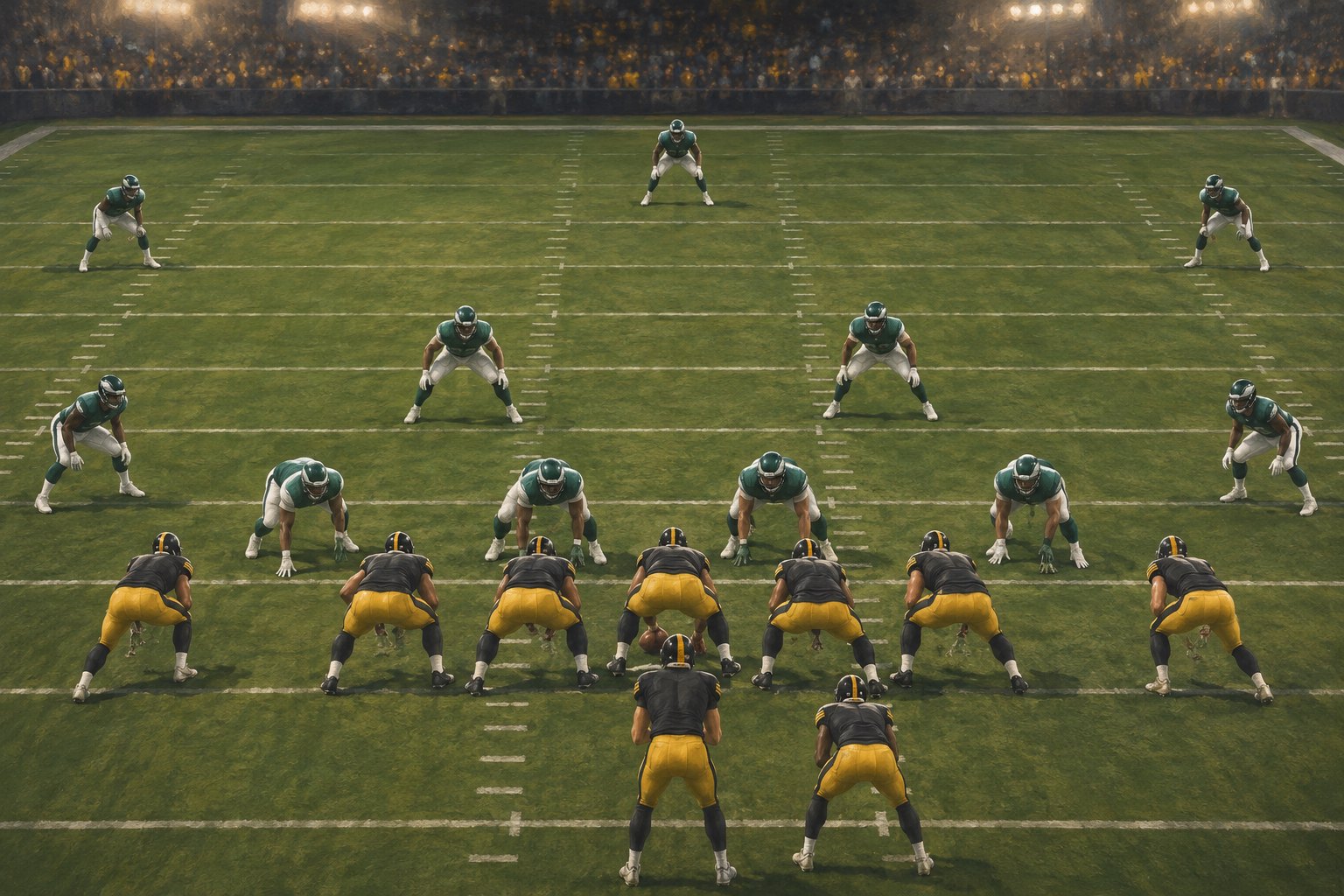
The Eagles’ defensive performance against the Steelers receives a favorable assessment in Bleeding Green Nation’s Eagles–Steelers film review. The useful question behind that verdict is what made the defense effective—and how a viewer can distinguish coordinated execution from a play that simply ended well. Defensive football rewards attention to the whole frame, including players who never reach the ball.
This is commentary on that assessment and a guide to evaluating its central claim, rather than an independently charted breakdown of the game. The positive verdict alone does not establish individual assignments, coverage calls, or particular turning points. Here, film means football footage: the subject is Philadelphia’s defense against Pittsburgh, not a feature film with scripted characters or dialogue.
What a positive defensive verdict needs to establish
A strong defensive review should explain how a result happened. An incomplete pass might reflect tight coverage, a hurried quarterback, an inaccurate throw, or a receiver’s mistake. Those possibilities can produce the same result on the scoreboard while supporting very different judgments about the defense.
For the Eagles–Steelers matchup, the most revealing distinction is between opportunities Philadelphia prevented and opportunities Pittsburgh failed to use. A defense deserves credit for taking away a throwing lane. It deserves a more qualified assessment when a receiver becomes available and the offense misses him. Both situations can end a possession; only one demonstrates that the defense controlled that particular exchange.
My view is that consistency makes a positive assessment persuasive. Several ordinary snaps showing coordinated positioning can tell us more than one spectacular collision. The question is whether the same sound decisions remain visible when the offense changes formations, alters its timing, or presents a different problem.
Read the front through the players’ competing responsibilities
Start with the defensive line, but resist following only the first player to break through. A defender can attack a blocker, occupy space, or preserve an outside boundary. The visible action needs to be understood in relation to nearby teammates. Without the actual call, an observer should remain cautious about declaring exactly what each player was assigned to do.
Consider the decision facing an edge defender in a hypothetical passing situation. Taking the shortest route toward the quarterback may look aggressive, yet moving too far inside can open an escape route. Maintaining outside position may look less impressive while helping the rest of the rush finish. The individual’s apparent hesitation can therefore be part of collective control.
That is a useful lens for revisiting Philadelphia’s performance: follow where the quarterback could move, not merely where the nearest rusher went. Did pressure restrict his options, or did it create a new exit? This is an evaluation question, not a claim that a particular Eagles snap unfolded either way.
Coverage gives the action away from the ball its meaning
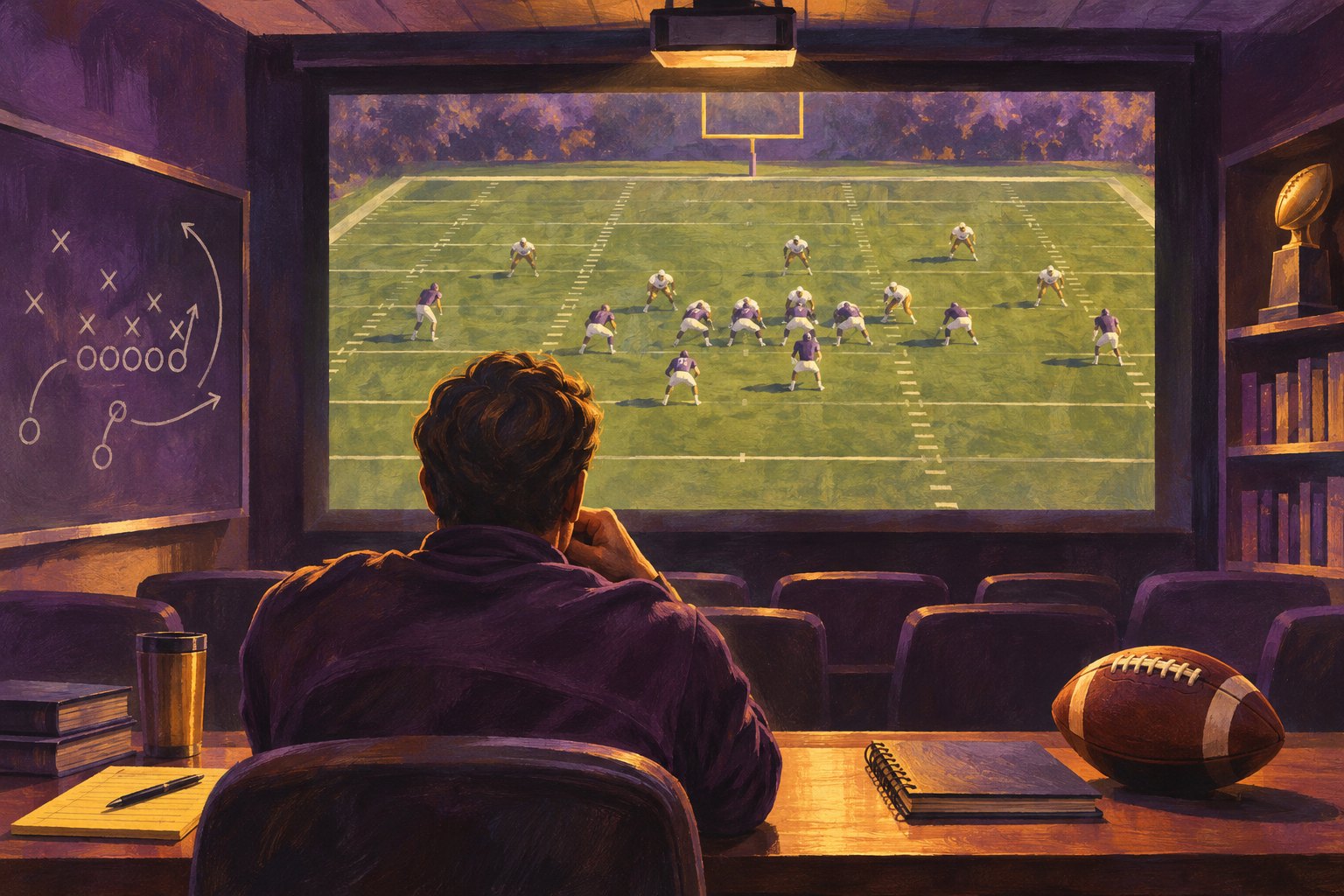
Pass defense is difficult to judge from footage that keeps the ball at the center of attention. A tight broadcast angle can show the throw and catch while hiding the route combinations that shaped the quarterback’s decision. A wider view may reveal that the targeted receiver was only one part of the problem.
Watch a defensive back through the moment the ball goes elsewhere. His positioning may have discouraged an attempt, protected a teammate, or left another area vulnerable. The absence of a target is not automatic evidence of excellent coverage, but it is a reason to keep watching instead of treating that player as irrelevant.
This attention to supporting contributions has a parallel in our analysis of Cliff Booth and Hollywood’s indispensable background labor. In both kinds of viewing, the most conspicuous figure does not necessarily account for everything that makes the scene function. On a football field, however, that interpretation must remain anchored to observable movement.

Judge pressure and coverage together
A pass rush and a secondary are not separate stories. A quarterback may hold the ball because his first option is covered, giving a rusher time to arrive. Alternatively, immediate pressure may force a throw before a route can develop. Crediting only the player nearest the finish can obscure the contribution that made it possible.
When reviewing the Eagles against the Steelers, pause at the quarterback’s first clear decision point. Look at the space around him, then at the available receivers if the angle permits. The aim is to reconstruct the choices visible on screen without pretending to know his thoughts. Footage can show movement and timing; it cannot directly disclose intent.
A useful interpretation should also survive a second viewing focused on another player. If a supposed individual victory depends on a teammate occupying a blocker or closing a passing window, the description should acknowledge that relationship. Shared credit is often more accurate than a single-hero account.
Watch the routine plays before choosing the highlights
The favorable assessment of Philadelphia’s defense invites scrutiny of ordinary work: maintaining position, responding to movement, and finishing tackles. These actions lack the immediate drama of a turnover, but they help distinguish a dependable performance from a collection of memorable moments.
A practical rewatch can follow three steps:
- Watch once at full speed. Establish the sequence and outcome before assigning praise or blame.
- Rewatch one defender away from the ball. Track his movement relative to the play and his teammates.
- Record the uncertainty. Separate what the camera shows from what would require another angle or knowledge of the call.
This approach also protects against selecting only evidence that supports the initial verdict. Include unsuccessful snaps. A defense can perform well overall while making mistakes, and those mistakes may reveal where an otherwise effective approach became vulnerable.
The distinction between an isolated moment and a complete performance also matters in our discussion of performance, repetition, and David Fincher’s Cliff Booth. Football footage has its own demands: replaying the same action can clarify it, but additional viewings cannot supply information the camera never captured.
The deeper value of a coordinated defense
My preferred reading of defensive excellence centers on interdependence. One player’s restraint can preserve another player’s opportunity. A defender may contribute most by refusing an attractive route to the ball because taking it would expose someone else. That is a more interesting standard than simply counting conspicuous acts of aggression.
Bleeding Green Nation’s favorable Eagles–Steelers verdict provides a starting point for that examination. The strongest case for it would show Philadelphia repeatedly limiting Pittsburgh’s choices through connected decisions. Until those sequences are established, the responsible conclusion remains bounded: the assessment is positive, while its tactical explanation requires the footage. Watch the whole formation, follow the less visible work, and let each claim earn its place on screen.
Original content by this site's editorial team. Published: November 25, 2026 at 16:00:19 PST (Los Angeles time)