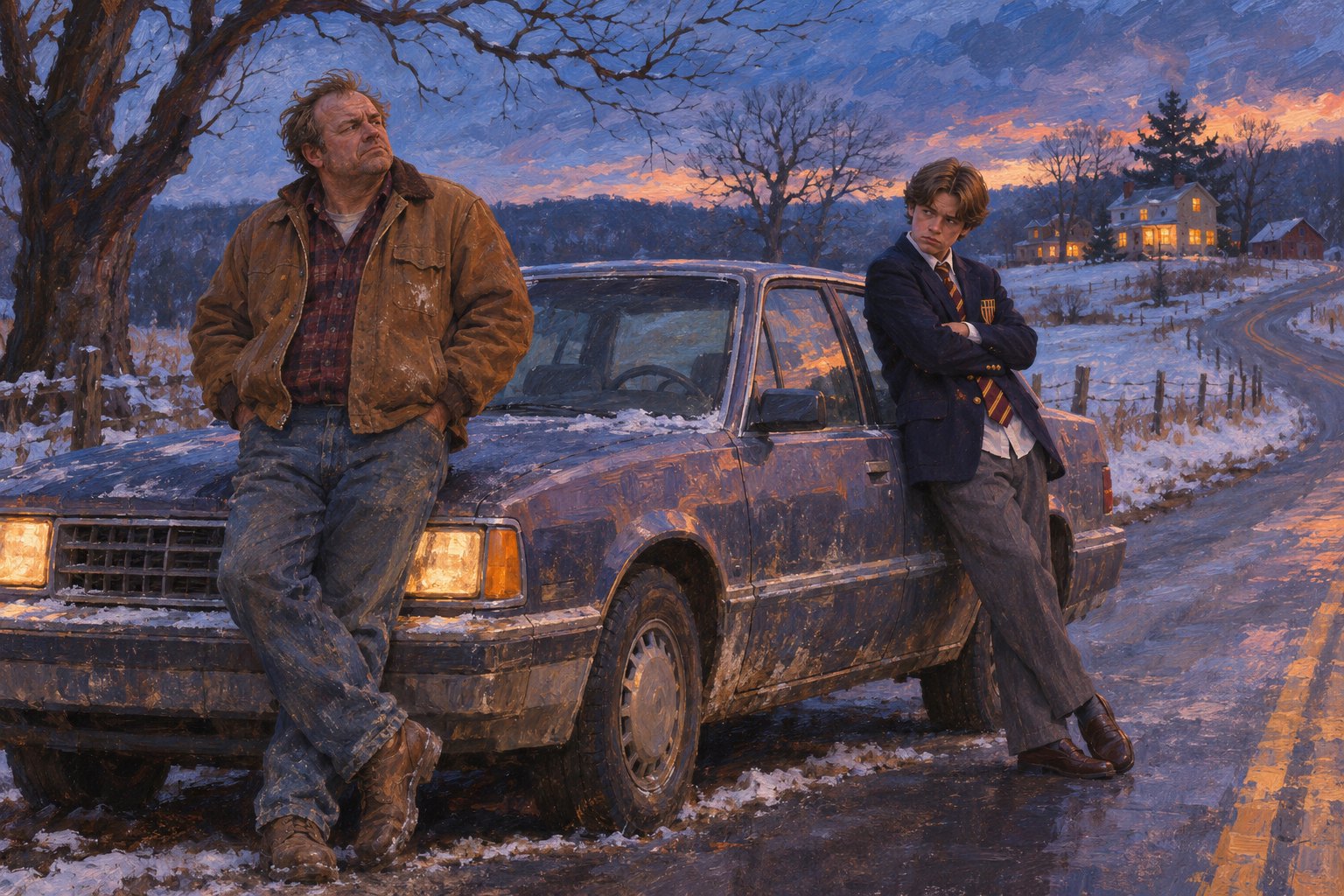
Dutch is a Thanksgiving comedy in which getting a child home becomes an escalating contest of humiliation, destruction, and wounded male pride. Released in 1991, written by John Hughes, and directed by Peter Faiman, it pairs Ed O’Neill’s Dutch Dooley with Ethan Randall’s Doyle Standish. The holiday promises reconciliation; the journey repeatedly suggests that neither traveler understands what reconciliation requires.
My verdict: this is an uneven but revealing comedy, more interesting when its characters expose their insecurities than when they punish each other. Its outrageousness has a purpose, although the film sometimes mistakes an adult’s refusal to back down for evidence that he deserves a child’s trust.
Spoilers follow, including the ending. Viewing note: The film includes violence involving a child, sexual references, sex workers, and gun-related threats. Its holiday setting should not be mistaken for a promise of gentle family entertainment.
Doyle treats rejection as a question of social status
The assignment sounds manageable: Dutch will bring his girlfriend Natalie’s son from boarding school in Georgia to Chicago for Thanksgiving. Doyle wants his father, Reed, instead. That preference supplies more than an obstacle to the itinerary. It establishes the emotional misunderstanding driving the whole movie.
Doyle believes that siding with his father gives him a position of strength. He can dismiss Dutch’s manners, occupation, and appearance because those judgments let him avoid a more frightening question: why does the parent he admires keep making himself unavailable?
Read this way, Doyle’s snobbery becomes a rehearsed defense. If he can classify someone as beneath him, he never has to admit that he needs anything from that person. His cruelty remains cruelty, but it also reveals a child borrowing an adult’s vocabulary of superiority before understanding its cost.
Randall’s performance makes that defense abrasive. Doyle does not invite affection through adorable mischief. His refusal, “I choose not to,” distills his attitude: withholding cooperation feels like the last authority he possesses. The line is funny because its composure is so excessive, and uncomfortable because the boy appears to depend on that composure.
The relationship offers a harsher version of the family gatekeeping explored in our analysis of approval and control in Focker-in-Law. Here, the prospective newcomer faces a child who treats accepting him as an act of betrayal.
Dutch wants respect before he has earned trust
Dutch understands the insult in Doyle’s class prejudice. He is much less successful at understanding the fear behind it. His answer is to demonstrate that he cannot be intimidated, an approach that makes emotional sense for his pride and very little sense for his responsibility.
The disastrous school pickup establishes the problem. Doyle attacks him; Dutch eventually carries the boy away tied to a hockey stick. The sequence turns an introduction into a victory. From that point, their relationship has a dangerous vocabulary: whoever forces the other person to yield gets to define what happens next.
O’Neill gives Dutch the blunt confidence needed to keep this character watchable. Yet that confidence has an interesting weakness. Dutch seems to believe that being direct about his feelings makes those feelings fair. He resents condescension, so retaliation begins to look, to him, like a defense of basic dignity.
His shelter-room explanation, “Because I’m 15,000 cheeseburgers ahead of you in life,” captures the more appealing version of that personality. It turns age and physical bulk into an absurd measure of experience. There is room for companionship in this kind of teasing: Dutch can acknowledge the difference between them without demanding a surrender.
The trouble is that he keeps returning to the contest. A child’s provocation may explain an adult’s anger, but it cannot make them equally responsible for what follows. The movie gets some of its comic energy from pretending otherwise.
The road trip strips away their favorite defenses
The snowy walk and the destruction of Dutch’s car escalate the feud until ordinary travel becomes impossible. These are not simply interchangeable mishaps. Each retaliation reduces the pair’s options, turning the desire to win into a practical reason they cannot get home.
That is the strongest structural joke in Dutch. Both characters think their pride protects them. In practice, it makes them dependent on strangers.
For Doyle, the journey challenges the idea that money and pedigree reliably identify people worth respecting. For Dutch, it exposes the weakness in treating self-sufficiency as a performance. A person can be resourceful and still need assistance. Refusing to admit that need does not make the need disappear.
The comedy is less persuasive when another escalation arrives before the previous one has acquired emotional weight. Surprise can sustain a scene, but it cannot automatically sustain sympathy. The distinction resembles the question in our discussion of whether enjoyable movie moments add up to a satisfying whole: a memorable bit can also weaken the larger story.
The shelter changes what Thanksgiving means
At a shelter, Doyle encounters a family whose circumstances challenge his assumptions about security. The scene matters because the conversation temporarily moves beyond his feud with Dutch. Other people have needs, histories, and disappointments that do not exist to confirm his importance.
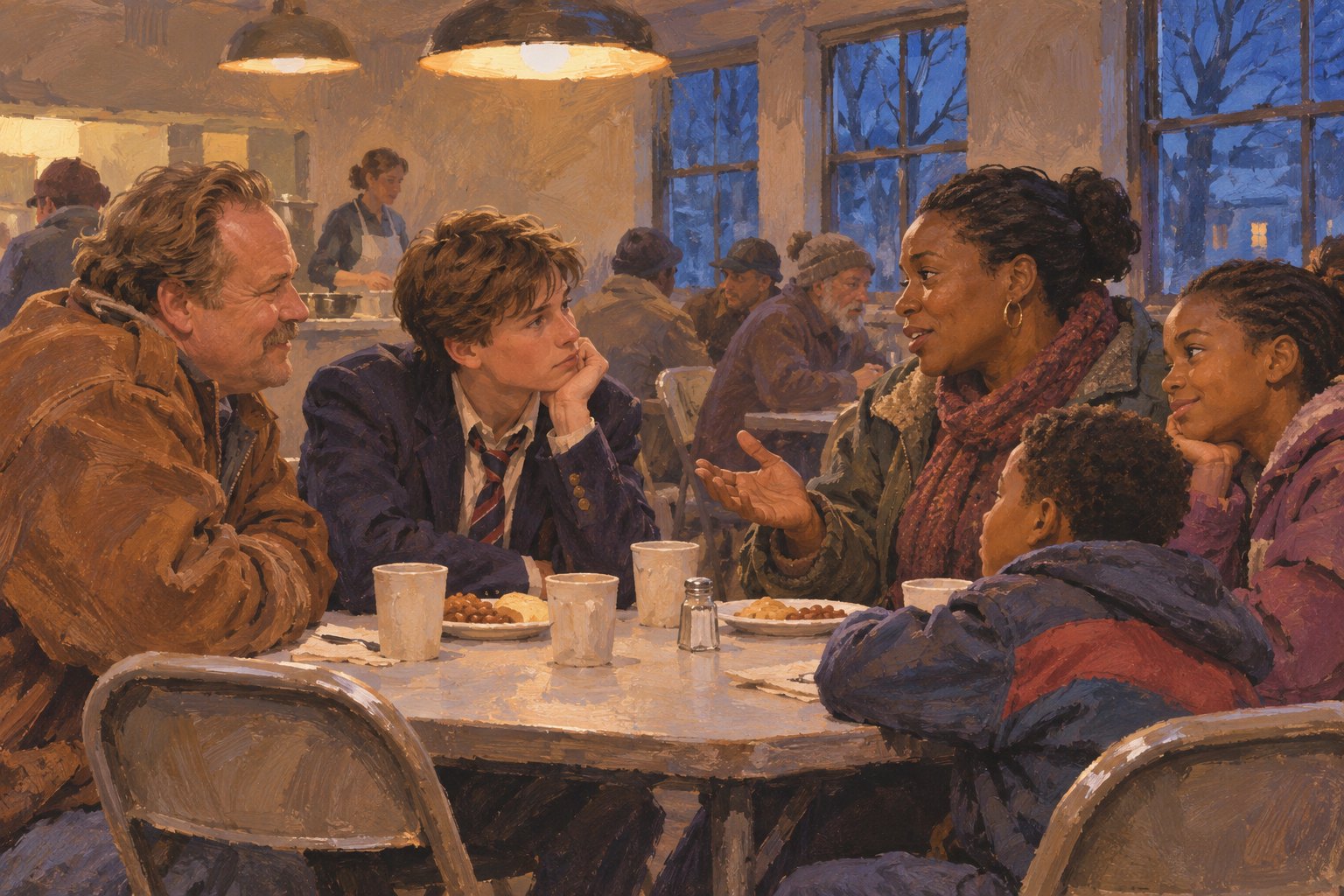
My reading is that Doyle’s real education begins when he listens. Dutch’s confrontations have demanded a response; this encounter asks for attention. That difference gives the quieter material more force than another lecture about how lucky the boy should feel.
There is a limitation here. The family’s hardship also serves the familiar narrative purpose of improving a privileged protagonist. Their lives deserve more than usefulness to his development. Still, the sequence introduces a standard of generosity that neither combatant has managed to establish through force.
Thanksgiving consequently becomes more than the deadline at the end of a drive. Gratitude requires Doyle to recognize people whose value cannot be measured by what they own. It also requires recognizing care when it arrives without his father’s prestige attached.
Reed loses his authority, but Dutch keeps the last shot
Doyle discovers that Reed lied about his travel plans. The discovery breaks the connection between the father’s status and his credibility. Reed’s polished confidence can no longer substitute for showing up.
“I wouldn’t dare lose,” Reed says elsewhere in the film. That brief declaration makes a useful key to his character: relationships become arrangements in which somebody must retain the advantage. Doyle has been learning that habit from the person whose approval he most wants.
The homecoming gives the boy a chance to choose differently. Dutch, however, still settles matters physically, and the final pellet-gun payoff revives his promised retaliation against Doyle. The film wants that return to aggression to register as affectionate comic closure.
For me, it complicates the emotional resolution. Doyle has changed his understanding of other people, while Dutch retains the privilege of enforcing the last joke. The adult helps dismantle one model of domination without entirely surrendering his own.
A Thanksgiving movie about the limits of keeping score
The deeper interest of Dutch lies in that imbalance. Its journey suggests that belonging depends on accepting help, reconsidering loyalties, and noticing other people. Its punch lines repeatedly reward toughness and retaliation. Those impulses never comfortably agree.
That makes the film worth revisiting for viewers who enjoy abrasive character comedy and can tolerate its tonal jolts. It is less convincing as a model of healing than as a portrait of people struggling to imagine affection without a winner. Doyle begins to learn that love cannot be secured through status. Dutch’s unfinished lesson is that it cannot be secured through victory, either.
Original content by this site's editorial team. Published: November 25, 2026 at 10:36:55 PST (Los Angeles time)