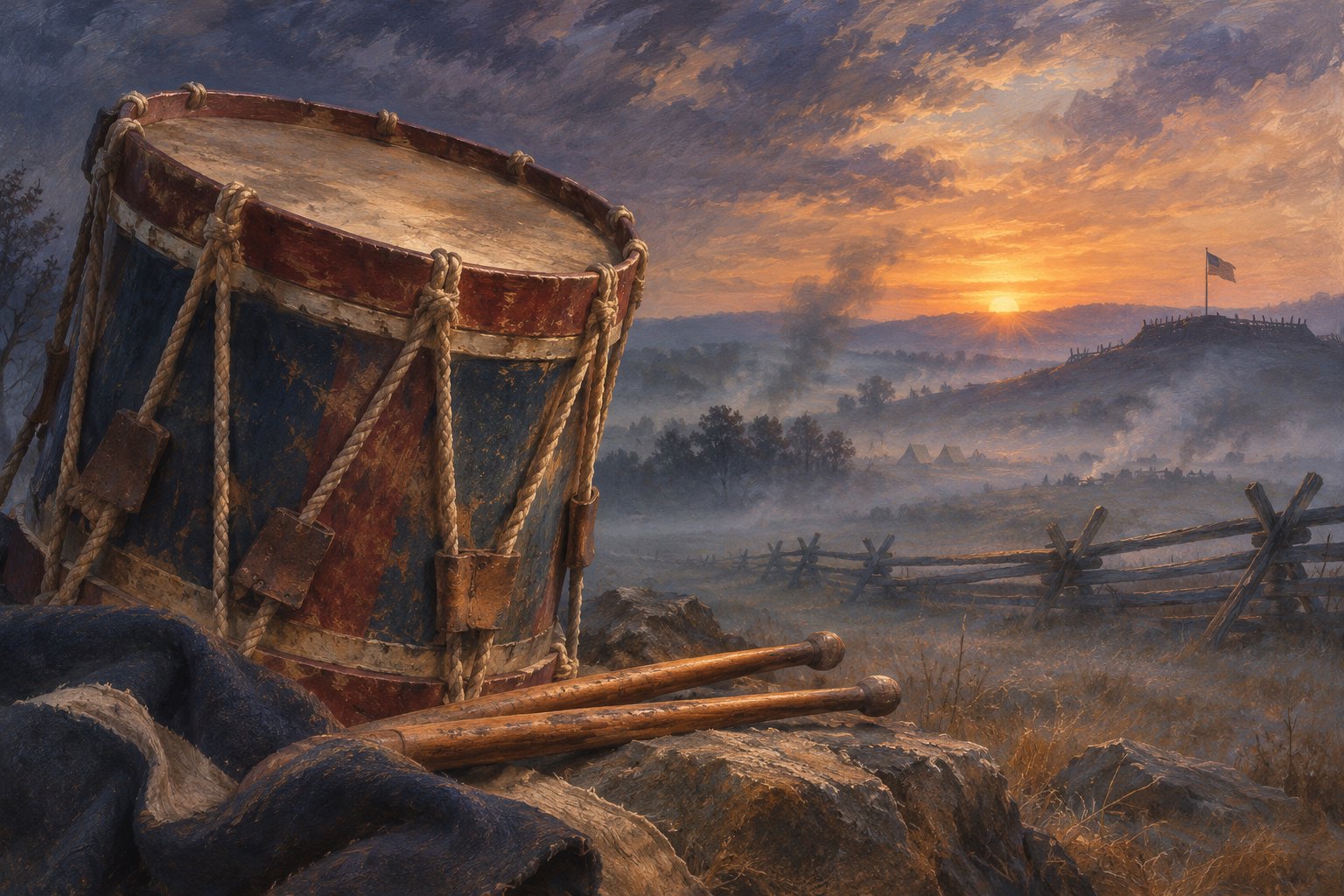
Drummer Boy makes the American Revolution a family conflict, with brothers Jeremiah and Benjamin Clem entering opposing armies while their childhood friend Emmaline seeks freedom from enslavement. Its most compelling dramatic question is whether people using the same word—freedom—understand how differently it operates in one another’s lives.
Directed by Ben Smallbone and Joel David Smallbone, the historical musical stars Joel David Smallbone as Jeremiah, Lucas Leach as Benjamin, and India Brown as Emmaline. Angel lists a November 6, 2026, theatrical release and a running time of 129 minutes. The American rating is PG-13 for war violence and some bloody images.
Spoiler notice: The following analysis discusses character motivations and reported late-story decisions. It draws on published plot accounts rather than a firsthand screening; judgments concern the story’s dramatic ideas, not unverified claims about performances, editing, or individual shots.
Jeremiah: When Protecting a Family Becomes a Compromise
Published accounts describe Jeremiah’s enlistment in the British army as a response to danger surrounding his family. After Benjamin’s outspoken behavior provokes hostility, Jeremiah tries to demonstrate their loyalty to the Crown. That motivation complicates an easy reading of the older brother as simply the one who chooses the wrong side.
Protection can become its own trap. Jeremiah’s reasoning asks us to consider a familiar bargain: accept an institution’s demands now so that the people you love remain safe. The difficulty is that institutions rarely stop demanding obedience once the original emergency passes. A protective gesture can become an obligation to participate in harm.
My reading is that Jeremiah’s story becomes interesting at precisely that point. The question is no longer whether he loves his family. It is whether love excuses the decisions he makes in their name. A character can act from a recognizable motive and still need to acknowledge that his solution has created another danger.
That distinction gives the divided-brothers premise more substance than a simple contrast between patriotism and disloyalty. Jeremiah’s allegiance is also a claim about responsibility: he believes he understands what survival requires. Benjamin’s refusal to share that judgment threatens both his authority and his confidence.
Benjamin: Finding a Place Without Surrendering Judgment
Benjamin serves the American troops as a drummer boy. His position makes music part of his participation in the conflict, rather than merely an accompaniment to it. The title directs attention toward a young person whose contribution is audible even when he does not occupy the conventional role of a battlefield hero.
For Benjamin, belonging carries an emotional temptation. Being accepted by a cause can feel like proof that every impulse associated with that cause is justified. Yet recognition and moral maturity are different achievements. A young man can discover that he matters while still needing to learn what to do with his anger.
Movieguide’s plot account describes Major John Ambrose counseling Benjamin to forgive his enemies. Read dramatically, that advice challenges the idea that political commitment requires personal hatred. Benjamin does not have to become indifferent to the war’s stakes to question what resentment is doing to him.
This is also where the brotherly conflict acquires a useful second dimension. Each brother can interpret the other’s choice as a rejection of their shared past. Political disagreement then becomes painfully intimate: the person who should know you best appears to have misunderstood everything that matters.
Emmaline: Freedom Cannot Remain a Metaphor
Emmaline’s effort to purchase her freedom prevents the brothers’ struggle from defining the entire meaning of liberation. Her circumstances expose the gap between fighting for a political ideal and extending that ideal to another human being.
The distinction matters. Jeremiah and Benjamin can debate allegiance, duty, and national identity. Emmaline confronts a system that denies her authority over her own life. Treating these experiences as interchangeable would weaken the very comparison that makes the story worth discussing.
Her religious conviction adds another layer. Published accounts describe her belief that God made her free. As an idea, this places human dignity beyond the permission of those exercising power. Her worth does not begin when someone agrees to recognize it.
The strongest interpretation of this character therefore keeps her goal concrete. Freedom must mean the ability to make decisions, leave, refuse, and imagine a future. It cannot function only as an inspiring image that helps other characters become better people.
Our discussion of recognizing fully realized characters beyond cultural shorthand offers a related principle: a person’s dramatic importance depends on the life the story allows them to possess. Emmaline deserves to be considered through her own stakes, not solely through her effect on the brothers.
What the Musical Form Brings to the Conflict
The combination of war drama and musical creates a productive possibility. Military participation organizes people into opposing groups; singing can expose desires that those group identities conceal. The form can let an audience hear vulnerability beneath certainty.
That is a critical possibility, not proof that every number succeeds. A song earns its place when it changes our understanding of a decision, reveals a contradiction, or makes an emotional cost harder to overlook. Repeating a theme at greater volume does not automatically deepen it.
The title’s instrument offers a particularly useful interpretive thread. A drum can suggest belonging, coordinated action, and the pressure to keep moving with everyone else. Within this story, it also invites a question about individual judgment: when should a person follow the collective rhythm, and when should conscience interrupt it?
Forgiveness Matters When It Changes Conduct
Movieguide reports that Jeremiah ultimately refuses to fire on American troops. That decision gives the forgiveness theme a material consequence. He does something different; reconciliation is connected to an interruption of violence.
My interpretation is that this is the story’s crucial moral distinction. Regret can remain private and comfortable. Refusal places a person’s convictions into conflict with an immediate demand. Whatever an audience makes of the finished scene, the reported action gives Jeremiah’s change a dramatic test.
There is a related tension in our analysis of choice and emotional responsibility in Good Will Hunting: understanding a character’s wounds does not eliminate the need for that character to choose differently.
The Deeper Question: Who Gets to Be Free?
Drummer Boy is best approached as a faith-centered historical musical whose central concerns include family division, mercy, and liberation. Its title should not be taken as a promise of viewing suitable for very young children; the war violence and bloody imagery are relevant considerations.
The most demanding reading of its story holds personal forgiveness and public responsibility together. The brothers’ reconciliation can matter profoundly without resolving the injustice governing Emmaline’s life. These are connected struggles with different consequences.
That is where the film’s premise has its sharpest potential. Freedom becomes meaningful when it extends beyond the people we already recognize as our own. Forgiveness becomes meaningful when it changes what we are willing to do to someone else. The strongest version of this story asks its characters to accept both obligations.
Original content by this site's editorial team. Published: November 5, 2026 at 14:16:59 PST (Los Angeles time)