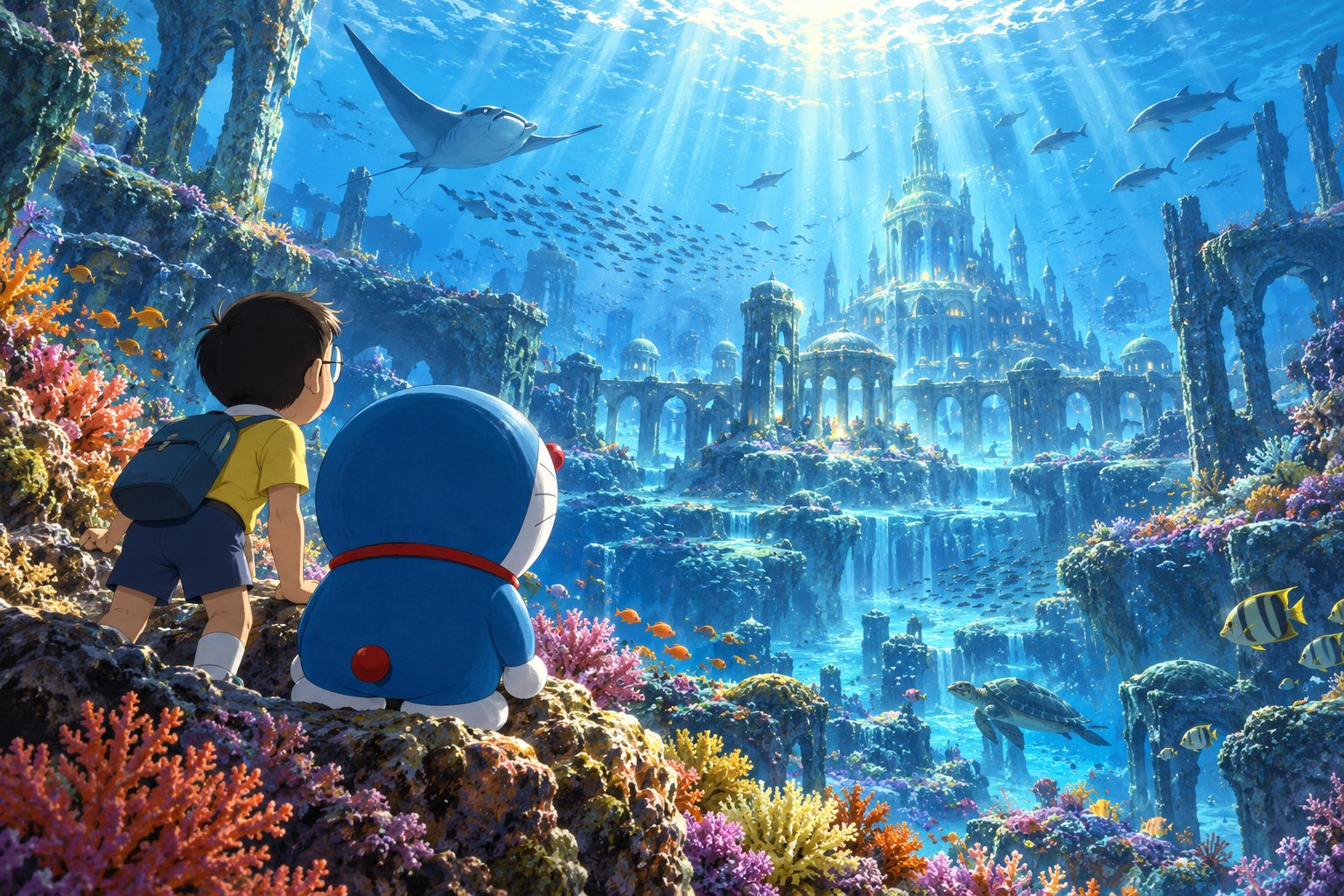
Doraemon’s journey into Indian cinemas puts a familiar friendship inside a much larger world. The film at the center of the team’s discussion with Variety is Doraemon the Movie: New Nobita and the Castle of the Undersea Devil, with an announced October 2 release in Hindi, Tamil, and Telugu. Behind that theatrical occasion sits an appealing dramatic question: what happens when children who arrive somewhere seeking adventure discover that the people living there do not trust them?
That question gives Nobita’s undersea excursion a sharper edge than its vacation premise initially suggests. Spectacle offers an invitation; the encounter with strangers supplies the more interesting reason to accept it.
Scope and spoilers: This is an analysis of the officially described story and the team’s reported approach to the Indian release, rather than a screening-based review. It discusses the opening setup and central conflict without claiming to assess the ending, individual performances, or the finished film’s pacing.
What the team wants to preserve in India
Variety’s interview brings together representatives of TV Asahi, Shin-Ei Animation, and Fujiko Pro. Their comments frame expansion around continuity. TV Asahi’s Sumida Maiko describes longevity as the measure of success, while Fujiko Pro’s Yoshida Kenji emphasizes protecting work conceived for children, including the childlike perspective adults can retain.
Yoshida’s phrase “for children” is a useful critical standard. It asks whether a film gives young characters meaningful emotional experiences. Recognizable faces and elaborate scenery can attract attention, but neither establishes that the story understands its audience.
My view is that the strongest family adventures respect the seriousness of small feelings. Being excluded, misunderstood, or frightened can occupy a child’s entire world. A film does not need to diminish those feelings when it introduces a larger danger. It can let the larger danger reveal why they matter.
That distinction also keeps the release discussion grounded. A team’s intentions tell us what it values; the completed film must demonstrate how those values become drama. As in our examination of how a filmmaker’s endorsement shapes critical expectations, statements about artistic purpose are an invitation to examine the work closely.
Nobita’s adventure begins with an ordinary disagreement
The official synopsis starts with the friends disagreeing over where to camp during summer vacation. Doraemon proposes the ocean. Gadgets make the expedition possible, including an underwater buggy and a device that helps the group adapt to the environment. A sunken ship leads them toward an encounter with El, a resident of the undersea Mu Federation.
As a storytelling premise, the camping disagreement is effective because it begins at a scale children can recognize. Before anyone faces an unfamiliar civilization, the group has to negotiate something as basic as how to spend time together. The adventure grows out of a shared social problem.
For a reading centered on Nobita, that starting point matters. He enters the situation as part of a group of vacationers, without an obvious claim to authority over the place he visits. The audience can approach the unknown alongside him, carrying curiosity before knowledge.
The critical question is what the story does with that imbalance. Does unfamiliarity encourage listening? Does fear make the visitors defensive? A convincing adventure allows its young protagonists to revise their understanding. Simply transporting them somewhere extraordinary would leave the most valuable part of the journey unused.
Doraemon can provide access, but trust requires something else
Doraemon’s proposed solution turns the ocean from an obstacle into somewhere the friends can explore. Read symbolically, the gadgets perform a generous function: they expand the children’s range of experience. They make an impossible outing available.
That creates an interesting limit for the story to explore. Equipment can solve a practical difficulty without settling a relationship. Being able to enter another community does not mean being welcomed into it, and understanding an environment physically does not mean understanding its inhabitants.
For me, this is the most promising tension in the premise. If every difficulty yields to a convenient invention, the children have little reason to change. A conflict involving suspicion demands another kind of effort: patience, attention, and actions that give other people reasons to reconsider.
This reading also offers a useful way to evaluate Doraemon’s role. A guide can make discovery possible while leaving room for companions to make decisions. The emotional value lies in what the children choose once access has been granted.
El gives the underwater world a point of view
The official character description identifies El as a Mu Federation soldier assigned to monitor Doraemon’s group. The synopsis establishes that the undersea inhabitants distrust people from the surface. It also introduces news that the feared castle has become active, widening the danger beyond the camping trip.
El’s position makes him especially important to a character-focused interpretation. From the visitors’ perspective, observation may feel unfriendly. From the perspective of someone responsible for an unfamiliar group entering his home, watching them has a different meaning.
A story can become richer when it permits both perspectives to exist. The visitors’ innocent intentions do not automatically erase the residents’ concerns. Equally, suspicion should remain open to challenge when individuals behave differently from expectations.
The dramatic opportunity is therefore more specific than a general lesson about friendship. It concerns how people earn the right to be understood as individuals. El’s role makes that issue visible before any claim can be made about how the finished film resolves it.
Why the Indian cinema setting matters

The announced Hindi, Tamil, and Telugu versions give the Indian release a concrete connection to the team’s emphasis on children. For a young viewer, language is part of how quickly a joke registers, how clearly an argument makes sense, and how immediately a worried voice communicates fear.
Those possibilities should not be mistaken for a verdict on the dubs. Assessing them would require hearing their performances and dialogue. But language deserves attention as an artistic component of the experience, alongside the practical question of which version a family can attend.
The theater adds another dimension: children and adults encounter the same surprises together. Our discussion of what makes a shared movie screening work considers how presentation shapes that collective experience. Here, the particular opportunity is for adults to follow a child’s curiosity without requiring the child to share their nostalgia.
The deeper promise: learning how to be a guest
The most compelling interpretation of this undersea premise concerns the responsibility of entering someone else’s world. Wonder is an excellent beginning, but wonder alone can leave the visitor at the center of everything. An encounter becomes meaningful when the unfamiliar place acquires inhabitants whose feelings carry equal weight.
That is the standard I would bring to Nobita’s adventure in India: whether its excitement gives young viewers room to imagine another person’s position. The ocean supplies distance from ordinary life. The conflict over trust brings the story back to an ordinary, difficult task—meeting someone without assuming that your first impression tells you everything about them.
Original content by this site's editorial team. Published: October 4, 2026 at 00:07:05 PDT (Los Angeles time)