Divine Rivals, Rebecca Ross’s bestselling fantasy romance, is heading to Disney for a feature adaptation, according to Deadline. For readers waiting to see the book reach the screen, that is the central news. For moviegoers, it introduces an equally interesting question: how can a film make a fantasy romance feel intimate when the surrounding production invites scale?
The answer will depend on dramatic choices that a studio announcement cannot reveal. A recognizable title creates anticipation; a convincing relationship has to earn it, scene by scene. My strongest hope for this adaptation is that its characters’ emotional lives determine how the movie looks, moves, and spends its time.
This is a spoiler-free adaptation preview, not a review of a finished film. The discussion below considers the reported project and its creative possibilities. It does not describe unseen footage, quote an unverified screenplay, or predict specific changes to Ross’s story.
What the Disney news establishes
The reported development connects Disney with a feature version of Divine Rivals. Its identity as an adaptation of Ross’s fantasy romance bestseller is the starting point. That gives audiences a title, an author, a genre, and a proposed screen format to discuss.
It does not, by itself, establish what the performances will be like, how the screenplay will organize the material, or what visual style the filmmakers will choose. A release date, cast, director, rating, and distribution plan require their own confirmation. The Disney association should not be treated as an answer to those separate questions.
That distinction matters especially for readers searching for a Divine Rivals movie release date or casting news. The development headline is meaningful, but it is not a viewing calendar. Nor does the word “feature” settle which parts of the source material will receive the most attention.
The central challenge: making interior experience visible
For a fantasy romance adaptation, the most consequential translation may happen between a character’s private feelings and their observable behavior. Prose can let readers inhabit hesitation, self-protection, or longing for pages. Film has to find an equivalent through performance, framing, sound, and duration.
A useful test is whether an emotional change remains understandable without a character explaining it. Does someone listen differently than they did earlier? Does a pause suggest increased trust, or a new reason to withdraw? Can the audience recognize a decision before the dialogue names it? These are hypothetical examples of screen technique, not descriptions of scenes planned for Divine Rivals.
From a character-centered perspective, the adaptation’s task would be to preserve the reasons behind behavior. A gesture that appears romantic from outside may feel risky to the person making it. A refusal may express fear, pride, or a practical concern. Good screen storytelling gives viewers enough evidence to distinguish those possibilities.
This is also why fidelity cannot be measured only by counting retained incidents. An adaptation can reproduce an event while losing its emotional logic. Conversely, a compressed exchange can remain faithful to a character if it preserves what that person wants, what they misunderstand, and what choosing differently costs.
Romantic chemistry needs more than attractive casting
Whenever casting becomes part of the conversation, appearances will offer the easiest comparison. But the more revealing question will be how the performers respond to one another. Chemistry depends on attention: who notices discomfort, who catches a change in tone, and who adjusts their behavior because the other person matters.
My preference would be for the film to give those responses room. Constant cutting can make a conversation brisk while obscuring the moment it becomes emotionally significant. A sustained shot can let viewers discover a shift for themselves. Neither approach is automatically correct; the choice should follow the relationship’s dramatic needs.

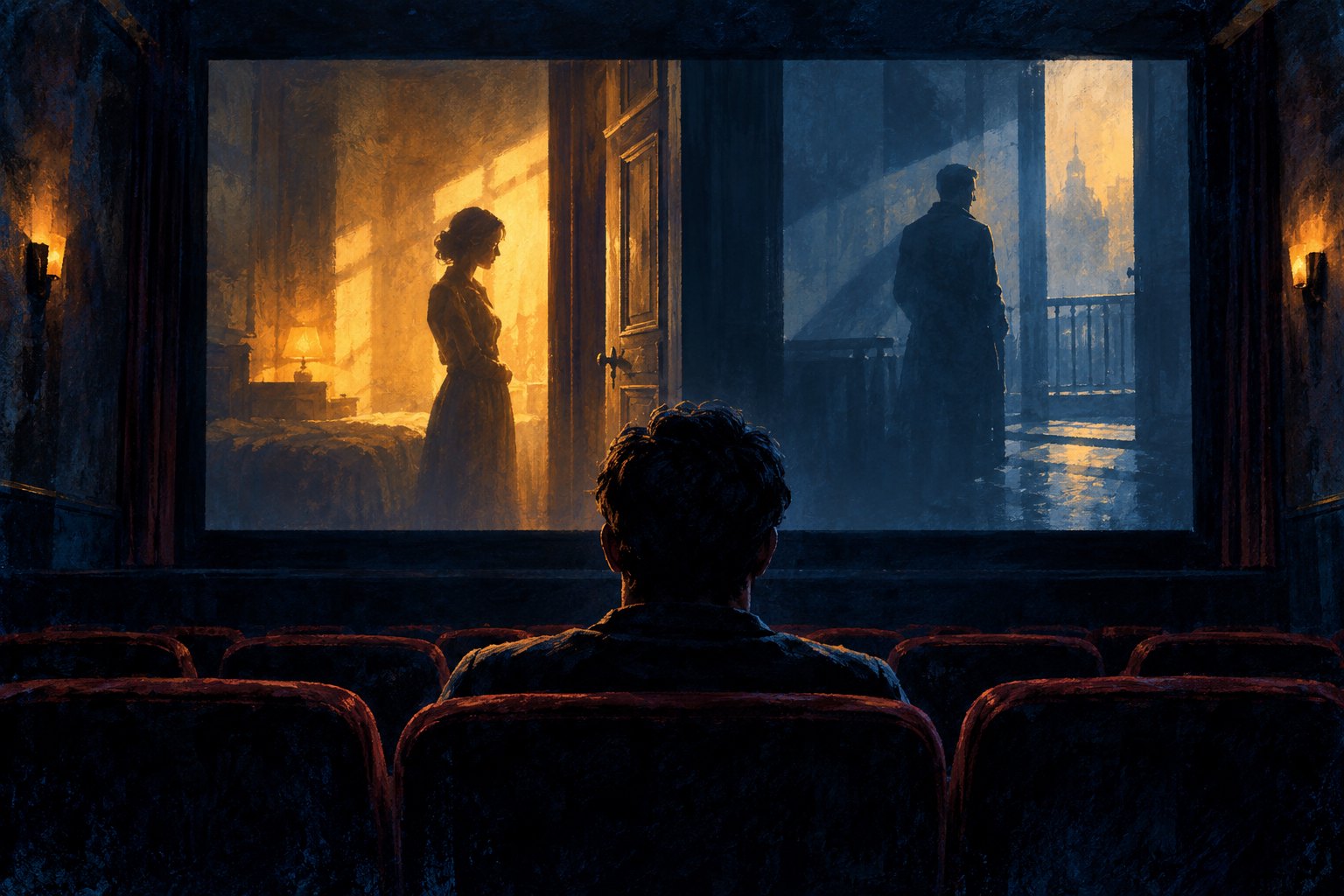
The illustration captures the balance at stake: two places for human interaction surrounded by an imposing imagined world. It is conceptual artwork, not production imagery. The relationship needs to remain legible even when the setting becomes the largest thing on screen.
Fantasy should shape the emotional stakes
The fantasy component presents a related opportunity. An invented world becomes dramatically useful when its conditions influence what characters can do. Exposition works best when it helps viewers understand a choice, an obstacle, or a consequence at the moment that knowledge matters.
For Divine Rivals, the creative question is therefore how fantasy and romance will function together on screen. If the world requires explanation, whose experience will guide us through it? If the imagery becomes expansive, what emotional perspective will hold the sequence together? These remain questions for the adaptation, not claims about its screenplay.
Our discussion of the dramatic challenge behind the Elden Ring film’s scale raises a related issue: an audience needs a reason to care about what an imagined world contains. Here, the fantasy romance designation makes the relationship an especially important part of that equation.
A feature film needs a deliberate emotional rhythm
A feature cannot reproduce the experience of reading at an individual pace. Readers can linger, reread, or stop at a moment of tension. A movie establishes a shared rhythm, deciding how long we remain with uncertainty and how quickly one development follows another.
That makes pacing an emotional issue as much as a structural one. Moving efficiently through events is not enough if the audience never has time to register their effect. For this adaptation, I would look for transitions that show the aftermath of a choice rather than merely delivering the next piece of information.
The same principle applies to memorable language. A beloved sentence can lose force if it arrives before a performance has earned it. Until film dialogue can be verified, presenting quotations as movie highlights would be premature. Eventually, the useful critical question will be how a line functions in the scene, including what the listener does after hearing it.
What would make Divine Rivals succeed on screen?
The most persuasive adaptation would allow newcomers to understand the emotional stakes while giving readers recognizable character logic. Those goals can reinforce each other: clear motivations help both audiences, even when their familiarity with the story differs.
As our reflection on reading film criticism through concrete evidence suggests, a verdict ultimately needs scenes and performances to support it. Disney’s involvement is a development to follow, not evidence of artistic success or failure.
The deeper promise of a fantasy romance lies in the relationship between extraordinary circumstances and recognizable vulnerability. Spectacle can enlarge a feeling, but the feeling must already be there. If Divine Rivals gives its characters convincing reasons to protect themselves, reconsider each other, and take emotional risks, the adaptation will have something more durable than an impressive world: people whose choices make that world matter.
Original content by this site's editorial team. Published: October 27, 2026 at 12:18:43 PDT (Los Angeles time)