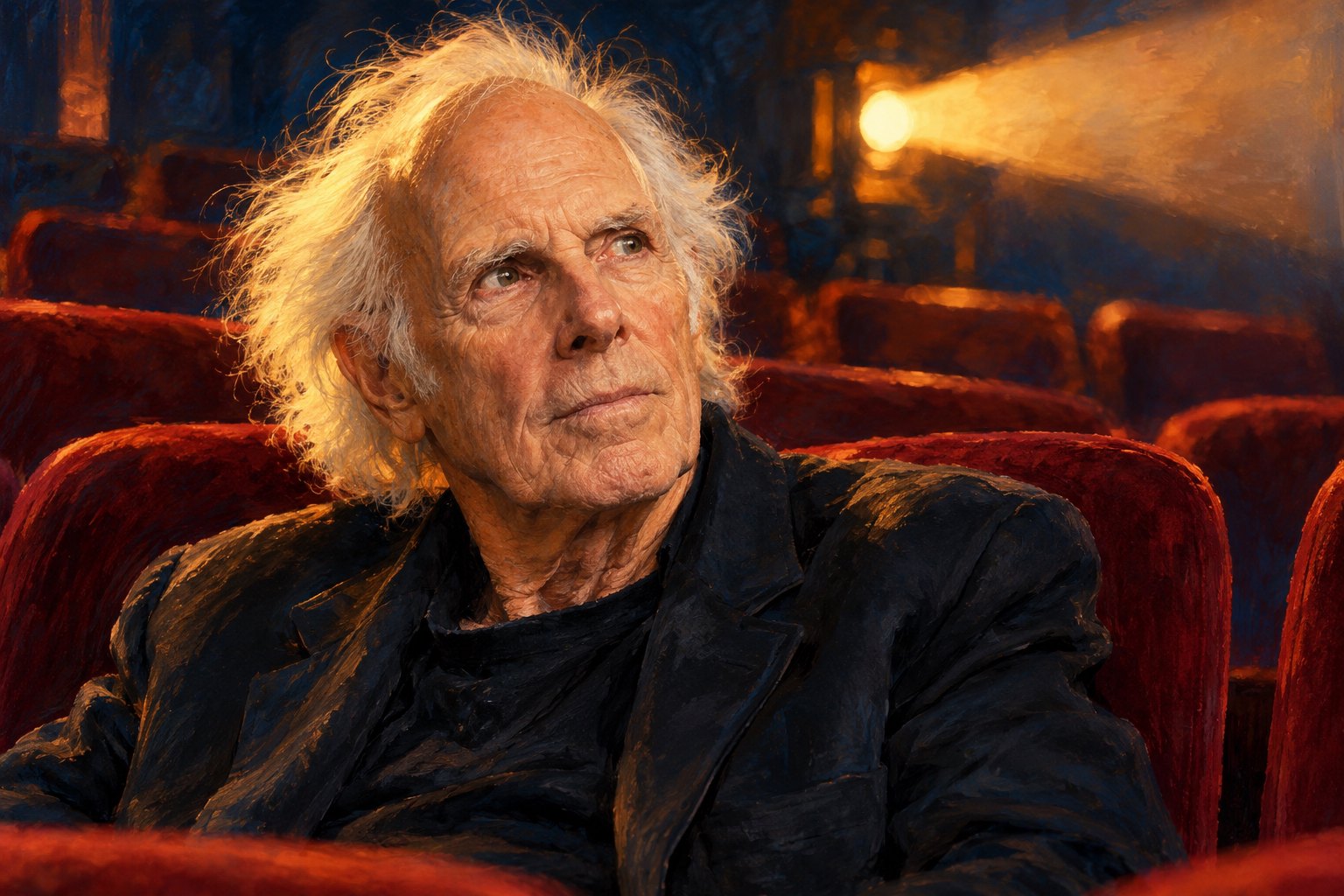
Dernsie: The Amazing Life of Bruce Dern puts a familiar screen presence at the center of his own story. Awards Radar’s SCAD Savannah Film Festival coverage greeted the documentary as an affectionate celebration of Dern. The more interesting question behind that welcome is what a tribute can preserve: an actor’s achievements, certainly, but also the habits, instincts, and stubborn individuality that made those achievements possible. [Awards Radar’s festival coverage](https://awardsradar.com/2026/11/01/scad-savannah-film-festival-review-dernsie-the-amazing-life-of-bruce-dern-is-a-wonderful-tribute-to-a-legend-of-the-screen/)
This is spoiler-free commentary on the documentary’s verified premise and approach, rather than a firsthand screening review. Its appeal lies in the opportunity to consider Dern as a working artist and storyteller. Calling someone a legend can close a conversation just when the useful questions should begin.
What Dernsie brings to the screen
Directed by Mike Mendez, the documentary draws on more than 50 hours of conversations, previously unseen photographs, and personal video letters. SCAD’s program identifies Bruce Dern, Laura Dern, Walton Goggins, and Quentin Tarantino among its participants and scheduled the film as a Southeast premiere at Trustees Theater. Those details establish a portrait built from several kinds of testimony, with Dern’s own voice at its center. [SCAD’s official film program](https://filmfest.scad.edu/schedule/dernsie-amazing-life-bruce-dern)
That combination offers distinct ways of understanding a person. Conversation records how someone organizes experience into stories. Photographs preserve details that memory may overlook. A personal letter reveals a relationship through what its writer chooses to recognize. These materials need not tell identical versions of the same life to belong together.
For viewers, the useful distinction is between access and insight. Extensive access creates possibilities; selection and arrangement determine whether those possibilities become understanding. Without assessing the finished film firsthand, its editing rhythm, emotional balance, and treatment of contradictions remain open questions. The documented materials nevertheless suggest a more personal starting point than a simple procession of credits.
Bruce Dern as the protagonist of his own history
The official Cannes synopsis describes a career spanning more than 65 years, narrated by Dern himself, moving from television villains in the 1960s toward the recognition associated with Nebraska and beyond. Cannes also lists Laura Dern, Quentin Tarantino, and Alexander Payne as participants. [Cannes’ official documentary entry](https://www.festival-cannes.com/en/f/dernsie-the-amazing-life-of-bruce-dern/)
That trajectory invites a character-centered reading, with an essential qualification: Dern is a real person, not a fictional protagonist whose every experience exists to complete a dramatic arc. A satisfying career narrative can turn uncertainty into destiny after the fact. For the person living it, however, a difficult stretch is not necessarily a prelude to recognition. It is simply the present, with no promise attached.
This is where an actor’s account can be especially valuable. Public memory tends to leap between recognizable titles. The person who performed those roles must remember the spaces between them, too. A portrait attentive to those spaces can make persistence concrete without pretending that persistence guarantees success.
From this perspective, the documentary’s central subject is larger than professional longevity. It is the relationship between being seen by an audience and continuing to believe there is something worth offering that audience.
What a “Dernsie” says about acting
In Associated Press coverage of the documentary’s Cannes appearance, Dern explained the spontaneous additions associated with the term “Dernsies.” His description was direct: “I don’t rehearse it.” That is a quotation from the interview coverage, not a verified line from the documentary. [Associated Press’ interview with Dern](https://apnews.com/article/336dccaf813dbcf17d0f1d51083eb183)
The remark provides a useful way into the craft. An unexpected gesture can make a character appear to have thoughts that are not entirely contained by the written scene. A pause, a change of emphasis, or an apparently incidental movement may suggest that a person has existed before the camera arrived.
Spontaneity alone, though, is not an artistic achievement. An addition earns its place when it changes our understanding of the character or sharpens a relationship. If it merely draws attention to the performer, it can interrupt the scene’s emotional logic. The interesting critical question is therefore what an improvisation reveals.
That distinction also helps explain why a career documentary should look closely at small choices. A montage can demonstrate range, but it may rush past the moment that makes a performance distinctive. Our analysis of Patrick Stewart’s controlled menace in Green Room approaches performance from a related direction: screen authority often depends on how an actor handles a moment, rather than how much dialogue the role supplies.
Endurance gives the tribute a human scale
SCAD’s description connects Dern’s long-distance running with his career’s persistence through prosperous and lean periods. As an organizing idea, endurance is more revealing than an uninterrupted ascent. It allows repetition, fatigue, and uncertainty into the picture.

The running comparison is most useful when it directs attention toward daily practice. A career consists partly of returning to work without knowing whether that work will become culturally important. Recognition arrives unevenly; the task still has to be done. This makes endurance an artistic subject rather than merely an inspirational slogan.
There is a danger in treating survival as proof that the system eventually rewards everyone fairly. A more thoughtful interpretation recognizes both individual determination and the opportunities a performer cannot create alone. Casting, collaboration, timing, and someone else’s willingness to take a chance all matter.
A tribute should preserve complexity
The presence of family and fellow filmmakers creates an opportunity to distinguish professional reputation from personal significance. Those perspectives need not compete. A colleague may remember a creative risk; a family member may understand the circumstances surrounding it. Their accounts can illuminate different dimensions of the same decision.
Affection becomes critically useful when it gets specific. General praise tells us that someone is admired. A precise memory can show why. Likewise, an archival excerpt is most illuminating when it encourages viewers to notice something they previously missed. Our discussion of how a performance excerpt can shape a screen tribute considers that relationship between recognition and renewed attention.
The deeper meaning: a legacy remains open
The strongest reason to be interested in Dernsie is the possibility of encountering a career as an ongoing practice. “Legend” describes how others regard an actor. It says less about what the actor is still trying to discover.
My reading of the documentary’s premise is that its most productive tension lies between retrospective celebration and the working artist’s forward attention. Looking back can establish importance; listening closely can preserve curiosity. A meaningful tribute should leave viewers wanting to revisit the performances, examine the choices, and see the person with greater precision. For Bruce Dern, that seems a more fitting form of appreciation than allowing admiration to become the final word.
Original content by this site's editorial team. Published: November 1, 2026 at 04:09:29 PST (Los Angeles time)