David Fincher’s explanation of AI use in Cliff Booth brings a specific filmmaking choice into focus: combining the preferred sound of a performance with the preferred image when they come from different takes. The interesting question for moviegoers is what happens to a character when a face and a voice can be adjusted independently.
According to Variety’s reporting on Fincher’s conversation with Sean Fennessey on The Big Picture, AI-assisted lip synchronization helped reconcile those selections during postproduction. Fincher also discussed a possible future involving fewer repeated takes while retaining performances grounded in human actors. That broader ambition should be distinguished from his account of work actually done on this film.
This is spoiler-free commentary on the filmmaking issue, not a review claiming firsthand knowledge of the finished movie. The explanation invites a close look at performance and authorship. It does not, by itself, establish how successfully any individual scene works.
What Fincher’s Explanation Does—and Doesn’t—Establish
The reported method addresses a familiar creative frustration: one take can contain the most compelling expression, while another delivers the line with better rhythm or emphasis. Fincher describes using technology to bring those strengths together.
His explanation is useful because it identifies a task. The label AI alone tells an audience very little about what changed. Adjusting the relationship between recorded speech and visible mouth movement is a more concrete proposition than saying a movie used artificial intelligence.
But that account should not be stretched into a complete inventory of the production. Nor does a proposed future workflow prove that the same process was used throughout Cliff Booth. A director’s description of a technique and an assessment of its results remain different kinds of evidence.
For criticism, this distinction matters. Knowing how an image was made can sharpen our attention, but it cannot substitute for watching how that image behaves within a scene.
A Character Lives Between the Face and the Voice
Consider a hypothetical exchange, not a scene being attributed to Cliff Booth: a character says something reassuring while their expression remains guarded. The tension between those signals may reveal dishonesty, embarrassment, or an effort to protect someone. The apparent mismatch can be the point of the performance.
Now imagine choosing a more confident line reading and pairing it with that guarded expression. The resulting character might seem calculating rather than uncertain. Neither selection needs to be technically defective for the combination to change the meaning.
That is why selecting the strongest visual take and the strongest vocal take does not automatically produce the strongest dramatic moment. Each performance belongs to a rhythm: the breath before speaking, the movement of the shoulders, the way attention shifts toward another person. Those details can explain why a line sounds the way it does.
For a film centered on Cliff Booth, the relevant critical question is therefore one of consistency. Does the character appear to think, feel, and speak through a connected sequence of impulses? Or does the scene seem assembled from individually effective gestures that never quite share an emotional center?
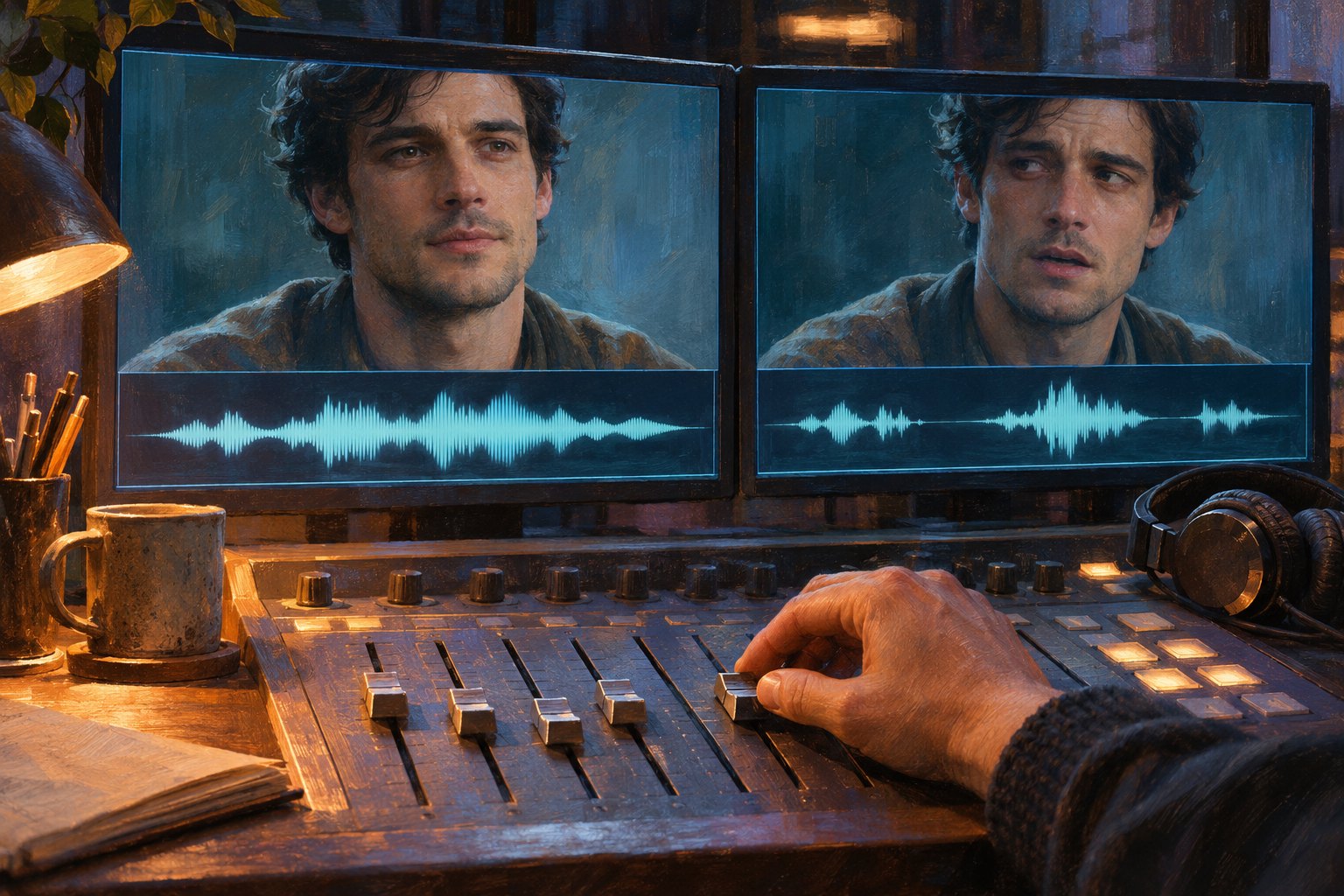
Invisible Editing Still Makes Interpretive Choices
My view is that an adjustment should be judged partly by the relationship it preserves between intention and behavior. A seamless mouth movement is a technical achievement. A believable shift from confidence to doubt is a dramatic one. The former can support the latter, but cannot guarantee it.
This is especially important when a performance depends on restraint. A small delay can make a response feel reluctant. Removing that delay might improve conversational speed while losing the suggestion that the character considered another answer.
The same principle applies to reactions. A listener’s expression gives the speaker’s words consequences. If every element is optimized separately, the exchange can become less convincing even as its individual pieces become cleaner.
Our analysis of Chiwetel Ejiofor’s performance in Dirty Pretty Things offers a related way of looking at screen acting: attention to behavior can reveal pressures that dialogue does not spell out. That remains a useful standard when considering a digitally adjusted performance.
Fewer Takes Could Help, but Efficiency Is Not the Verdict
There is a reasonable artistic argument for reducing repetition. In principle, a process that gives filmmakers more usable material could help preserve a fleeting expression or an unusually alive exchange. A moment should not necessarily be discarded because another component of the shot presents a problem.
There is also a reason to resist treating repetition as pure waste. Actors can discover an unexpected emphasis, alter their response to a scene partner, or find a less obvious emotional direction while working through a scene. The value of another take depends on what it makes possible.
Fincher’s future-facing idea therefore raises a practical question: which difficulties are merely obstacles, and which are productive parts of making the scene? A technical fix might remove an obstacle. It might also encourage a production to postpone decisions that benefit from being explored together on set.
Neither outcome should be assumed from the presence of AI. The meaningful evidence would be specific: what was captured, what was altered, and how the resulting moment serves the character.
How to Watch Without Turning the Movie Into a Detection Test
Viewers do not need to diagnose software artifacts to have a useful response. A face that looks unusual is not reliable proof of a particular production method. Watching only for suspicious details can also divert attention from the dramatic structure that gives those details meaning.
A more revealing approach is to follow three relationships:
- Speech and intention: Does the delivery fit what the character appears to want from the exchange?
- Movement and emotion: Do posture, breathing, and expression support the emotional change?
- Action and response: Does one person’s behavior seem to affect the other, or do the performances feel disconnected?
These questions apply regardless of the tools involved. They also leave room for deliberate ambiguity. A character can conceal a feeling, contradict themselves, or remain difficult to read without the performance being incoherent.
That distinction between production discourse and the experience of watching connects with our commentary on James Gray and the limits of festival judgments. Context can guide an evaluation; it cannot supply the evaluation in advance.
The Deeper Issue Is Who Shapes the Character
Fincher’s explanation makes visible a question that extends beyond mouth movements: how much of a screen character emerges during the recorded performance, and how much takes shape through later selection and alteration?
My critical preference is for choices that preserve meaningful friction. Hesitation, uneven confidence, and an awkward breath can make a person legible in ways polished delivery cannot. They deserve consideration as expressive material, rather than automatic correction.
The strongest defense of an adjustment would be that it helps a character become more precise, more complicated, or more emotionally convincing. For Cliff Booth, that is the standard worth carrying into the theater: whether the finished performance gives us a person whose behavior holds together, even when that person remains difficult to understand.
Original content by this site's editorial team. Published: November 26, 2026 at 20:16:51 PST (Los Angeles time)