
David Bailey’s three sacks of Deshaun Watson give the New York Jets’ film breakdown an immediately understandable attraction: one defender repeatedly bringing the opposing quarterback’s play to an end. The number supplies the headline. The more interesting question concerns everything that happens before the finish—how a defender reaches the ball, which spaces remain available, and when the quarterback’s options disappear.
Here, “film” means football game footage. Bailey and Watson are athletes making decisions under pressure, not fictional characters following a screenplay. Their opposing objectives nevertheless create a compelling subject for visual analysis: Bailey needs to close distance while Watson needs enough time and room to complete a play.
This is commentary on that three-sack matchup, not a verified reconstruction of each snap. The Jets identify the three takedowns as the subject of their breakdown; that premise alone does not establish the blocking assignments, rush techniques, or available receivers on any individual play. Those distinctions matter if the goal is understanding Bailey’s success rather than simply replaying its conclusion.
Three Sacks Give Us an Outcome, Not a Single Explanation
A sack offers an unusually decisive image. The quarterback goes down with the ball, the action stops, and the defender who finishes becomes the natural center of attention. That clarity makes the play satisfying to watch. It can also make its causes appear simpler than they are.
Three sacks need not represent three versions of the same victory. A defender might beat a blocker quickly, continue pursuing after an initial route closes, or capitalize when pressure elsewhere changes the quarterback’s position. These are possible explanations, not claims about Bailey’s individual plays. Each would describe a different contribution.
My view is that the most revealing question about Bailey’s three finishes is whether the process repeats. If a particular movement consistently creates an advantage, the footage can help explain a repeatable skill. If the routes to Watson differ, the interest may lie in adjustment and persistence. Either possibility is more informative than treating the count as a complete scouting report.
Bailey’s Perspective: Getting Close Is Only Part of the Job
From a pass rusher’s perspective, the quarterback is a moving destination. Getting past the initial blocker does not automatically produce a useful path to the ball. A rush can travel too far upfield, lose its angle, or leave room for the quarterback to move away.
That makes the relationship between speed and control central to evaluating Bailey. Speed matters because the offense is trying to complete its action before pressure arrives. Control matters because arriving near the quarterback and bringing him down are different achievements. An impressive burst deserves attention, but so does the ability to redirect without surrendering the advantage.
For these three sacks, the meaningful distinction would be between creating an opening and using one. Both can require skill. A defender who exploits a teammate’s pressure still has to recognize the opportunity and finish. Conversely, a defender who forces the first disruption may contribute substantially even when someone else receives the statistical credit.
This is where a player-centered reading becomes useful: follow Bailey’s problem from start to finish. What obstacle stands between him and Watson? Does that obstacle change? Which visible action reduces the distance? Those questions keep appreciation attached to evidence rather than to an assumed story of effortless dominance.
Watson’s Perspective: Space Has an Expiration Date
For Watson, the same action presents a different problem. A quarterback must coordinate looking downfield, preparing to throw, and responding to pressure. The open patch of grass visible in a replay is not necessarily an escape route he can reach while maintaining control of the play.
Hindsight makes these decisions look deceptively generous. A paused image gives the viewer unlimited time to examine several possibilities. The quarterback has to act while those possibilities are changing. Any judgment about a missed throw or escape should therefore account for when the option existed, not merely whether it appears somewhere in a frame.
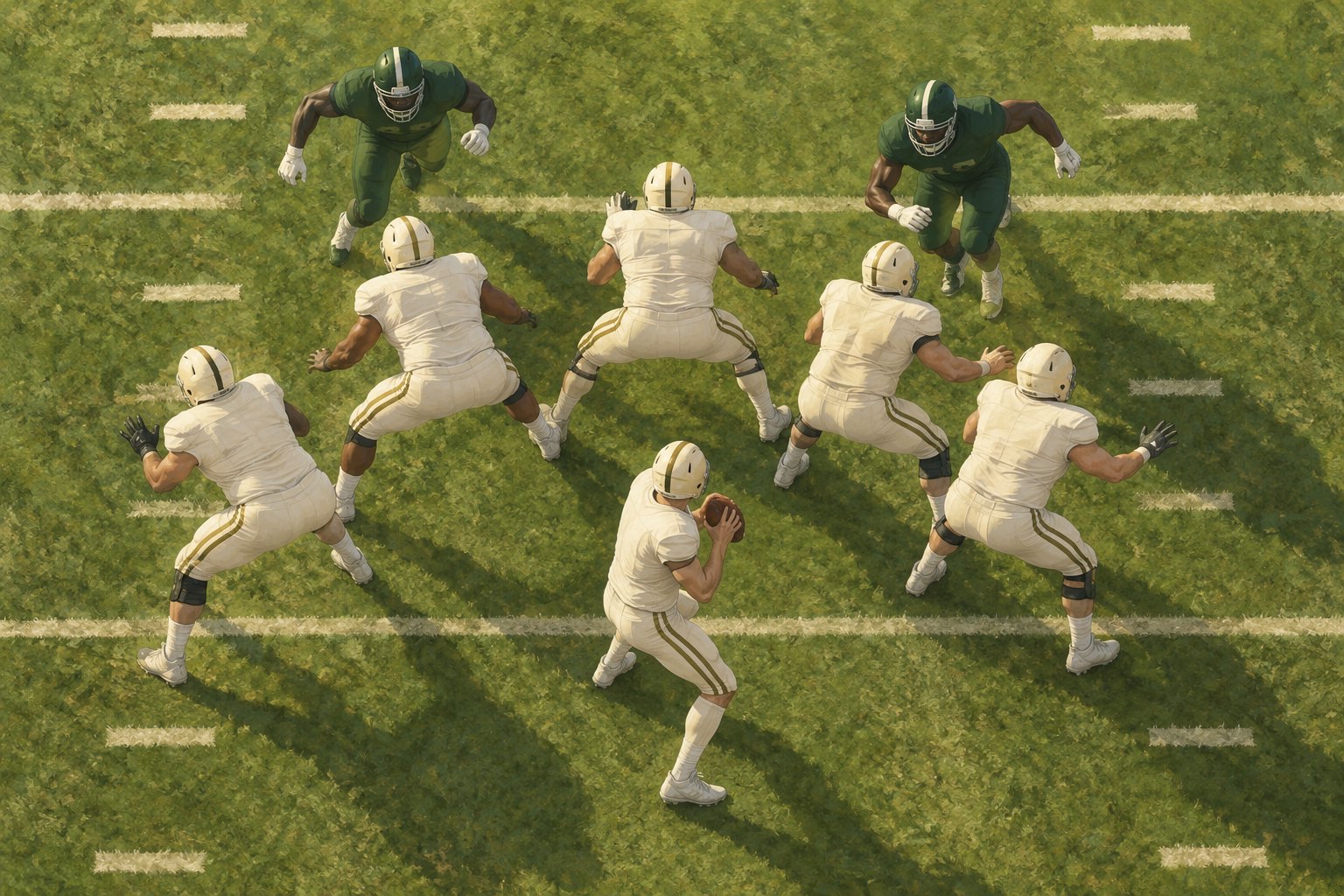
That does not remove Watson’s responsibility. It makes the standard for assigning it more precise. If a quarterback retains a usable throwing opportunity and passes it up, that is different from being disrupted before the opportunity develops. Likewise, movement that avoids one defender can create exposure to another.
Bailey’s success and Watson’s decision-making therefore belong in the same analysis. Praising the defender does not require inventing a mistake by the quarterback. Criticizing the quarterback requires more than the fact that the defender eventually reached him.
Repetition Creates Drama—and Can Hide Differences
Three finishes involving the same two players invite a miniature rivalry narrative. Once viewers know Bailey will reach Watson repeatedly, each encounter can feel like another installment of an inevitable outcome. That is an effective structure for a highlight package, but inevitability is something the audience brings from knowing the result.
The analytical task is to recover the uncertainty inside each play. Before the tackle, there are competing movements and unfinished decisions. Showing where an advantage emerges can turn a familiar endpoint into something newly legible. Repeating the endpoint alone cannot do that work.
This concern connects with our discussion of reading football footage beyond the ball. In Bailey’s case, the particular challenge is comparison: determine whether the three outcomes share a mechanism before describing them as a pattern.
What Would Make the Breakdown Convincing?
A persuasive account should distinguish three layers: what the picture shows, what the analyst infers, and what remains unknown. Visible contact between a rusher and blocker belongs to the first category. An explanation of the intended protection may require information beyond the image. Claims about a player’s thoughts require still greater care.
The same discipline underlies our argument for criticism that preserves careful observation. Recorded images reward close attention, but interpretation becomes stronger when it acknowledges their limits.
Bailey’s three sacks of Watson are a compelling subject because a clear result sits at the end of a complex contest. The deeper interest is how one player’s opportunity becomes another player’s constraint. A useful breakdown makes that transition visible. The tackle tells us where the play ended; the best analysis explains how the available choices narrowed until that ending became possible.
Original content by this site's editorial team. Published: October 13, 2026 at 08:46:53 PDT (Los Angeles time)